What Type of Assets Go into Taxable vs. Retirement Accounts

It really is a classic question many investors have. How do I decide what type of stocks, bonds and funds to put into my taxable brokerage account vs. my tax deferred 401K/IRA accounts? The overall idea is to reduce the impact of taxes on your investments. There is no “one size fits all” approach and sometimes your allocation depends on what stage of life you are in. I’ll assume in this article that you are over 50 and planning or are in retirement.

Tax Deferred 401K/IRA Accounts:

  1. The strategy is to have higher tax items in these accounts.
  2. Stocks or funds where dividends are taxed as “ordinary income”.
  3. Mutual Funds or ETF’s that have a high beta, or churn. This means the portfolio can have big tax consequences since they typically have short term capital gains taxed as ordinary income.
  4. REIT’s and BDC’s, whose dividend payouts are generally considered nonqualified and taxed at ordinary income tax rates.
  5. Any preferred stock who’s dividends are taxed as ordinary income, i.e. preferred REIT’s.
  6. Trust preferred’s that are taxed as ordinary income.
  7. Dividends from some foreign stocks and funds that are taxed as ordinary income.
  8. Options trading

Taxable Accounts:

  1. Strategy is to have tax friendly assets in this account and also a high degree of control.
  2. All cash for retirement living expenses or an emergency fund.
  3. Growth stocks that don’t pay dividends but will be held for long term gains.
  4. Tax-free bonds and bond funds.
  5. Unless you are looking for a “no-income” approach, stocks or funds with “qualified dividends”.
  6. MLP’s, if held for a long time since most distributions are a “return of capital” until the stock is sold.
  7. Any investment used as a “hedge” such as Gold stocks, inverse S&P etc. since they can be used for an offsetting capital loss at tax time if desired.

ROTH IRA Accounts

  1. This is the best account to hold high tax items in.
  2. It is also probably the safest place to shelter future income since the government has constantly changed tax rates and thresholds on taxable and tax deferred accounts (ordinary income tax rates). It’s hard to believe the government would change the tax-free provisions of the ROTH IRA.

How to Easily Beat 80% of Hedge Funds – Just Buy the Market

You see all the talking heads on TV, explaining how they are long xxx stock and short xxx stock. They toss out complicated terms like forward EPS, tangible book value and so forth. Many have analysts on the payroll to help them pick the very best investments. Yet in 2014 about 80% of Hedge Funds are reportedly underperforming the overall all US market, namely the S&P 500 index (SPY). SPY is an ETF sold by State Street Advisors that is commonly referred to as the “market”.

Just to clarify a common misconception, many investors think the Dow Jones Industrial Averages “the Dow” is “the market”. It isn’t predominately because it is a very small sampling of 30 very large companies. In addition it is know as a “price weighted” average. This means that a 1% change in a $100 stock has twice the imp[act as a 1% change in a $50 stock. Therefore, if IBM at $155 and Visa at $258 have bad days the Dow average will be down sharply, but the overall market could be up nicely.

Today it is really easy to have a “market performing” investment portfolio, just buy the market. Arguably the great investor of all time, Warren Buffet suggests that people who don’t want to take the time to actively manage a portfolio just buy the S&P 500 Index. The S&P 500 Index is actually 501 stocks, and 500 companies. It just so happens that Google is listed twice due to a split into type types of shares for the same company (voting and non-voting).

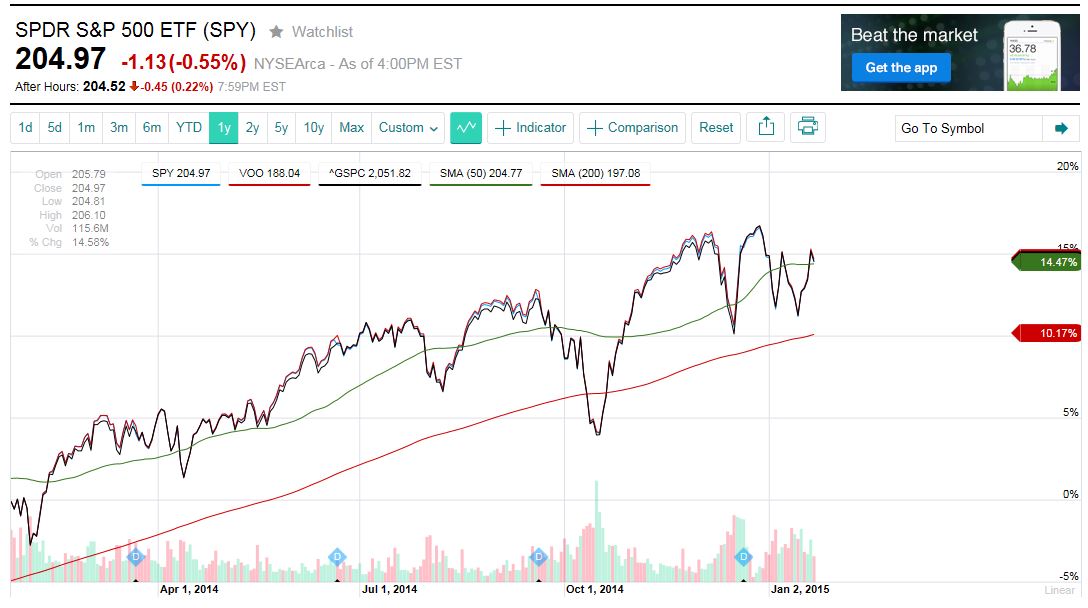
If you put all of your investments in just the SPY ETF or the Vanguard S&P Index ETF “VOO” you would have made over 14% in the last 12 months. In addition you would have collected 1.9% in dividends.

SPY


You can choose either fund, it just so happens that VOO has a smaller annual expense fee of 0.05% vs. the SPY at 0.09% expense ratio. If you had a $1,000,000 investment the SPY ETF would costs you $400/year more in fees than the VOO.

If you want to beat the Hedge Funds and most other investment managers, it is simple, just invest in the “market”.


How to Measure Your Stocks – A Simple Technical

We all have investments in both taxable and tax deferred accounts. Many people however are unsure exactly how to measure whether their stock or fund is doing well or not. Professional investors have dozens of tools by which to judge performance, I’ll just show you a simple one.

This measurement is to compare your investment to the S&P 500 Index, commonly referred to as “the market”. The S&P 500 is made up of the 500 largest companies listed on the NYSE or NASDAQ stock exchange. When you hear comments like a stock or fund “beat” the market, it normally refers to its performance against the S&P 500.

One simple and common measurement to judge the performance of your stocks is to compare it to the overall market, and then look at a comparison to its own “moving average”. I like to use both a 50 day and 200 day MA (moving average). The moving average quickly shows growth or decline over a longer period of time.

 We’ll look at two stock charts. The first chart is for one of my favorite holdings, Kroger (KR). It is almost the perfect stock from a “technical” point of view. In stock lingo, “technicals” refer to the analysis techniques from a chart. “Fundamentals” by comparison refers to looking at a stocks PE, beta, PEG ratio, last earnings report and so forth. Yahoo Finance has a simple easy to use chart capability.

 Kroger


This chart shows Kroger’s has substantially outperformed the market over the 12 months. In addition it has consistently stayed above its 50 day and 200 day moving average, the price keeps going up in a nice smooth, consistent way. Also notice that the gap is widening between the 50 and 200 day MA, the rate of growth is increasing. In the last 12 months the S&P has gone up 9.64%, and Kroger has gone up 82%.

 The next stock is Goldman Sachs (GS). I bought GS on August 7th at $183.90, just after the 50 day MA crossed above the 200 day MA, it looked like the stock was on the rebound and would outperform the market. Last week they reported disappointing earnings and the stock has slid down every day since. It finally crossed the 200 day MA and I sold it this morning for small loss. Part of my decision to sell was that almost all of the big banks and financial services companies are reporting weaker than expected earnings and the entire sector looks in trouble for at least the 1st half of 2015. I also own a position in Morgan Stanley (MS), it too dropped but only below the 50 day MA, not the 200 day.

Goldman


Comparing your investments to the market and their own moving averages will help you determine if you have chosen the right investments in your accounts. In a future post I’ll give you a few more things to look for.


6 – New Years Retirement Planning Resolutions for 2015

Summary

New Years is always a great time to prioritize the things that are most important in our lives, not just the “urgent” things that will always distract us. As Stephen Covey says, “Most of us spend too much time on what is urgent and not enough time on what is important.” As you age, and either contemplate retirement or are actually retired, financial planning is one of the important tasks you need to continually address.

Here are 6 “important” steps to get your retirement investments and plans in order for 2015:

  1. Take responsibility, become active, plan and manage your investments.
  2. Develop or update a written financial plan.
  3. Learn how to choose and analyze investments like a professional.
  4. Take action with your investments, set up rules for adding and eliminating.
  5. Set-up or revise your “In Case of Emergency” document.
  6. Determine if you need a Revocable Living Trust.

Take Responsibility.

The finances that you and your family will live on once you leave the workforce won’t just automatically fall into place; you need to make it happen. Your retirement is your responsibility, you need to take charge. You need to become a “Vice President of Financial Responsibility”. Many older workers just don’t feel comfortable or may not have the skills to plan and manage their retirement. This however is their responsibility and they either need to develop the skills or get someone they implicitly trust to help them. The internet, including most brokerage sites like Fidelity, have tools and educational materials to also provide help.

Written Plan.

Almost everyone I speak to about retirement planning and investing claim they have a “plan”, very few can honestly say they have a written plan. A written plan can help take you from concepts to an actual roadmap. The plan should include a written description of your current situation, your short and longer term plans, tax planning strategies and investment goals. In addition to the written descriptions it should also include annual goals for income to be generated, living costs, emergency funds and yearend portfolio values. If you just have a spreadsheet and no written document, you don’t have a plan.

Analyze Like a Professional.

You don’t need to be a day-trader or professional advisor to use the basic analytical tools to help choose and manage your investments. When I trade in my professional account I might look at a 60 and 5 minute stock chart, RSI and MACD indicators and “futures” charts. However when I review my retirement investments I’m looking at completely different set of metric’s. Why? Because my goals and time horizons are different. In a future blog posting I’ll give you the tools I use for managing the stocks and bonds in my retirement accounts.

Take Action.

One of the biggest mistakes people make in their investments is to “Buy and Forget”, see my story on this here. Most people know how to buy but don’t know how or when to sell or rebalance. You need to set up rules that will help you decide how to manage your investments. The poor people that couldn’t endure the pain anymore and decided to sell their key holdings in March 2009, and then sat in cash for the next few years as the market completely rebounded.  Those that stayed with blue-chips did well, those in cash will never again recover their losses.

“In Case of Emergency” Document

Everyone who is married or has any assets whatsoever needs to have a “In Case of Emergency” document.  Check here for a detailed list of what should be in your document and how to manage it.

Revocable Living Trust

Why would you need a Trust, the new federal estate tax exclusion has been raised to $5,340,000 per person and twice that much for a married couple. Most people don’t have assets that exceed these amounts. Maybe you should just have a simple will. The issue isn’t about federal estate taxes, it about the other benefits of a trust. Here are some reasons to consider a Revocable Living Trust:

  1. Protection for or from your beneficiaries and their creditors. Do you have a 20-30 year old “child”, should they just be given the money outright, might hey spend it foolishly?
  2. Control of your wealth beyond just a will. How should the money be distributed and when. What can it be used for?
  3. Keep your privacy and money out of state probate court and avoid the high cost of probate. In general most states require a will to be implemented through the probate process and can include some substantial fees, along with being public. A Revocable Living Trust does not need to go through the probate process.
  4. Manage or avoid state estate taxes. 20 states currently have various forms of estate taxes and a Revocable Living Trust may help you batter manage or even avoid these extra costs.
  5. Always seek the help of a qualified attorney who specializes in Estate Planning and Tax law to help you determine if a trust is right for you.

1st Thing to do in 2015 – Develop an “In Case of Emergency” Document

2014 was a big year for me personally. It was my first full year in retirement, we moved from Pennsylvania to Florida and I focused a great deal of time fine-tuning my retirement plans. This included an updated Revocable Living Trust, and a written 5 year financial, income, tax and expenses plan. One of the most important tasks was to create an “In Case of Emergency” document.

EmergencyThe “In Case of Emergency” document is a complete explanation of everything someone (like my wife, family or executor of my estate) would ever need to know about everything in my/our lives. It also includes immediate specific steps to take in case something happens to me or “us”. Keep in mind that the emergency may not be your death, but may be you becoming incapacitated, there is a difference.

It is an on-going document that is constantly being updated and enhanced. This document is stored on my computer, on a secure web site and in our safe deposit box. Every family member knows about it and understands what it is.

An “In Case of Emergency” document should include:

  • The location and attorney involved with the creation of our Revocable Living Trust, individual Wills, Durable Powers of Attorney, Healthcare Surrogate and other legal documents.
  • The names, account numbers, and contacts information for all bank accounts, investment accounts, pensions, and past/current employers. Also confirm the structure of each asset and in the case of IRA’s the beneficiary since these may fall outside of your Revocable Living Trust.
  • How income is generated, what steps are necessary to keep income coming in. Budget for living income and expenses. If you are still working, who at work to contact and what benefits might a spouse of a deceased worker get, like unused vacation pay, life insurance etc.
  • Location of safe deposit box and the location of the keys. It might be best to give multiple family members access to the box.
  • Business owned (if applicable) with complete details on tax and ownership structure, location of stock certificates and other important documents.
  • Birthdates, social security numbers and contact information for all family members.
  • The location of Tax records, past returns and contact information of tax preparer.
  • Social Security information. Explain if any benefits are currently being provided and the strategy for future benefits including how to file for Survivor benefits.
  • Your digital information including all login and passwords information, it’s best to have a software program or web site where these are stored and protected. All family members email accounts, your digital photographs, music, key documents on your computer and location of all back-ups.
  • Your home information, mortgage holder (if applicable), how payments get made, contact and account information for utilities, trash collectors, newspapers, landscaping and other service providers. How are property, school and other taxes paid?
  • Insurance information, including location of policies, account numbers, contacts, etc. Be sure to include homeowners, car, healthcare and life insurance
  • Automobile information, including loans (if applicable), location of title, registration #’s, license plate #’s etc.
  • List all healthcare providers like family doctors, insurance policy renewal information and an updated history of healthcare issues. Reference any Durable Powers of Attorney, Healthcare Surrogates and other healthcare information.
  • Credit Cards, loans and other obligations. List all account numbers, and toll free numbers to call to cancel cards or pay off balances.
  • Family cell phone accounts and structure of plans.
  • Churches, Clubs and organizations along with contact information
  • Neighbors and friends that should be notified with full contact information.

Finally, include a list of specific steps to immediately take in the days after an emergency.


Hate a Colonoscopy – Fine, Buy This Stock and Get This New Test

Colonoscopy

I don’t know anyone who claims to enjoy a Colonoscopy, the preparation and the procedure are not things that are my fun list. There is no doubt that a Colonoscopy can help detect colorectal cancer. Starting at 50, the American Cancer Society recommends you begin regular colorectal cancer screening. More than 9 out of 10 diagnoses of colorectal cancer occur in patients at least 50 years old.

Due to new technology, we now have another option to detect colorectal cancer. Exact Sciences Corporation (EXAS) released their Cologuard DNA test kit this year. Cologuard is an easy to use, noninvasive colon cancer screening test based on the latest advances in DNA science. Cologuard finds both cancer and precancer situations. You can perform this test from their kit in the privacy of your own house and send the results to their lab for evaluation. Cologuard requires a doctor’s prescription and most doctors are just now coming up to speed on the benefits of this test. Centers for Medicare and Medicaid Services (CMS) have approved payment for this test in 2015, other insurance carriers should be jumping on this bandwagon. Traditional Medicare (Part B) patients should not have any co-pays, deductible amounts, or co-insurance for Cologuard. Medicare Advantage patients might be subject to laboratory co-pays or co-insurance as determined by their plan.

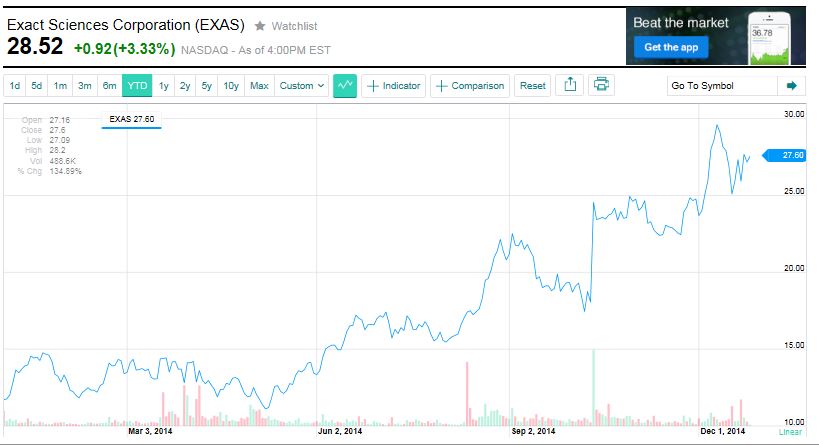
Now for the stock. Exact Sciences Corporation (EXAS) has already been up over 130% this year as compared to 18% for the S&P500. I started buying this stock in early summer in the $12-$15 range, it closed Friday at $28.52. Of 14 analysts who follow the stock, 4 rate it a Strong Buy, 6 a Buy, 3 a Hold and 1 an Underperform. EXAC is a somewhat volatile stock with a 1.48 beta.

EXAC

I like buying stocks with a real life benefit and a great revenue growth story. This could easily double again in 2015 as the new Cologuard test kits get used by millions of people and the company starts to expand internationally.


5 Advantages of Roth IRA’s you may not have considered


Roth

In the years leading to retirement you face a decision, whether to fund a Traditional IRA or a Roth IRA.

  1. Tax-free withdrawal. This you already know, however another major advantage of a Roth is that withdrawals are not included in any “income” calculations, including Social Security benefits or the current 3.8% surtax on net investment income above $250k for joint returns.
  2. No minimum distribution. Have a sizeable IRA in retirement is both great and a problem. The problem is that at age 70 ½ you must begin a Minimum Distribution from an IRA, and if you do the math, it isn’t so “minimum”. If you really don’t need this money, you first pay taxes on it as ordinary income, then you invest it into a taxable account and continue to pay taxes on it. The Minimum Distribution possibly raises your tax rate on your Social Security benefits. The Roth is 100% tax free after the age of 59 ½ with no requirements to ever distribute it.
  3. Penalty free withdrawal. If you fund a Roth IRA you can withdrawal your contribution with no tax penalty. A withdrawal from an IRA before 59 ½ incurs both income tax and a 10% penalty. A Roth can become an emergency fund if necessary.
  4. Estate planning. With a Roth you can pass your account to your heirs and other than an annual tax free withdrawal the account could continue for decades all tax free. The power of compounding could turn a modest account into a 7 digit account in no time. A Traditional IRS can be left to heirs but they must pay taxes on the annual withdrawals.
  5. Conversion flexibility. Let’s say that in January you convert $100,000 of Apple stock from a IRA to a Roth, you immediately incur a tax liability for $100,000 of income. Unfortunately by October 15th the market has dropped substantially and this investment is worth only $75,000. You can actually reverse the conversion (still only $75,000) and eliminate the tax on $100,000. This protects you in a down market. Of course if the market goes up as in the last few years you are even further ahead with a conversion.

The US Dollar is Very Strong – A Simple Way to Play It

The US dollar has become the strongest currency in the world for a lot of good reasons. A strong dollar benefits such things as international travel and imported goods and materials. Our dollar strength is primarily due to the fact that the US economy is the stronger than South America, Europe, Asia and Emerging Markets. As our Fed (central bank) is ending our Qualitative Easing, places like Europe’s ECB is just talking about starting theirs to boost the economy. The Russian Ruble has all but collapsed and inflation is already running at 10%. UUP Dollar

 So how can you invest in something to take advantage of this situation? One simple way is to invest in the PowerShares DB US Dollar Bullish ETF “UUP”. Behind the scenes this stock index is made up of long futures contracts. These contracts are long (betting the price will go up) the US Dollar against the Euro, Japanese Yen, British Pound, Canadian Dollar, Swedish Krona and Swiss Franc. The UUP can be easily bought and sold just like any other stock. It has plenty of liquidity, trading over a million shares per day on average so there is no problem buying or selling.


Beware Mutual Fund Owners – Here Comes the Tax Man

Many people still invest money in mutual funds held in their taxable accounts.  Mutual funds give investors the opportunity to pool money with others and own securities such as stocks, bonds and so forth. A more recent investment type has surfaced in the last decade called Exchange Traded Funds (ETF’s).

So what is the issue with the “tax man”? Normally in December Mutual Funds make distributions to their shareholders that can be quite a tax surprise. Let’s say that you own 1,000 shares of a well-known equity fund that currently trades for $50/share. In mid-December the fund declares a $2/share distribution classified as capital gains. In December you elect to get this distribution as cash in your account instead of additional shares. On the distribution date the mutual fund share price (NAV) will drop to $48, representing the distribution and you will get $2,000 in your cash account.

Now comes the surprise, you have to pay capital gains tax on the $2,000 even though you never sold any of your mutual fund shares. Now let’s add fuel to the fire, you actually bought these shares at $100/share and this year you lost $50,000 in the value of your fund, yet still owe taxes.

Tax Man

That’s how it works with mutual funds. This happens because mutual funds must periodically sell shares to fund investors who sell their mutual fund shares.

There is another way to get the same benefit, switch from mutual funds to ETF’s. ETF’s act just like stocks from a tax point of view. If you don’t sell them you don’t have any capital gains! No December surprises. ETF’s have many other advantages for all types of investors.

Just Google ETF’s and read about the advantages.

BTW, if you act quickly you can sell your mutual fund before the distribution date and save on taxes. Many mutual funds have already posted their expected “distributions” on their web site.  


Problems Getting a Mortgage if you are Asset Rich, but Have Little “Income”

So, you’ve worked hard all your life, saved and invested smartly and now you’d like to retire and enjoy yourself. That’s all well and good, but you might have a problem getting a simple mortgage.

Let’s say that you live up north, have your house paid off and would like to sell it and move to your dream house in Florida or Arizona. Maybe you have decided to delay your Social Security until you are 70 and earn 8% a year while you wait. So in effect, you have little or no income other than maybe a small pension or two and dividend and interest. Your financial advisor suggests you invest the proceeds of your house up north and take out a mortgage on your new Florida home. Since mortgage interest rates are around 4% and are tax deductible this might make good sense.  When you apply for your loan the new mortgage rules call for 43% debt to income ratio, but you no longer have “income”. Under the new rules the banks want to see a demonstrated process where you are already turning investments into income. Your substantial base might not qualify, as such, for even a smaller $100,000 – $250,000 mortgage.

Here is what you can do well before you try and apply for a new mortgage:

  1. Reduce your debt, you are retired and no longer have a paycheck. Once you get a budget in place you can go back to enjoying your new retirement life.
  2. Make sure there no other obstacles to getting a mortgage, for example your Credit Score. It is helpful to have an 800+ credit score.
  3. If you are going to hold your new house in a revocable trust along with your other assets, set it all up ahead of time. You’ll still need to meet the income retirements.
  4. Even though you want to delay Social Security until you are 70, start it at least 3-4 months before applying for your loan, you now have income. You can later (within 1 year) stop Social Security and send them all the money back, with no penalty.
  5. Modify your investments in your taxable account so that you are generating a good bit of monthly and quarterly dividend income. Check the ex-dividend and payment dates so that you can prove income.
  6. Set up a systematic, monthly withdraw from your brokerage account into your household checking account and make sure you have 3-4 months of proof these transactions took place.

With the above steps in place you should now have “income” to meet the debt/income ratio. You’ll feel pretty secure that once the closing on the new house has taken place and the boxes are unpacked you can reverse some of the steps shown.

Enjoy your retirement.