The US Dollar is Very Strong – A Simple Way to Play It

The US dollar has become the strongest currency in the world for a lot of good reasons. A strong dollar benefits such things as international travel and imported goods and materials. Our dollar strength is primarily due to the fact that the US economy is the stronger than South America, Europe, Asia and Emerging Markets. As our Fed (central bank) is ending our Qualitative Easing, places like Europe’s ECB is just talking about starting theirs to boost the economy. The Russian Ruble has all but collapsed and inflation is already running at 10%. UUP Dollar

 So how can you invest in something to take advantage of this situation? One simple way is to invest in the PowerShares DB US Dollar Bullish ETF “UUP”. Behind the scenes this stock index is made up of long futures contracts. These contracts are long (betting the price will go up) the US Dollar against the Euro, Japanese Yen, British Pound, Canadian Dollar, Swedish Krona and Swiss Franc. The UUP can be easily bought and sold just like any other stock. It has plenty of liquidity, trading over a million shares per day on average so there is no problem buying or selling.


Retirement Planning Part 4 – What Should I Invest in While in Retirement

In Part 3 we discussed how to determine how much money you’ll need or have in retirement. In this post we’ll discuss what type of investments you should have in your portfolios.

Let’s start with the premise that your retirement plan calls for you to withdraw 4% a year from your investments to cover your expenses. This is a common benchmark used by many planning tools. A common recommendation is that you maintain an allocation of stocks vs. bonds that match your age, for example if you are 65 years old you would have 65% invested in bonds and 35% in stocks. We’ll look at your investment options.

What should I invest in?

  1.  First of all these general recommendations were pretty good when we had a “normal” market environment. 65% in bonds or any fixed income was not a problem since the US 10 year Bond yields from 1996 to 2006 ranged from 5% – 16%. If you wanted to withdraw 4% and were making 5%+ you were in pretty good shape. Today 10 year Bonds yield under 3%, with Bond prices surely headed down. Therefore you are stuck with a rapidly depreciating asset. Furthermore, you are withdrawing more than you are earning. Bonds today are safe, but not the best investment.
  2. Stocks, by comparison have had a pretty good run since the 2009 market lows. For the smart people (brave) people who hung on to their solid stock investments through the recession, they are now back to all-time highs. The poor people who were panic struck and sold at the bottom of the market and stayed in cash for a year or so, they are financially stuck.
  3. Given the current market conditions investors should look to overweight stocks, especially those with solid dividends. Many of these stocks have “bond-type” yields and have the possibility of both increased yields and growth in value. I’ll cover some of these possibilities in a separate posting, including stock preferred shares, MLP’s, BCD’s and REITS. For your general investment pick household names that have a solid track record of dividend growth such as:
    1. Verizon 4.37%
    2. Altria 4.23%
    3. American Electric Power 3.49%
    4. Proctor & Gamble 2.80%
    5. Microsoft 2.57%
  4. All of these recommendations need to be adjusted on an annual basis, just like rebalancing your portfolio. Some of these investments might be “buy and hold” but not “buy and forget” as I explained in a prior article. Some people think this is like day-trading, a risky practice if you’re not properly trained, but it isn’t. There are a few individual stocks you can keep forever, but many need to be swapped out. One good practice is to set goals when you buy a stocks, you need a purchase price and a sale price, before you buy. Don’t buy at the top and sell at the bottom.
  5. Many people may not feel like picking individual stocks, they are better off buying Exchange Traded Funds (ETF’s). ETF’s are usually better than Mutual Funds because they are more transparent and easier to understand. ETF’s trade like stocks, Mutual Funds trade based on a NAV, Net Asset Value, this is calculated at the end of each day.
  6. So what about bonds? It’s OK to have a small bond position today, just make sure they are of “short duration” and keep an eye on the core price. High quality corporate bonds are OK. As prices drop over the next 6 months get out and sit in cash or high dividend stocks until bond yields climb above 4 or 5% then start buying on a “ladder” basis.

In summary, you can’t withdraw 4% on an investment only yielding 2-3%, you’ll run out of money sooner than later. In the current market high quality, high dividend stock or stock ETF’s  are a safe bet.

In our next post we’ll discuss how some specific investments will help you grow your portfolio to meet your retirement needs.

Building a High Yielding Retirement Portfolio – Part 5 MLP’s

In my previous posting I discussed the need to include high-yielding securities in a retirement portfolio, in Part 2 I reviewed Preferred Stocks, in Part 3 BDC’s, in Part 4 REIT’s. In this article we’ll discuss MLP’s (Master Limited Partnerships).

A MLP is a partnership that generates income from real estate, natural resources and commodities. MLP’s are a major factor in the transportation and storage of oil and natural gas. MLP’s, similar to REIT’s and BDC’s pay little or no corporate income tax and must distribute at least 90 percent of taxable income as dividends or return of capital to investors. This results in many cases in both capital growth and high-yields. When you buy stock (units) in an MLP you become a “partner” in that MLP. The distributions are not taxed when you receive them, instead, they are considered reductions in the investment’s cost (return of capital), and you don’t have a tax liability until you sell the MLP. Your income from the MLP is reported to you on a K-1 each year.

If you are looking to get into the booming energy market and don’t want to worry about the volatility of oil and low prices of natural gas, the MLP’s that provide the pipelines and storage facilities might be your best choice. You see, these MLP’s charge for distribution and storage they aren’t effected by the price of the commodity. I’ll also warn you that like all other high-yielding investments that are subject to the volatility of changing interest rates. Many of these were heavily sold earlier this year as the talk of Fed tapering surfaced and the 10 year bond yield jumped overnight. Once interest rates calm down these can be great investments.

Here are some of my favorite MLPs you might consider:
UBS E-TRACS 2x Leveraged Long Alerian MLP (MLPC)  9+% yield
Linn Co (LNCO)   9% yield
Magellan Midstream Partners (MMP)   3.6% yield (stock is up 50% this year alone)

Check out the performance of MLPL in the past year. Not only has it out performed the S&P 500 index, but it also delivered > 9% dividend yield.
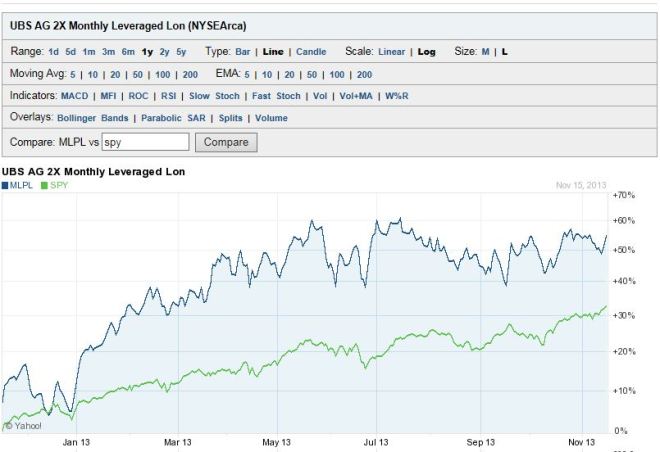
Capture

By allocating a portion of your portfolio to some of these ultra-high-yielding investments you’ll be able to improve your cash flow while waiting for the next Facebook or Apple investment to come along. In future posts we’ll discuss the pros and cons of these investments and some helpful tips.

Building a High Yielding Retirement Portfolio – Part 4 REIT’s

In my previous posting I discussed the need to include high-yielding securities in a retirement portfolio, in Part 2 I reviewed Preferred Stocks, in Part 3 BDC’s. In this article we’ll discuss REIT’s (Real Estate Investment Trusts).

A REIT is a company that owns and operates income generating real estate. REITs can own commercial properties from office and apartment buildings to hospitals, retirement homes, warehouses, hotels, shopping centers, hotels and timberlands. REITs are also a major factor in financing housing. REIT, similar to BDC’s pay little or no corporate income tax and must distribute at least 90 percent of taxable income as dividends to investors. This results in many cases in both capital growth and high-yields.

There are a lot of different types of REIT’s, agency and non-agency etc., I won’t get into all of these here. I’ll also warn you that like all other high-yielding investments that are subject to the volatility of changing interest rates. Many of these were heavily sold earlier this year as the talk of Fed tapering surfaced and the 10 year bond yield jumped overnight. Once interest rates calm down these can be great investments.

Here are some of my favorite REIT’s you might consider:

  • W P Carey (WPC)  5% yield
  • Hospitality Properties Trust (HPT)   6.50% yield
  • American Capital Agency (AGNC)   13% yield

Check out the performance of W.P. Carey in the past year. Not only has it out performed the S&P 500 index, but it also delivered > 5% dividend yield.

REIT-1

By allocating a portion of your portfolio to some of these ultra-high-yielding investments you’ll be able to improve your cash flow while waiting for the next Facebook or Apple investment to come along. In future posts we’ll discuss the pros and cons of these investments and some helpful tips.


Building a High Yielding Retirement Portfolio – Part 3 BDC’s

In my previous posting I discussed the need to include high-yielding securities in a retirement portfolio, in Part 2 I reviewed Preferred Stocks. In this article we’ll discuss BDC’s (Business Development Company).

BDC’s are companies that function like Venture Capital or Private Equity funds however they allow smaller investors like you and me to invest in their companies. VC and PE funds are often closed to all but wealthy investors. BDCs, on the other hand, allow anyone who purchases a share to participate in the open market.

BDCs have become popular since they pay little or no corporate income tax and must distribute at least 90 percent of taxable income as dividends to investors. Many BDC’s distribute 98 percent of their taxable income to avoid all corporate taxation. This results in many cases in both capital growth and high-yields. Returns to the stock holder matches the on the type of income earned by the BDC. Ordinary income to the BDC is taxable to us as ordinary income and their capital gains is generally taxable to us as capital gains.

Here are some of my favorite BDC’s you should consider:

  • Prospect Capital Corp (PSEC)  11.50% yield
  • Ares Capital Corp. (ARCC ) 8.41% yield
  • Hercules Technology Growth Capital (HTGC) 7.03% yield

Check out the performance of Hercules Technology Growth Capital in the past year. Not only has it out performed the S&P 500 index, but it also delivered > 7% dividend yield.

BDC-1.jpg

By allocating a portion of your portfolio to some of these ultra-high-yielding investments you’ll be able to improve your cash flow while waiting for the next Facebook or Apple investment to come along. In future posts we’ll discuss the pros and cons of these investments and some helpful tips.

Building a High Yielding Retirement Portfolio – Part 2 Preferred Stocks

In my previous posting I discussed the need include high-yielding securities in a retirement portfolio. In this article we’ll discuss Preferred Stocks.

Preferred stocks are positioned between common stocks and bonds. Most commonly preferred shares carry no voting rights but have a higher claim to earnings than common share and are usually less volatile than common. When the S&P 500 fell 37% in 2008, for example, the iShares preferred fund fell only 24%. Preferred shares are next in line to bond holders in the capital chain of any company. Investors can easily choose from preferred stock ETF’s or individual stocks. Investors should also understand that most high-yield stocks are affected by rising interest rates, similar to bonds.

Here are some examples of ETF’s you should consider:

  • iShares U.S. Preferred Stock ETF (PFF) 5.6% yield
  • PowerShares Preferred Portfolio (PGX) 6.8% yield
  • SPDR Wells Fargo Preferred Stock (PSK) 6.7% yield

Many of the high-yield preferred stocks are in the financial sector, including REIT’s.  Here are a few that I either currently own or have owned in the past:

  • Privatebancorp Capital Trust IV (PVTBP) 9.7% yield
  • Magnum Hunter Resources Corp (MHR/PC) 10.1% yield
  • SandRidge Energy (SDRXP) 8.2% yield

If you are a first time investor you should research a little more on how preferred stocks are priced before adding them to your portfolio. For example, SandRidge Energy (SDRXP) has a Face Value of $100, its original selling price when issues. Today it is selling for $103.75, a slight premium. The preferred pays an 8.50% “coupon rate”, however since the stock sells at a premium, you will only get paid the current 8.2%. In addition this preferred stock is “callable” at the option of the company. I wouldn’t worry too much about this, the fact is you will earn a nice yield on your investment.

By allocating a portion of your portfolio to some of these ultra-high-yielding investments you’ll be able to improve your cash flow while
waiting for the next Facebook or Apple investment to come along. In future posts we’ll discuss the pros and cons of these investments and some helpful tips.

You might own more Microsoft, Apple, Google and Exxon than you think

Many investors are looking for well diversified investment portfolios and most own the S&P 500 index in their retirement accounts. Investors should however beware that standard S&P funds or ETF’s like SPY are market cap weighted, meaning that the bigger a company is (its market cap) the more of its shares are in the index. For example, recently Apple was 4+% of the SPY, however Apple is only 1 of 500 companies in the index. Today the top 10 (of 500) companies in the SPY account for over 18% of the index. This may not be the diversification you are looking for.

Here is a great tool from Finviz.com that displays the cap weighting of the S&P Index.

SP Map

There are other choices for the S&P 500 that are market weighted, like the Guggenheim S&P 500 Equal Weight ETF (RSP). This ETF has been around for over 10 years and is a very safe investment. Whereas half of SPY’s total capitalization is made up of mega-cap stocks (companies with market values in excess of $200 billion), these giants only make up 11 percent of RSP’s line-up.

Here is a comparison of the holdings between the two ETF’s.

SP vs RSP

Also the RSP has consistently outperformed the SPY (S&P 500 index), see below.

SP chart-1

What Boxes are Your Investments in?

In a previous post I discussed the need to re-balance your portfolio on a regular basis. One of the first steps to doing this re-balance is to first determine the make-up of your current mix of investments. There are a variety of free tools that let you accomplish this. In this post we’ll talk about the “9 Boxes” or Style Box popularized my Morningstar.

The Style Box will allow you to visually map your portfolio into the 9 categories of:

    • Large value
    • Large blend
    • Large growth
    • Medium value
    • Medium blend
    • Medium growth
    • Small value
    • Small blend
    • Small growth

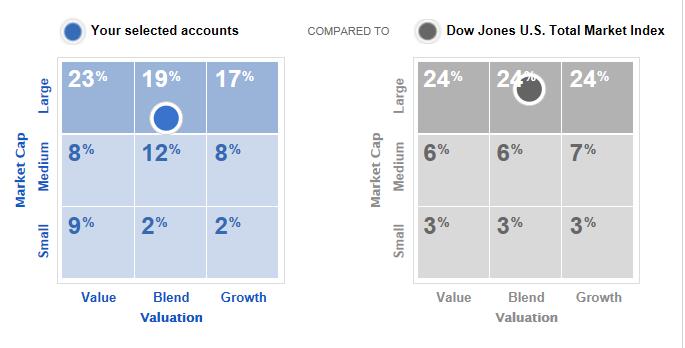
The horizontal rows represent “valuation” and the vertical columns represent market cap. Here is an example comparing a portfolio to the Dow Jones US Total Market Index.

9 Boxes Example

As a point of further reference let’s compare the above example with the Market Barometer on Morningstar’s web site today (August 29, 2013).

9 Boxes Example-2

In this comparison it shows that in the last 3 months and 12 months small cap stocks, ETF’s and mutual funds have out-performed the large caps. Therefore we might want to consider re-balancing some of our portfolio into small or even mid-cap investments.

Buy and Holding Becomes “Buy and Forget”

We all remember the old adage regarding investing, Buy and Hold. The theory is that you just buy good companies and hold onto them forever. Unfortunately, what happens many times is “hold” turns into “forget”. The buy and hold concept also assumed that you adjust and reallocate your portfolio from time to time. However, most people don’t and in many cases they don’t even know how to. Adjust or reallocate means selling under-performers and adding new opportunities.

Advisors use to suggest that you reallocate your investments on an annual basis.  This however may not make sense, what is so special about any single anniversary date?

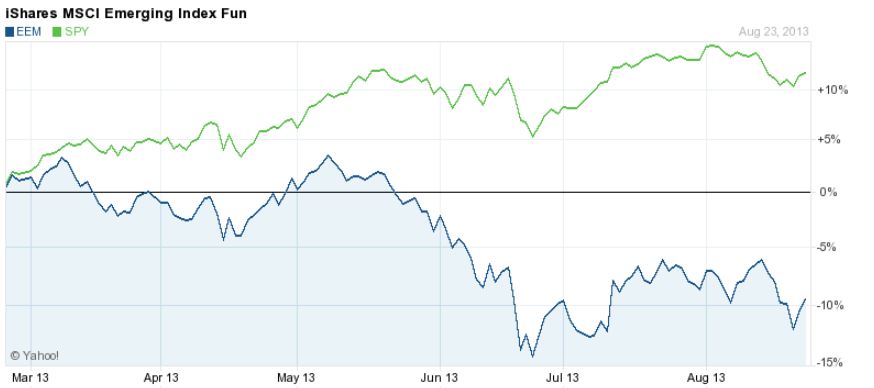
So what should you do? My suggestion is to do an extensive review and adjustment to your portfolio on a quarterly basis. Stop putting money into down-trending stocks/funds or ETF’s. For example, on January 1st this year the emerging markets (ETF: EEM) looked great, even outperforming the S&P. However by March it was tumbling and by using the “Buy and Forget” model you would be down 10% while the S&P advanced 10%, a 20% spread.

In future blog postings I’ll give you some tools and ways to better manage your investments.

EEM vs SPY