2014 Year End Tax Planning for Retirees

If you are like me, you are either retired or close to it. One quick shock on the day you retire is that you no longer have that pay check you’ve been getting most of your adult life. If you’ve done a good job of planned your retirement in advanced you can be celebrating instead of worrying. While in retirement you can set new goals, one of might be to pay the smallest amount of federal income tax as possible. Is it possible to appear “poor on paper” yet live a comfortable lifestyle? Yes!

Here are some items for your consideration.

  1. Manage your 2014 tax bracket. For example, if you just started receiving Social Security this year, consider returning it and delaying payments till you are 70 ½. There is no penalty for doing this. Some of this will be taxable. This might give you a chance to live off savings (cash) while paying little if any tax.
  2. Contribute the maximum amount you can to an HSA account, this will provide a credit to your Taxable Income.
  3. If possible, maximize your deductible items such as medical expenses by getting those new eye glasses, dental cleaning and so forth this year instead of early next year. Consider prepaying your property taxes.
  4. One big issue can be stock market opportunities in your taxable account. With the recent volatility in the market consider selling stocks, ETF’s or fund’s with short-term losses. These losses can then offset gains. You can also carry forward a maximum of $3,000 into future years. Just make sure you watch out for a “Wash Sale” on stocks sold for a loss if you put this money back to work in the market. When you use a loss to offset a gain you also get the benefit of re-setting your “cost basis” for the stock. This will benefit you if you buy back and then sell this stock for a gain in the future.
  5. Also regarding your taxable brokerage account, try and maintain “qualified-dividend” stocks which get preferred tax treatment or no tax at all if you can find a way to stay in the 15% tax bracket. Keep in mind that if you are in the 10% or 15% tax bracket there is 0% tax on “qualified dividends” and Long Term Capital Gains.
  6. If you’ve done a good job being “poor on paper”, you can also convert some of your IRA into a Roth IRA. Just keep an eye of your plan so that you don’t jump into a higher tax bracket.
  7. If you hold Equity Mutual Funds watch for the December “Distribution Date”, consider selling before that date if a large capital gain is expected. Otherwise you will be surprised by paying tax on a distribution you don’t actually get (the fund price, in theory is lowered by the distribution amount).

In a future post I’ll provide a plan for postponing your Social Security and various options.

A Conservative Method to Earn Extra Income – Sell Call & Puts

Investors are always looking for ways to enhance their income without taking unnecessary risks. As you get older the more conservative you become. We just can’t afford to risk our retirement income. One way to achieve additional income in your investment portfolio is to Sell Calls and Puts.

Most investors have no idea what Options are and therefore immediately believe they must be risky. The fact is, Selling Cover Calls and Cash Secured Puts is a very safe, easy and conservative way of enhancing the returns for your investments.

Selling a Covered Call – This pays you an immediate premium (Premium) for giving someone the right to buy your shares at a future date (Expiration Date) at a specific price (Strike Price). You cannot lose the premium. Covered Calls allow you to enhance gains instead of just “buy and hold”. For example, today you buy 100 shares of Facebook (FB) at $53.81/share $5,381 total cost. You then sell (write) a Covered Call for FB, get an immediate premium of $1.17/share and agree to sell your 100 shares on January 10, 2014 at $56.50/share. Therefore if FB hits $56.50 on January 10th you will have made $269 on the stock, $117 Call Premium, total $369 or 7%. A 7% return in  less than 1 month is a pretty good return.

You can learn more about Covered Calls from the CBOE, the world’s largest Options Exchange:

http://www.cboe.com/Strategies/EquityOptions/CoveredCalls/part1.aspx

Selling a Cash Secured Put – This pays you an immediate premium (Premium) for agreeing to buy shares at a future date (Expiration Date) at a specific price (Strike Price). You cannot lose the premium. The Put allow you to buy your favorite stock at a lower price and get paid until it hits your price. Using our FB example above, lets say you would like to buy FB at only $50/share. You would Sell a Put for a January 18th $50 Strike Price and immediately get a $1.04/share premium. Let’s say that on January 18th FB is selling at a price higher than $50, your Put Option expires and you still get to keep the $104 premium. Your return was 2% ($104/$5000) for about 1 month, that’s 24% annualized.

In future postings I’ll give you some helpful tips on how to use Calls and Puts while protecting yourself from losses.

Building a High Yielding Retirement Portfolio – Part 5 MLP’s

In my previous posting I discussed the need to include high-yielding securities in a retirement portfolio, in Part 2 I reviewed Preferred Stocks, in Part 3 BDC’s, in Part 4 REIT’s. In this article we’ll discuss MLP’s (Master Limited Partnerships).

A MLP is a partnership that generates income from real estate, natural resources and commodities. MLP’s are a major factor in the transportation and storage of oil and natural gas. MLP’s, similar to REIT’s and BDC’s pay little or no corporate income tax and must distribute at least 90 percent of taxable income as dividends or return of capital to investors. This results in many cases in both capital growth and high-yields. When you buy stock (units) in an MLP you become a “partner” in that MLP. The distributions are not taxed when you receive them, instead, they are considered reductions in the investment’s cost (return of capital), and you don’t have a tax liability until you sell the MLP. Your income from the MLP is reported to you on a K-1 each year.

If you are looking to get into the booming energy market and don’t want to worry about the volatility of oil and low prices of natural gas, the MLP’s that provide the pipelines and storage facilities might be your best choice. You see, these MLP’s charge for distribution and storage they aren’t effected by the price of the commodity. I’ll also warn you that like all other high-yielding investments that are subject to the volatility of changing interest rates. Many of these were heavily sold earlier this year as the talk of Fed tapering surfaced and the 10 year bond yield jumped overnight. Once interest rates calm down these can be great investments.

Here are some of my favorite MLPs you might consider:
UBS E-TRACS 2x Leveraged Long Alerian MLP (MLPC)  9+% yield
Linn Co (LNCO)   9% yield
Magellan Midstream Partners (MMP)   3.6% yield (stock is up 50% this year alone)

Check out the performance of MLPL in the past year. Not only has it out performed the S&P 500 index, but it also delivered > 9% dividend yield.

Capture

By allocating a portion of your portfolio to some of these ultra-high-yielding investments you’ll be able to improve your cash flow while waiting for the next Facebook or Apple investment to come along. In future posts we’ll discuss the pros and cons of these investments and some helpful tips.

Building a High Yielding Retirement Portfolio – Part 4 REIT’s

In my previous posting I discussed the need to include high-yielding securities in a retirement portfolio, in Part 2 I reviewed Preferred Stocks, in Part 3 BDC’s. In this article we’ll discuss REIT’s (Real Estate Investment Trusts).

A REIT is a company that owns and operates income generating real estate. REITs can own commercial properties from office and apartment buildings to hospitals, retirement homes, warehouses, hotels, shopping centers, hotels and timberlands. REITs are also a major factor in financing housing. REIT, similar to BDC’s pay little or no corporate income tax and must distribute at least 90 percent of taxable income as dividends to investors. This results in many cases in both capital growth and high-yields.

There are a lot of different types of REIT’s, agency and non-agency etc., I won’t get into all of these here. I’ll also warn you that like all other high-yielding investments that are subject to the volatility of changing interest rates. Many of these were heavily sold earlier this year as the talk of Fed tapering surfaced and the 10 year bond yield jumped overnight. Once interest rates calm down these can be great investments.

Here are some of my favorite REIT’s you might consider:

  • W P Carey (WPC)  5% yield
  • Hospitality Properties Trust (HPT)   6.50% yield
  • American Capital Agency (AGNC)   13% yield

Check out the performance of W.P. Carey in the past year. Not only has it out performed the S&P 500 index, but it also delivered > 5% dividend yield.

REIT-1

By allocating a portion of your portfolio to some of these ultra-high-yielding investments you’ll be able to improve your cash flow while waiting for the next Facebook or Apple investment to come along. In future posts we’ll discuss the pros and cons of these investments and some helpful tips.


Building a High Yielding Retirement Portfolio – Part 3 BDC’s

In my previous posting I discussed the need to include high-yielding securities in a retirement portfolio, in Part 2 I reviewed Preferred Stocks. In this article we’ll discuss BDC’s (Business Development Company).

BDC’s are companies that function like Venture Capital or Private Equity funds however they allow smaller investors like you and me to invest in their companies. VC and PE funds are often closed to all but wealthy investors. BDCs, on the other hand, allow anyone who purchases a share to participate in the open market.

BDCs have become popular since they pay little or no corporate income tax and must distribute at least 90 percent of taxable income as dividends to investors. Many BDC’s distribute 98 percent of their taxable income to avoid all corporate taxation. This results in many cases in both capital growth and high-yields. Returns to the stock holder matches the on the type of income earned by the BDC. Ordinary income to the BDC is taxable to us as ordinary income and their capital gains is generally taxable to us as capital gains.

Here are some of my favorite BDC’s you should consider:

  • Prospect Capital Corp (PSEC)  11.50% yield
  • Ares Capital Corp. (ARCC ) 8.41% yield
  • Hercules Technology Growth Capital (HTGC) 7.03% yield

Check out the performance of Hercules Technology Growth Capital in the past year. Not only has it out performed the S&P 500 index, but it also delivered > 7% dividend yield.

BDC-1.jpg

By allocating a portion of your portfolio to some of these ultra-high-yielding investments you’ll be able to improve your cash flow while waiting for the next Facebook or Apple investment to come along. In future posts we’ll discuss the pros and cons of these investments and some helpful tips.

Building a High Yielding Retirement Portfolio – Part 2 Preferred Stocks

In my previous posting I discussed the need include high-yielding securities in a retirement portfolio. In this article we’ll discuss Preferred Stocks.

Preferred stocks are positioned between common stocks and bonds. Most commonly preferred shares carry no voting rights but have a higher claim to earnings than common share and are usually less volatile than common. When the S&P 500 fell 37% in 2008, for example, the iShares preferred fund fell only 24%. Preferred shares are next in line to bond holders in the capital chain of any company. Investors can easily choose from preferred stock ETF’s or individual stocks. Investors should also understand that most high-yield stocks are affected by rising interest rates, similar to bonds.

Here are some examples of ETF’s you should consider:

  • iShares U.S. Preferred Stock ETF (PFF) 5.6% yield
  • PowerShares Preferred Portfolio (PGX) 6.8% yield
  • SPDR Wells Fargo Preferred Stock (PSK) 6.7% yield

Many of the high-yield preferred stocks are in the financial sector, including REIT’s.  Here are a few that I either currently own or have owned in the past:

  • Privatebancorp Capital Trust IV (PVTBP) 9.7% yield
  • Magnum Hunter Resources Corp (MHR/PC) 10.1% yield
  • SandRidge Energy (SDRXP) 8.2% yield

If you are a first time investor you should research a little more on how preferred stocks are priced before adding them to your portfolio. For example, SandRidge Energy (SDRXP) has a Face Value of $100, its original selling price when issues. Today it is selling for $103.75, a slight premium. The preferred pays an 8.50% “coupon rate”, however since the stock sells at a premium, you will only get paid the current 8.2%. In addition this preferred stock is “callable” at the option of the company. I wouldn’t worry too much about this, the fact is you will earn a nice yield on your investment.

By allocating a portion of your portfolio to some of these ultra-high-yielding investments you’ll be able to improve your cash flow while
waiting for the next Facebook or Apple investment to come along. In future posts we’ll discuss the pros and cons of these investments and some helpful tips.

Building a High Yielding Retirement Portfolio – Part 1

It’s never too early to start planning for your retirement. Many of us who are just beginning our retirement need to plan on having enough cash flow to cover our living needs for the next 20 – 30 years. We will have Social Security and possibly a pension to help us along; however a substantial portion of our retirement income may need to come from the investments we’ve made over our lifetime.

One issue many face is how to generate retirement income from dividends. Today’s ultra-safe investments like Treasury Bonds pay a paltry 2-3%, Money Market accounts and CD’s are paying 1% or less. We might need investments that pay a lot more than this to be able to withdraw say 4% per year while still maintaining a substantial nest-egg for our loved ones.

Wise investors will have an allocation strategy in their portfolio that includes both high-yielding stocks and other investment to help cover any shortfall.

Here are some choices for investments and a sample range of yields:

  • Preferred Stocks – 4% to 10% Yields
  • Business Development Company (BDC) – 6% to 10% Yields
  • Real-estate Investment Trusts (REIT’s) – 5% to 13% Yields
  • Master Limited Partnerships (MLP) – 5% to 15% Yields

By allocating a portion of your portfolio to some of these ultra-high-yielding investments you’ll be able to improve your cash flow while waiting for the next Facebook or Apple investment to come along. In future posts we’ll discuss the pros and cons of these investments and some helpful tips.

Warning – Check your 401K and IRA’s for Bonds and SELL them Quickly!

Many people own bonds today, why not there has been a 20+ year bull market for bonds. However, that is all about to come to an end pretty quickly. Bonds have been the backbone of fixed income investing for many years. Existing Bond holders are going to see the value of their investments drop substantially. You don’t think you own any Bonds, just check some of your mutual funds in your 401K and IRA and you might be surprised at how mucj you own.

When the Fed stops or “tapers’ its buying of assets, currently $85 billion per month, bond yields will go up and Bond prices will drop. If you still own Bonds, you’ll keep getting your dividend, however the value of the Bond or fund will fall. What good is an investment that pays a 3% dividend, but goes down 9% in price?

Here is what you need to know about Bonds:

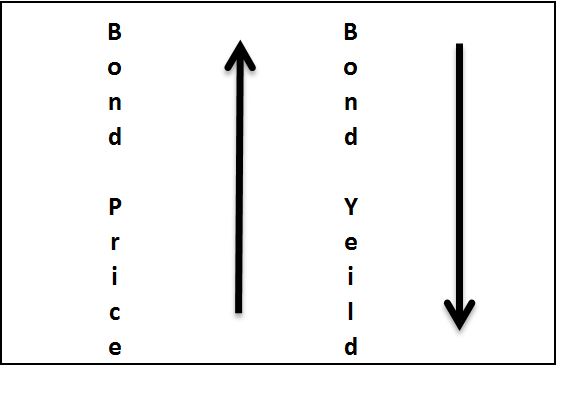
1. When Bond prices go up, Bond yields go down. This is what has been happening as the Feds keep buying  Bonds.

Bond-1

2.  Normally the value of equities (stocks) are the opposite of Bond prices. This last year has however been an exception. Up until January 2013 the price of stocks and bonds often traveled in the same direction. But that has all changed now, see the chart below, it compares the price of the 20 year Bond fund (TLT) to the S&P 500.

Bond-2

Now is the time to get out of your existing Bonds. As Bond yields go up (and prices drop) you may want to get in at a later date.