YOU Must Really Be In Debt!!!

download

You must be in one heck of a lot of debt. I say that because I’m retired, might be described as a high net worth individual and I don’t carry any debt. HOWEVER, based on the latest reports American consumer debt is now at all time high’s again. If I’m not carrying any debt, than maybe you are carrying my share. Here are some just released  national statistics.

Debt
The New York Federal Reserve released a new report in May 2017 that showed U.S. collective household debt balances totaled $12.73 trillion in March 2017, surpassing the 2008 peak of $12.68 trillion.

The amount of debt you carry might be harmful to both you, and in total, to our entire economy.

  1. Massive student load debt is a deterrent to home ownership until much later in life, if at all. Student loan debt is one of the few debts NOT discharged under bankruptcy.
  2.  People are taking out very long term car loans to keep monthly payments down. However, they end up with a large negative equity. Typically, car dealers tack on an amount equal to the negative equity to a loan for your next vehicle. To keep the monthly payments stable, the new credit is for a greater length of time. Over the course of multiple trade-ins, negative equity accumulates. Moody’s calls this the “trade-in treadmill”.
  3. Older Americans are taking on a greater share of debt than in years past. Those ages 60 and older held 22.5% of total household debt at the end of 2016, compared with 15.9% in 2008 and 12.6% in 2003.These high levels of debt could mean older Americans don’t have enough money saved for retirement!
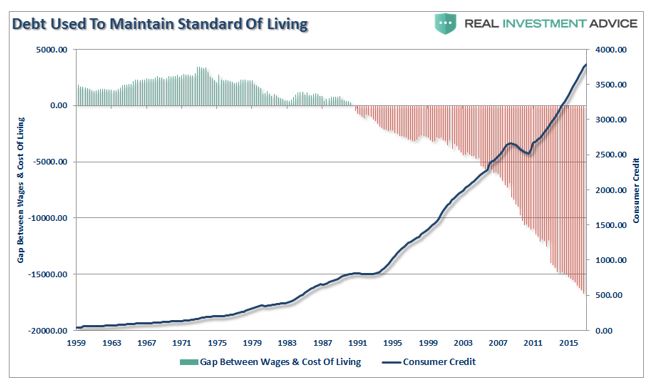
  4. Keeping up with the “Jones”? The rise in the cost of living is greater than income growth over the last 13 years. Median household income has grown 28% since 2003, but expenses have skyrocketed. Medical costs increased by 57% and food and beverage prices by 36% in that same time frame. Check out the chart below, pretty sick!

Pict-1

We are currently in the late stages of an economic boom, workers are comfortable with their jobs, the stock market is hitting all-time highs almost everyday, life is good.

Your life may not be so good if you are carrying too much debt for your stage of life and income level. It also greatly depends on what type of debt you are carrying. I’ll write more about consumer debt in a future article.

Never Giving Up …. As Impossible as it Might Seem!

12715645_1278067085542456_5715322089222207430_n

What are the odds that a golf course, enclosed in a Florida gated community, closed for over 2 years would ever be brought back to life …… not very good for sure! Here is the story of how this actually happened. The story includes a lot of information never before made public, all the drama of a TV reality show, some mistakes, and finally after 2+ years, success. This story was written as my recollection of the events with the help of hundreds of emails, documents and research. The reopening of the Plantation Palms Golf Club and ensuing improvements in our property values would not have happened had it not been for the countless hours of work and support from a small group of dedicated people.

I am proud to have been able to lead this effort.

Here is a link to my free e-book #1 detailing the journey. I hope you enjoy the read.

https://historyofplantationpalms.wordpress.com

Book 2 should be finished in a few months, it too has a ton of drama.


The Real Story about “Income Investing”

Income

Summary:

  1. Most investors don’t understand the fundamental concepts of Income Investing vs Growth Investing.
  2. Income Investing is specifically designed to help fill the “gap” between guaranteed retirement income and actual spending needs.
  3. Income should come from dividends or interest.
  4. Income Investors do not selling shares, only as a last resort.
  5. High yield instruments should account for income and inflation.
  6. Dividends from Income Investing should cover all RMD requirements.
  7. Stock price growth of the stocks, although nice, is not the main goal of the portfolio.
  8. Income Investors don’t need to check their stock prices every day.

Few investors seem to really understand the concept of “Income Investing” until retirements is upon them and they find the need to fill the income gap between their living expenses and their Social Security and pension payments. They need to generate income from dividends or interest (Bonds).

If a retiree needs income they have two basic choices, see shares or accumulate dividends. An Income Investor does not sell shares for income, other than in some emergency situation. Of course any investor, including an Income Investor will sell share if the stock or fund is no longer meeting the investors requirements or as part of a re-balancing. For example a growth investor may have 100 shares of Facebook, if this investor needs cash the investor must sell a few share of Facebook, thus lowering the core portfolio. By comparison an Income Investor would not hold Facebook, since it pays no dividend. This investor might hold AT&T (ticker T) and it generates around 5% dividends.

A retiree may have multiple accounts, a taxable growth account, an IRA income account and even a ROTH IRA. The taxable account might be set aside primarily for growth, maybe building wealth for future generations of the family. The IRA as an income account is an idea place where you might have a well-diversified group of higher yielding dividend stocks. In this case an idea situation would be to earn enough in dividends to cover all cash requirements, inflation and the RMD (Required Minimum Distribution) beginning at age 70.

I’m both an Income and a Growth investor at the same time.

The investor should construct the Income Account well before needing actual cash withdrawals for retirement. A few years or experience with different investments in the Income Account will provide a valuable education. How diversified should my investments be, what is my average yield goal. You can almost work backwards from the portfolio value. For example, I need $25,000 a year in steady cash flow and my average yields is designed to be 5%, then I need to have $500,000 in my IRA.

Let’s take a little better look at this sample $500,000 portfolio. At age 70 the 1st year RMD would be about $18,250, in year 7 the RMD would climb to about $25,242, this assumes 5% dividend yield and a 1% growth in underlying stock prices (6% total return).

If you needed to generate a guaranteed 5% yield and have diversification you might want to target even 6% to cover the normal ups and downs in dividend adjustments. This portfolio cannot just include blue-chip, large cap stocks, most don’t come close to a 6% yield. You will need to go up the risk curve a little and add items like:

  • Preferred Stocks 
  • CEF’s – closed end funds 
  • REITS – real estate investment trusts
  • BDC’s – business development companies
  • MLP – Master Limited Partnerships
  • Telecom Stocks
  • Tobacco Stocks 

Below is a chart showing my Income Account that will more than fill my “gap” and RMD requirements. With my Social Security, pensions and this Income Account we can live a comfortable life style without needing to touch our Growth taxable brokerage account.

This portfolio yields about 7.45% based on my costs. I have 29 stocks, ETF or funds in this portfolio. I tend to like Preferred’s most of which are banks, followed by REIT’s and Closed End Funds.
My IRA

If you are nearing retirement age or are retired you too should consider building an Income Investing strategy to fill your gap.


Mark Your Calendar, on October 13th you may get a $38,000 Social Security Increase

SS

For most retirees Social Security is the core component of their retirement income plan. Any increase in Social Security benefits has tremendous value. Social Security is subject to a strange cost of living formula, COLA. Even a small increase is set for life and can then be compounded with future increases. That’s because the rate is never reduced, but can be increased.

So what is strange about the SS COLA? Social Security COLAs are based on the Consumer Price Index For Urban Wage Earners And Clerical Workers, known as CPI-W. It is similar to CPI inflation index that we normally hear about,  but includes consideration unique to households with at least 50% of the income coming from clerical or wage-paying jobs. Why only index clerical or wage-paying jobs household inflation, who knows, it’s the government.

So, here is how the new COLA gets set. The COLA effective for December of the current year is equal to the percentage increase (if any) in the average CPI-W for the third quarter of the current year over the average for the third quarter of the last year in which a COLA became effective. If there is no increase, there is no COLA. So it is NOT based on a full year look at inflation, but just the 3rd quarter.

How are we going to get that extra $38,000? Well the maximum husband/wife Social Payment in 2016 is about $58,600, based on one spouse waits till 70, the other spouse gets 50% at FRA. If however, say a wife has her own Social Security that is higher than 50% of her husband’s, she would then get the higher amount at FRA. 

The current news reports that the COLA for 2018 could be 2.2%. The SSA says it will release the official COLA number on Friday, October 13 at 8:30 AM! Stay tuned.
For those interested in determining the veal value of their Social Security income from an “investment point of view”, you can read my analysis on how to do this here:

https://jhammondblog.com/2015/07/06/you-have-a-800000-1400000-bond-understanding-it/

I’ll be closely watching the news on October 13th!

My Client Get’s National Recognition

Capture

It’s always nice when your consulting client gains national recognition for the growth of their business and adding jobs in the workplace. The Decker Group has been a pleasure to work with and I look forward to helping them meet their future goals. 

You can check out their story – click here

Capture 2


Why Turn On “Margin” in Your Taxable Investment Account

Margin

I can hear the horror stories now, just spare me please! Let’s look at the facts first regarding a margin account. 

Most investors don’t understand the power and flexibility of having your taxable investment account classified as a “margin account”. There is NO downside to doing this other than taking foolish risks. A Margin Account is like attaching a line of credit to your brokerage account, or a Home Equity Line of Credit to your house. If you don’t take the money there is no interest expense. However, if you ever need it it is there immediately. In addition, this type of loan does not show up on any credit report.

Here are some of the benefits to converting your account into a margin account:
1. Leverage. You can use your existing securities to help you buy more securities. It can increase the size and value of your portfolio, especially during up markets. Let’s say that you are pretty comfortable that the S&P will go up 10% in the next 6 months. You can use money in your margin account to buy the S&P  index. Your gains will exceed your interest expense and you will profit on borrowed money. If you are a day trader, you must have a margin account to be able to get in and out of large positions. For example, when I was day trading, I had a relativity small professional account, about $100,000. However, I had purchasing ability intra-day of 4 x (Tradestation), allowing me to make multiple buy-sell trades up to $400,000 each. 
2. A Quick Convenient Loan. What if you had say $500,000 in your brokerage account and you needed an immediate $100,000 to cover an emergency. You need it tomorrow, you can wait for a loan, how would you come up with these emergency funds. Just tap your margin account, on-line transfer $100,000 from your brokerage account to your checking account at your bank and you have it! You did not have to sell any securities to do it. There is NO preset payment plan required. Your account must just continue to meet your margin requirements. By the way, the interest charged on your margin account is FAR less than interest on any credit card. Many times it is equivalent to a Home Equity Line of Credit (HELC) interest rate. 
3. Tax Deductible Interest. Interest on margin loans may be tax deductible. Consult your tax advisor for details regarding your particular situation. 
4. Short-Selling and Options. Having both a margin and an options agreement allows you to place advanced options orders such as spreads, butterflies, and uncovered options on equities, ETFs, and indexes. In addition most brokerage houses require a margin account to allow you to “short” a stock (betting that it will go down, not up). When you short a stock, you are actually behind the scenes “borrowing” it from your broker.

How easy is it to have your current account at say Fidelity, Charles Schwab, etc converted to a “margin account”. Years ago I just called my Fidelity rep, told him I wanted to convert my account and by the following morning all of the securities in my account were shown as “margin”. From that point on I invest (buy or sell) in my margin account. There is NO fee or extra effort required. In my case right now I don’t use any “margin”, but I could and I could access a large sum of cash for any emergency.

I would be remiss in not acknowledging the “risk” of a margin account. The risk is identical to a credit card risk when you charge more than you can afford and get stuck with high interest expenses. If you are irresponsible with credit, maybe a margin account is not for you.

Does a Million Dollars Make You Rich Anymore?

Millionaire 3

I remember being worth a millions dollars at the age of 37. I had a 6 nice figure income, was an officer in company that had just gone public and made INC magazine top 100. My 144 stock (restricted shares) were tracking the common shares and I was going to be rich, rich, rich! Sort of glad I never “spent” any of that, a year later in a dispute with the founder I resigned and in 6 months they filed for bankruptcy. The stock was worth nothing, had I had to start over again. I did have better experiences at other businesses where my employee stock purchase, ESOP plans and the sale of a business produced much better results.

So, the question is, does having a million dollars make you rich today? In 2016 there were 9.4 million individuals with a net worth between $1 million and $5 million. There were 1.3 million people worth between $5 – $25 million. Net worth is assets less liabilities. It’s possible that a $1 million net worth is now in the upper middle class. By the way, a million dollars in 1984 would be worth at least $2.3 million in 2017 just based on inflation alone.

So, can you retire on a million dollars? Well it depends on a lot of issues. Let’s look at some of the issues.

 A Million might not be enough:

  1. Let’s first define this $1 million as “liquid”, not including your principle residence. This means that you have $1M+ in a combination of your 401K, IRA, Roth, after taxable brokerage account and savings.
  2. Using a simple rule of thumb one might calculate that a standard 4% withdrawal rate will give you $40,000 a year
  3. But wait, can you count on a “guaranteed” 4% without running out of money, maybe, maybe not.
  4. Will it be easy to generate on average 4%, year over year? If you are in bond funds and an annuity (more bonds) you might have a challenge. If you are 70 years old and follow the old adage, have your age in bonds (70%), you just aren’t going to make it to be 95.
  5. Never disregard inflation, right now it is very small, but a 4% return is maybe only 2% with inflation. You need a 6% total return to get a 4% return after inflation.
  6. Now let’s calculate taxes. There are some very unfriendly places to have your $1 million, namely any tax referred account, like that 401K, IRA, bonds or an annuity. This is because each of these is taxed as ordinary income. The tax issue is more complicated because withdrawing money from your $1 million dollar net worth will trigger taxes on your Social Security, up to a maximum of 85%. We’ll figure out how all this works below.

Best Places to Have Your $1 Million (best to worse):

  • ROTH IRA – this is the best place because it is 100% tax free. A Roth withdrawal does NOT count towards determining Social Security tax.
  • After Tax Brokerage Account – This is your normal taxable account where you invested your savings over the years. It’s a good place because qualified dividends and capital gains withdrawn can be at 0% – 20% max. These distributions do count towards the determination of Social Security being taxable.
  • 401K, IRA, Bonds, Annuity – The distribution from these are always taxed as “ordinary income”.
  • Cash – This is a little tricky. If you had all cash you would save on taxes, however, with no investment growth your 1 million will not last nearly as long a having that money in a mix of the other places listed above.

Now let’s look at a few possible outcomes for your $1 Million. In this chart I’ve shown the effects of modest inflation and taxes on both a 4% and 6% average rate of return.

Chart

If you assume that you and your spouse were living on a nice fat 6 figure income before retirement and didn’t exactly “feel rich”. You now collect your, say $45,000/yr combined Social Security, plus another $30 – $40,000 a year in investment withdrawals you’ll be living on $75,000 – $85,000 a year after taxes.

I’m not sure you’ll feel like you are a “millionaire”!

download


Have You “Made It” Financially – Here’s How to Check

Made it-2

Summary:

  1. “Made It” in life is when you have enough “cash” and retirement income TODAY, that you don’t HAVE TO
  2. There are some simple steps you can take to measure if you have Made It.
  3. We’ll determine your net worth and future income
  4. We’ll match it to minimum required expenses
  5. We’ll account for the tax man
  6. We’ll look at how to improve your situation so that you too,  Made It!

Everyone dreams (or worries) about the time in their life when they don’t have to work and can retire. You may want to work because you enjoy it or want to further build your nest egg, but you don’t have to work any longer. You might think that once I have a million dollars, you’ve Made It! Well, being a millionaire might not be enough anymore, depending on your age and future expenses.  I have a future article coming where I’ll explain this.

Here are the simple steps that we’ll discuss, determine “liquid net worth”, determine basic expenses, look at future income, subtract taxes and finally see if you have Made It.

The first step is determining your net worth, sounds like you need an accounting degree, but you don’t. I’ll walk you through a few steps. The key here is to determine your “liquid” net worth, normally your net worth would include the value of your house, cars, furniture etc. These items are liquid, you can’t easily turn them into cash to live on, besides you need a house, a car etc. to live after you’ve Made It. Normally determining your true Net Worth you would add in the cash value of all assets, house cars etc and then subtract out all “liabilities” balance of your mortgage, credit card debt, all loans etc. In our example, we’ll just include the monthly payments for these liabilities in our living expense calculations.

Liquid net worth include your savings, stocks, bonds and mutual funds that you can actually cash in. You can include your 401K, IRA and Roth IRA accounts. Do not include life insurance or an annuity. Calculate your Liquid Net Worth including your spouse if you are married. Here is a template showing what it will look like. Start with last year, then project out both the current year. Notice that I projected a 13% increase in investments in 2017. This is highly unusual and I only use it because 2017 looks to be a hot year in the market. For planning purposes I would suggest a 4-5% yearly increase based on your type of investments.

Combined Liquid Net Worth    
     
  12/31/2016 12/31/2017
Savings $80,000 $85,000
     
Brokerage Account – Taxable $300,000 $340,000
     
IRA Accounts $300,000 $340,000
     
Total Liquid Assets $680,000 $765,000


Your Liquid Net Worth can now help us determine how much you can withdraw during retirement so that you won’t run out of money.

Now we’ll determine how much income you’ll have available to live on. The money you live on in retirement will come from both withdrawals and “retirement income”.

Let’s calculate withdrawals. The issue becomes how much can you safely withdraw from your Liquid Net Worth each year in addition to Social Security and pensions. There are a lot of excellent articles about this topic, including this one here. The range is usually 3-4%, a safe bet is a 3.5%, that’s what my wife and I use. It also happens to be pretty close to the Minimum Required Distribution (RMD) rate from Social Security.

So, let’s do the math based on our expected Liquid Net Worth for 2017 – $765,000

                3% Withdrawal Rate – $22,950/year

                3.5% Withdrawal Rate – $26,775/year

                4% Withdrawal Rate – $30,600/year

Let’s examine Retirement Income. This includes Social Security and pensions. It is easy to determine your annual Social Security income, just go on-line and check it out. Beginning at age 62 you and/or your spouse can start receiving a reduced Social Security income. Waiting till your Full Retirement Age (FRA), usually 66 or 67, you can get your standard SS amount. However, if you wait until you are 70 you get a premium amount (an extra 8% per year from FRA until age 70). Financially waiting until 70 is a GREAT deal. In our SS calculations we’ll include one spouse at 100% and of course the other spouse is entitled to an additional 50% (there are lots of rules around all of this).

Retirement Income  
   
Social Security – Spouse 1 $25,000
Social Security – Spouse 2 $12,500
   
Pensions $7,000
   
Total Retirement Income $44,500


 Let’s add these together, here is the total income available:

Income Available  
   
3.5% Withdrawal Income $26,775
   
Retirement Income $44,500
   
Total Income $71,275

The next step is to determine your retirement living expenses. Many suggest that you just use 80% of your pre-retirement income as a short-cut calculation. I suggest that you take the time to calculate exactly what you will need, if you were a high income earner, you paid off your house and have no debt, you can probably live very comfortably on a lot less than 80% of your final income. In your annual expense calculations, include a line for “other”, for example the refrigerator dies, you need a new central air conditioner etc. You need a large emergency fund to handle these, also don’t under estimate the cost of healthcare.

For our example we’ll use Annual Expenses of $65,000.

So you might think that you have Made It, your expenses are less than your income. But, we haven’t included income taxes. We’ll calculate them now, if you are like me and moved to Florida to escape all state and local income taxes you just have to calculate federal taxes.

Federal Income Tax. Using the above income and the 2016 tax tables for Married Filing Jointly, age 65, using standard deductions here is what the Federal Taxes are.

Adjusted Gross Income:   $47,021

Taxes Due:                                  $ 2,834

Effective Tax:                               6%

Note that of $35,000 in joint Social Security only $13,246 was taxable income.

So have you Made It?

Income: $71,275
Less Expenses: $65,000
Less Federal Tax: $2,834
Balance:  $3,441


YES – MADE IT!

If you haven’t made it there are a lot of things you can do to make sure when you decide to retire that you have Made It. It’s actually simple, just generate more income or reduce your expenses. Most of these you control. Many other have Made It, you can too!


 

Freeze Your Credit – Keep The Bad Guys Out!

images

Many people know how to protect their financial information, like changing passwords, shredding documents etc. However, very few know that the bad guys can potentially access your credit report or set up credit cards without your permission.

There is a simple and cheap way to protect yourself – freeze your credit report!

Not only can you freeze your credit report, but each of the 3 credit reporting agencies will let you use a PIN# so temporarily “unfreeze” your account of a legitimate inquiry that you approve.

If you freeze your credit report it won’t impact your existing credit cards or loans.

In the past freezing credit has been available for free to victims of identity theft. Now all three of the major credit bureaus allow anyone to freeze their credit for a small fee. Many states have laws keeping the costs down or have NO FEE for credit freezes. In all cases it is really cheap to both freeze and do a un-freeze.

Please keep in mind that there are 3 credit bureaus and you need to pay each one to freeze your account. In most states once you freeze your credit it remains that way until you remove it.

For example, I live in Florida and I’m 65 or older, my freeze is FREE and $10 to remove the freeze!

Here is how you Contact the Credit Bureaus:

Transunion – web site click here

Equifax – web site click here

Experian – web site click here

There is a much smaller credit reporting service that may also want to contact called Chexsystems, you can find their web site here.

You can learn much more about the Freeze Credit process at the Federal Trade Commission, click here. On their site you can also investigate how to place a “Fraud Alert”.

A Loving Husband – Will Leave His Grieving Spouse Financial Instructions

Loving wife

We never know when our time will come, especially as we retire and grow older. What we can do is to leave our spouse or loved ones instructions to help them navigate their new financial situation. Each of us will, of course, have a different list. If you are unsure about providing such a list just think about what your loved one will be going through when you are deceased and maybe these instructions will help ease some of the burden.

To My Loving Wife,

We both worked had for many years and made many sacrifices so that we could be financially secure at this stage of our lives. We equally shared responsibilities and one of mine was to plan and manage our finances and investments. I wanted to make sure that when I’m no longer at your side you’ll feel a little more comfortable because of the planning I’ve done.

Your Loving Husband-

Here are my Top 10 Financial Instructions:

  1. Please review the document called “In Case of Emergency”, a link to it is located on my computer screen. It is a long detailed list of everything in our lives that involves money, property, investments, utilities, insurance, accounts and so forth. It will provide you with details, names, account numbers, phone numbers, passwords, etc. In this document you also find contact information on a preferred real estate broker, tax preparer and other professionals you may need. I kept this document updated monthly.
  2. As you are aware we have a complete Estate Plan, Trusts, Separate Wills, Medical Directive’s, Power of Attorney etc. all set up. Copies are stored both in the house and in our safety deposit box at the bank. You know our attorney and he is always available to help you.
  3. As a safety net and in case of emergencies, we always maintain 2 years’ worth of complete living expenses in cash between our bank and Fidelity accounts. Take your time making any decisions.
  4. I waited until I turned 70 to collect Social Security, this provided for the maximum benefit payable by each of us. You must notify Social Security of my death, and you will receive Survivor Benefits equal to my monthly Social Security Benefit amount. You will no longer receive Social Security Spouses Benefits (they were ½ of my benefit). See similar instructions for my two pensions in the “Emergency” document.
  5. You don’t have to worry about the investments in our joint Fidelity taxable account for an extended period of time. They are blue-chip and high growth investments that can remain as they are if you so choose. Keep in mind that any stock you sell in our taxable account will generate a tax bill, seek trusted advice regarding taxes before making any big stock decisions. If you are ever in doubt you can sell all remaining individual stocks and just add them to the Index ETF’s that are already in the account. You can view this account as your legacy and leave it to whom you see fit, you’ll probably never need the money in it to live on.
  6. The money in each of our Roth IRA’s is 100% tax free, you can use it in an emergency if ever needed.
  7. When I turn 70, by law I must start taking RMD (Required Minimum Distributions) each year from my personal IRA account. For years I’ve been planning for this and have invested in good dividend paying stocks. Each year the total dividends will cover the RMD, so you don’t have to sell any of the stocks themselves until you are well into your 90’s. You can decide who to pass this along to after your death. However, you must make sure that Fidelity transfers the RMD by December 31 of the year each year including the year of my death to your bank account. Fidelity will transfer the RMD amount from cash in the IRA account that is generated from dividends all year. My former IRA will now be in your name. Over the years we converted your IRA account over to a Roth IRA (100% tax free) so that you don’t have to worry about a RMD in your name.
  8. Regarding taxes, for the year that I die you will file taxes as a Joint Return and just sign my name. For the 2 following years after I’m deceased you will file taxes as a Qualified Widow, a favorable tax category. After those two years expire you will have to file as “Single” and will be in the higher tax category. I have provided some tax suggestions in the “In Case of Emergency” document, for your consideration.
  9. Simplify your life, don’t worry about things like getting the best deal in selling the house and so forth. Make everything as convenient as possible.  All of our monthly bills are automatically paid, we don’t write checks. The lawn and pool care companies will take care of the property. Again all of this detail is in the “Emergency” document.
  10. We have saved, planned and invested well. You will not have to worry about money the rest of your life. You will be able to pass on to our other family members and charities the wealth you too will leave behind. Seek a trusted family advisor to help you make decisions as necessary.

You can learn more about an “In Case of Emergency Document” here.