Our SCORE Chapter – Platinum Award!

score

Our SCORE Chapter servicing Pasco-Hernando Counties in Florida has again been awarded Platinum status, along with our SCORE District being nationally named District of the Year.

Serving on our SCORE Chapter’s Board of Directors and being an active Certified Mentor has been a very rewarding experience for me. Meeting with CEO’s and helping small businesses grow has produced many friends and a lot of personal satisfaction.

We are proud to announce that our SCORE Chapter generated the following results this Year:
New Businesses Started —- 177*
New Jobs Created —- 252*
Mentoring Sessions —- 1,508
73 Workshops with 808 Attendees

These results are excellent and considering that of our 25-30 volunteer members about a dozen of us account for the majority of the clients and  consulting sessions.

You are welcome to visit our SCORE Chapter site HERE.

*The SCORE Foundation engaged Pricewaterhouse Coopers to provide this study for 2015 (most current report) Other figures are from FY 16, October 2015 – September 2016.


My Favorite Preferred Stocks – High Dividends and Safety During Slow Growth Times

Dividends

The stock market looks uncertain, slow growth will be with us for years, bonds look risky and I want to make sure I can get my 5 – 8% Safe and Stable Income. I am drawn to Preferred Stocks because of their focus on delivering regular dividend payments.

These preferred stocks tend to be boring, they just sit there flat as a pancake and generate income for us.

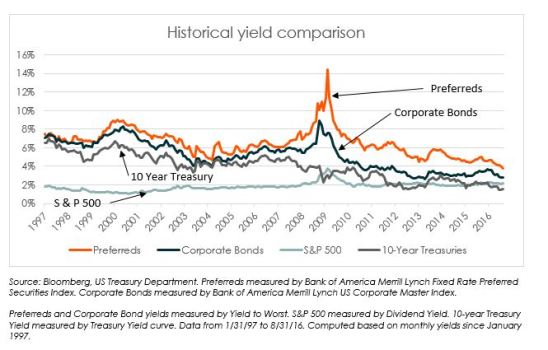
Check out the chart below, since 1997, the yield on preferreds has averaged nearly 2.4% higher than the yield of corporate bonds, and 5.7& higher than common stocks. There has not been a single year on this chart where stocks or bonds has yielded more than preferreds.

preferreds

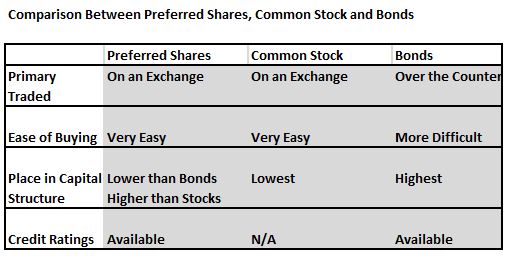
So how safe are preferred stock dividends, safer than common stock dividends. Preferred stocks are positioned between common stocks and bonds. See the chart below:

preferred-ranking

Most commonly preferred shares carry no voting rights but have a higher claim to earnings than common share and are usually less volatile than common. When the S&P 500 fell 37% in 2008, for example, the iShares preferred fund fell only 24%. Investors can easily choose from preferred stock ETF’s or individual stocks.

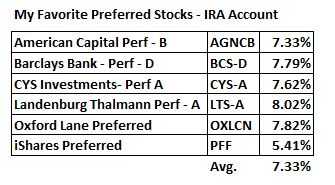
I happen to like the safety of financial based preferred stocks. Here are my current holding, they represent 28% of my IRA portfolio.

my-fav-pref

You are Richer Now Than Ever Before

rich-person

Do you feel richer, you should, at least according to the Federal Reserve.

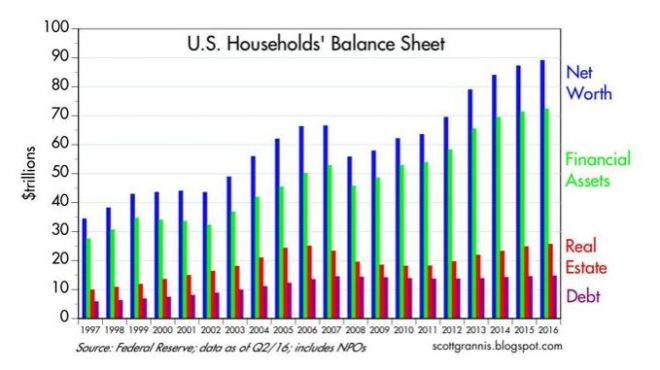
This month the Federal Reserve released its Q2 – 2016 numbers for the value of household balance sheets. This is what we are worth, all of our assets less our liabilities. This should be of interest since many people don’t feel as though they have recovered from the 2007-2008 financial crisis.

richer

The Q2 – 2016 numbers are the highest ever in terms of real and per capita terms. It is interesting to note that our “liabilities” or debt has not really increased since their 2008 crisis peak. In addition the real estate portion of our assets is just slightly above where it was in 2008.

So what does this mean?

  • The amount of debt we hold has decreased
  • The value of real estate is back to “bubble” level, but we aren’t in a bubble
  • Our savings rate has increased
  • Our investments have SOARED
  • Even in a very sluggish economy we are doing well

The question is …. have you been improving your “balance sheet”?

Understanding Dividends and Huge Tax Differences

download

You might pay $104 or $4,485 in taxes, just simply over the types and timing of your dividends. (See examples below.)

Even novice investors need to understand what dividends are and how they become taxable. There is a huge difference between dividend types in a taxable account.

  1. Type of Account: Any type of dividend earned in any “tax deferred” account such as an IRA or 401K is not taxable as a dividend. All withdrawals from an IRA or 401K are taxed as “ordinary income”. Only dividends earned in a taxable account are potentially taxable.
  2. Cash and Stock Dividends: There are two types of dividends, cash and stock dividends. A cash dividend is cash the company has on hand and transfers it to a shareholder. A stock dividend is an increase in the share count of the company, they must issue new shares, diluting to some extent the original shares. The stockholder gets more shares.
  3. Drop in Share Price: In all cases, when a company or fund issues a dividend the share price should drop to reflect the change in value, i.e. a 4% dividend paid on a $100 stock, should reduce the share price to $96. I say “should” because typically most stock prices adjust to their previous value shortly after the ex-dividend date.
  4. Tax Differences: Regarding taxes, not all dividends are treated the same. Dividends can be “qualified” or “non-qualified” dividend, non-qualified dividends are also called “ordinary dividends”. This makes a huge tax difference. “Qualified-dividend” get preferred tax treatment or no tax at all if you can find a way to stay in the 15% tax bracket. Keep in mind that if you are in the 10% or 15% tax bracket there is 0% tax on “qualified dividends” and Long Term Capital Gains. Ordinary dividends (not-qualified) are always taxed as ordinary income.
  5. Beware …. Bonds do not pay dividends, they pay interest. All interest is taxed as ordinary income. There are tax exempt bonds.
  6. Investments: Individual stocks, stock mutual funds and stock ETF’s can have dividends (standard and/or qualified).
  7. Standard or Qualified: You can easily research any stock and determine if it is a qualified or standard dividend. In general, most US companies that are normal corporations, your household name stocks, have “qualified” dividends. Stocks who’s company’s don’t directly pay taxes, or special stocks/funds like REIT, MLP, BDC, employee stock options, tax exempt companies etc. are all standard dividends (taxed as ordinary income).
  8. Know Your Dates: It’s important to understand two types of dates that will tell you when and how all dividends get paid and if you are entitled to them. In order to get a dividend you must own a stock, mutual fund or ETF on the Record date. If you are just purchasing a new stock you need to keep in mind that stock transactions are normally cleared in 3 days, commonly known as T+3. Therefore as an example, if you own a stock by 4PM on Friday, August 26, 2016 (the close of the market) the business day BEFORE the “ex-dividend date” Monday, August 29, 2016 you will get the dividend. In this case the Record date would be Wednesday, August 31, 2016. If you sold the stock on Monday, August 29th you would still get the dividend. If you bought the stock on Monday, August 29th you would not get a dividend. Even though you held a stock on the Record date, you won’t actually see the dividend in your account until the Pay or Distribution date.
  9. Shorts: For those of you that have a “short position” on a dividend stock over the ex-dividend date YOU must pay the dividend back to the exchange!
  10. How Long?: There is also a “minimum holding period”. For common stock, it must be held more than 60 days during the 120-day period beginning 60 days before the ex-dividend date. For preferred stock, the holding period is 90 days during the 180-day period beginning 90 days before the stock’s ex-dividend date. If you don’t meet the holding date requirement you lose the tax rate benefit on that specific dividend payment.
  11. Warning …. Some mutual funds keep their ex-dividend and distribution dates secret, only publish the dates a few days beforehand. This keeps people from buying and selling based on the dividend (or lack of dividend news).

Here are some tax examples for qualified and non-qualified dividends. I used a Social Security and W-2 Income examples:

Examples Div

The American Retirement Disaster – Do You Know Your “GAP”?

Retirement Disaster 2

Large segments of the American population are heading for a retirement disaster. No, I’m not referring to the viability of Social Security, I’m referring to the “Gap”. What is the Gap? The gap is the amount of savings/investments you will need in addition to Social Security and pensions to meet your retirement needs for the strong possibility that you will live to be over 90 years old.

Money Magazine published a 2016 survey on retirement and the results are SHOCKING.

56% of Americans Have Less Than $10,000 Saved for Retirement 

Two-thirds of women (63%) say they have no savings or less than $10,000 in retirement savings, compared with just over half (52%) of men 

74% of Americans age 60 and over have less than $260,500 saved

Savings

Let’s take a quick look at the 60 year old person in the above chart. Let’s assume this is a married couple, joint income of $60,000/yr. The assumption is that they will be able to live on 80% of their pre-retirement income. At age 67 they will be able to collect a total of about $30,000 in Social Security and retire.

Retirement Planning at age 67:

Social Security:  $30,000

Assume Savings/Investing $265,000

Emergency fund needed @ 6 months of expenses: $24,000

Available Retirement Funds: $241,000 (after Emergency Funds)

Annual income needed at 80%: $48,000

4% annual withdrawal from savings ($241,000 * 4%): $9,640

Results:

Needed Income: $48,000

Actual Income:    $39.640 (SS + 4% of Savings)

GAP: $8,360/year —– SHORTFALL or $250,800 over 30 years!

PLUS keep in mind that according to the above chart 74% of Americans are behind the Retirement Benchmark, which itself leads to a shortfall.

What can you do? Know Your GAP!

There are many online tools to help you discover your GAP. I can tell you from some research I’ve done, Fidelity Investments has an excellent Retirement Planning tools, https://www.fidelity.com/calculators-tools/overview

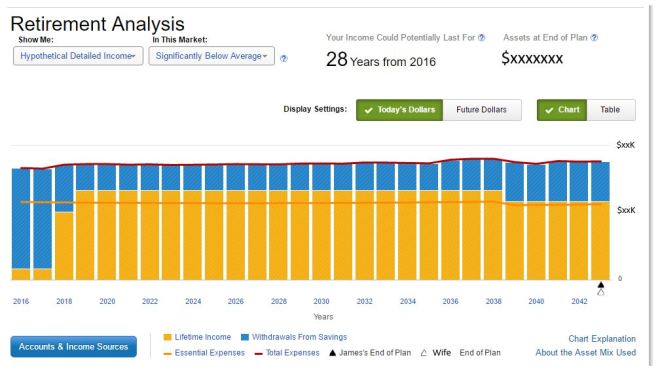
Here is an example of a Fidelity Retirement Plan Analysis. In this case there is NO GAP, and a surplus at the end of plan that might be passed on to loved ones.

Analysis Plan

In an upcoming post I’ll provide some suggestions for how to fill the GAP.

Top Problems Facing My CEO Clients – Part 3 Market Positioning

E,ploteeI consult with dozens of CEO’s from start-up’s to 20 years old small businesses, many of them have the same problems.

  1. How do I get access to capital? (click here to review)
  2. What do my financials really mean to me? (click here to review)
  3. How do I position myself in the market?
  4. How do I grow my revenue?

One could say that all businesses have more than one of these same problems. True, but small businesses make up the vast majority of the US economy and their issues tend to carry a huge weight on our daily lives. According to surveys 99% of US employers have less than 500 employees. Most of my established businesses have less than 20 employees and generate less than $2,000,000 in annual revenue. As a SCORE Mentor and Chapter Board Member I help my clients deal with these issues every week.

In this article I’ll just discuss Problem #3 – Market Positioning.

Whether businesses are in start-up mode or established and trying to re-invent themselves they typically have a challenge with Market Positioning. What kind of business do I want to be? What will be my “brand”, how will I be different? Almost like asking a college freshman, what do you want to be when you graduate?

Usually by the time we get to the market positioning stage of a consulting engagement, the CEO/owner generally knows the product and service that will be offered.

Here are some common discussion points that are typical problems:

  1. My business will be the cheaper/lower price provider, since I’m just getting started I can afford this as my market entry tool. I hear this most often, it is usually the worst strategy available. If you are going to launch a business as the low selling price competitor you are going to fail. You just can’t play the pricing game long enough to beat the “low cost” providers. You are going to sell a commodity price less than Amazon and Walmart, really?
  2. My business will provide a wide range of products and services, not very well defined. This too is a poor strategy. Competing with who? Most small businesses don’t have a lot of “bandwidth” in skills. Doing a little bit of everything, but nothing really well just won’t be successful.
  3. My business just wants a small piece of the large pie. This could be viable as a strategy but you must find a key differentiator or do a market study that show an unfulfilled need.

Here is what you can do, become unique, specialize, research:

  1. Instead of being the low selling price provider, become a “highest value” provider in a niche. Consumers will pay a premium for something that is both unique and an overall value.
  2. Do something highly focused, really, really well that other don’t do as well. Customers will pay a fair price for a better experience. Well defined boutiques can do well.
  3. Do your research, many franchisors do this quite well. For example, they have experience that shows when a new exit is built on a major expressway that a gas station and restaurant will generate good income and higher margins than the same businesses located 5 miles further down the road, in a less traveled area. If there is a growing population area, with a high traffic communing road, a dry cleaner might be a good business. Maybe the next available dry cleaners is 5-10 miles away. If you offer dry cleaning, add on alterations and drop-off for shoe repairs.

The last component of Market Positioning, might actually come before any of the above items come into play.

What kind of business do you want to be when you grow up?

  1. Build a Payroll Substitute In this business the owner is really looking to replace his previous pay check and enjoy a “life style” business. The owner doesn’t want to grow, manage and take the risk of a shooting start business, He/she would trade high growth for more flexible time, more company paid benefits, “business trip” vacations etc. Maybe even bring the kids and relatives into work there.
  2. Build a “feel good”, Socially Responsible These businesses are fundamentally a way to give back to the community. Doing good is just as important as making a lot of money. Many people don’t understand that a not-for-profit business can have administrative fees, and these can include substantial salaries for the owner. There are various guidelines involved, but these are not necessarily volunteer organizations.
  3. Build a Substantial Growth business, maybe even with a “sell the business” as an end goal. In this model, the owner is willing to take calculated risks, invest more money and bring in a higher level of talent right from the start. This CEO needs better business and financial plans along with the desire to work a huge number of hours to get the job done. Many time this business is the founders 2nd or 3rd business and he/she knows exactly what to do.
  4. Just Buy a Business. Keep in mind that the fastest path to achieving your goals might just be to buy an existing business. Sometimes the existing owner will be willing to work out a payment system instead of all up-front cash. There could be tax advantages.

The bottom line is that it is important that CEO’s of small businesses understand the Market Positioning and type of business they want to start or transform into. In the last article of this series I’ll cover the final topic, How to grow my Revenue.

You can research our Florida SCORE chapter here: https://pascohernando.score.org/


Understanding Baby Bonds – Exchange Traded Debt

bonds-letters_large

Most investors know how to invest in stocks, this is buying “Equity” in a company. You own a “piece” of the company. Few investors, other than institutions, know that you can also invest in a company’s debt. Investing in debt is much more secure than equity. Investing in a company’s debt is through buying its “bonds”. Most corporate bonds are sold in $1,000 increments in the Bond Market, a very unfriendly place as compared to buying stock on the stock exchange.  There is however another alternative, they are called Baby Bonds.

Exchange Traded Debt issues are known as ‘Baby Bonds‘. They are a safe and conservative investment that can pay you 5-8% interest. They are called Baby Bonds because most of the issues have a face value (par) of $25.00/share and generally are callable at $25.00 plus accrued interest 5 years from the date of issue.

Summary

  1. Baby Bonds are notes and bonds that trade on the stock exchanges just like regular stocks, instead of the bond market like regular Corporate Bonds. They have “ticker symbols” for easy look-up vs. CUSIP #’ that are unique to buying bonds in the Bonds Market.
  2. Most Baby Bonds are issued and callable at $25/share vs. $1,000/share for most Corporate Bonds
  3. Baby Bonds usually pay interest quarterly vs. semi-annually for Corporate Bonds
  4. Most exchange traded debt issues are ‘junior’ to the company’s secured debt and senior to preferred and common shares dividends. If there is a disruption in dividends Baby Bonds get paid before regular and preferred stock dividends.
  5. Baby Bonds have lower risk than common stock or preferred stock in the same company.
  6. Most preferred stocks are offered by banks, insurers, utilities and real estate companies. However Baby Bonds extend your choices to companies like Comcast, and Ford.
  7. A good share of the exchange traded debt issues are investment grade issues. This makes these issues a safer and more conservative investment by those that like preferred shares.
  8. As usual with bond investments, the issues pay you interest, which means that all quarterly payments are taxed as ordinary income rates, versus a “qualified” payment taxed at lower capital gains rates.
  9. A few Baby Bonds have a “survivor’s option” that may allow your beneficiaries to cash the shares in at par in the event of your death (example: IKJ from Bank of America).
  10. Some investors will like the Baby Bonds issues by BDC’s, Business Development Companies, These companies are required to maintain a 2 to 1 asset coverage ratio (determines a company’s ability to cover debt obligations with its assets after all liabilities have been satisfied). Furthermore no BDC has ever defaulted on a bond obligation.
  11. When buying any low volume stock, you must use a limit order and just wait for the sale to take place.

Here is an example:

Hercules Capital (HTGC), is a BSD, you can buy their stock today at $12.58/share and get a 10.50% yield. While 10.5% is a very nice yield, the stock like all other BDC’s is volatile. However, the same company has a series of Baby Bonds, one of them is HTGX. Its IPO date was 4/2012 at $25, it is a 7% yield, due 4/2019, and callable as early as 4/2015.

Here is a chart that shows the difference between buying the “Equity” as in HTGC stock or the “Debt” HTGZ Baby Bond. Note the big difference in volatility. The Baby Bond is a very “dull” investment, it just pays 7% interest each quarter.

Hercules Capital (HTGC) Stock vs Hercules (HTGZ) Baby Bond

HTGC

Here is an excellent resource to find Exchange Traded Debt

http://www.quantumonline.com/, Go to Income Tables —  Exchange Traded Debt

Also check out Dividend Yield Hunter; http://www.dividendyieldhunter.com/

Articles can be found in http://seekingalpha.com/

Here is a sample list of Baby Bonds

example


July 11, 2016 – Life as a Day Trader – Making a few Bucks

191rsejjt85zljpg

Summary:

  1. Market (S&P) Futures were up on the open, market would open strong.
  2. Gold (GLD) and Gold Miners (GDX) have both been volatile on high volume lately.
  3. The best trades are from 9:45AM to 11:30 AM, always looking for the 10 AM reversal.
  4. Use a “Candle” daily chart with 1 minute – 5 Minute timing.
  5. Used 50 and 200 Day EMA, watched S&P Futures Market and GLD on another screen

The Trade:
Bought 1,000 shares at $30.40, Sold at $30.65, profit $250 total time about 2 hours.

Initial Stop Loss set at $30.33 (loss of $70), Initial Exit order placed at $30.80 (gain of $400). Moved Stop Loss to Break Even after $.10 move, this changed the potential loss to $0. My initial trade had a potential for a $70 loss or a $400 gain, acceptable level of risk.

Gdx
Tips:

  1. Develop a trading plan and stick to it 100% of the time
  2. Don’t get greedy
  3. Always set stop loss exit trades on every trade.
  4. Only trade between 9:45 AM and 11 AM
  5. Make or loose and walk away after 11AM.


Top Problems Facing My CEO Clients – Part 2 Understanding Financials

download

I consult with dozens of CEO’s from start-up’s to 20 years old small businesses, many of them have the same problems.

  1. How do I get access to capital? (click here to review)
  2. What do my financials really mean to me?
  3. How do I position myself in the market?
  4. How do I grow my revenue?

One could say that all businesses have more than one of these same problems. True, but small businesses make up the vast majority of the US economy and their issues tend to carry a huge weight on our daily lives. According to surveys 99% of US employers have less than 500 employees. Most of my established businesses have less than 20 employees and generate less than $2,000,000 in annual revenue. As a SCORE Mentor and Chapter Board Member I help my clients deal with these issues every week.

In this article I’ll just discuss Problem #2 – Understanding Financials.

Small business CEO’s are best served by using financial management software right from the very start, for example QuickBooks. By using this type of software either by an employee or through an outside accounting firm, the CEO automatically gets important financial reports, the company’s “Financials”. The first step in “Understanding Financials” is to actually have access to them.

The issue I stress is that a CEO doesn’t need to become a “CPA”, however understanding financials, helps; a) spot trends, b) manage more effectively, and c) grow the business. The focus is to understand enough to analyze and take action. A great deal of “actionable” information can be gained by strategizing how your financial information is initially set-up.

The Income Statement
Understanding the Income Statement or Profit & Loss statement (P&L), is probably the 2nd most important report, after Cash Flow and Cash Forecast reports. I encourage CEO’s to start their business using Accrual Basis accounting vs. Cash Basis. Although the IRS allows small businesses to choose a method, starting with accrual or “modified cash” shows a much better view of a business’s performance. Besides, using something like QuickBooks makes this easy.

The very top of the P&L is Revenue and Cost of Goods (COGS). I suggest the segregating of revenue as much as possible and its associated costs of goods where possible. For example, in a services business track revenue and costs by various types of services, and then further separate out all product sales. Therefore when running reports you can easily see, at least, gross profit by type of service(s) and product(s). The ability to accurately determine costs that is unique to revenue vs. general business overhead is quite important. You want to potentially include directly related costs to “Cost of Goods”, vs. Expenses.

I tell my CEO’s the “best” kind of revenue is “reoccurring”, sell or contract once, enjoy it monthly. When possible find ways to provide on-going, auto renewing, contracted services. In a former business about 65% of my total revenue was “reoccurring”, enough to cover all business expenses except sales and marketing. We’ll talk more about this in a future article on “positioning a business”.

The income statement is somewhat meaningless, unless you also have a budget to compare to. Each line item should have a predetermined budget amount. The budget is normally done annually and the monthly portion is shown on monthly financials, similar with Year to Date (YTD). Comparison to budget, is “actionable” information, why are we over or under, what can we do about it.

The bottom half of the P&L is Expenses. The goal in every business is to continually manage and lower expenses as a percentage of revenue. A dollar saved in expenses is worth more than an extra dollar of revenue. The biggest single expense category in most businesses is payroll costs (salaries, taxes, insurance etc.). As business grow they need to add employees, managing this expense is the single biggest lever available to a CEO. Here’s a tip, unless you are in a really fast growth business, do not “let expenses chase revenue”.

Balance Sheet
For all practical purposes, CEO’s need to initially understand only a few items on the Balance Sheet (B/S). A Balance Sheet merely shows Assets, Liabilities and Paid In Capital (Owner Equity). Three items are most critical on a B/S: Cash – Asset, Accounts Receivables (A/R) – Asset and Accounts Payable (A/P) – Liability. Cash is exactly what is in your checking or other business accounts at the end of the accounting period. A/R is the total amount owed by customers, and A/P is money you owe vendors for products or services they have already provided billed or unbilled (accrued costs). Keep in mind that whereas cash is easy to understand, A/R and A/P need further analysis, that’s why they are “aged” on a separate report. The longer out on an aging report the A/R and A/P is, the more trouble you are in. Unless you have very unique business requirements, A/R should be kept as current as possible. If you are carrying accounts more than 30-60 days you have issues. In my past business I changed my terms of sale and specified ACH Debit as my standard method of payment, over 80% of my billings were paid in the month billed. One would look at my AR month end report and think we were in trouble, not so, it was all turned to cash.

That are the two biggest factors that affect AR? First, how you “train” your clients. If you allow them to pay in 60 – 90 days they will take advantage of you. If you call them 1 day after the due date they will get the message. Secondly, happy customers are much more likely to pay on-time. You can’t “make them happy”, but you can treat them really well, they’ll probably decide on their own to be happy.

Cash Flow Forecast
You notice that I’m not referencing a Statement of Cash Flow, but a forecast here. Yes, a cash flow statement is a very important tool, but it is “yesterday’s newspaper” by the time your read the report, it is too late to take action. For small company CEO’s, more important is your forecast for future cash requirements, usually in a spreadsheet format. You can easily build the cash forecast from both the statement of cash flow and your budget. It is a whole lot more comfortable for a CEO to have 3-4 months of cash on hand than to continually worry about making payroll.

The bottom line is that it is important that CEO’s of small businesses understand the key elements of their financials. Getting consulting services from SCORE or a business advisor may help you in your efforts. Once a CEO has a sufficient level of financial understanding he/she can focus on other key areas of the business. In future articles I’ll cover the remaining 2 Problems shown above.

You can research our Florida SCORE chapter here: https://pascohernando.score.org/


Top Problems Facing My CEO Clients – Part 1 Capital

Cash Flow   I consult with dozens of CEO’s from start-up’s to 20 years old small businesses, many of them have the same problems.

  1. How do I get access to capital?
  2. What do my financials really mean to me?
  3. How do I position myself in the market?
  4. How do I grow my revenue?

One could say that all businesses have more than one of these same problems. True, but small businesses make up the vast majority of the US economy and their issues tend to carry a huge weight on our daily lives. According to surveys 99% of US employers have less than 500 employees. Most of my established businesses have less than 20 employees and generate less than $2,000,000 in annual revenue. As a SCORE Mentor and Chapter Board Member I help my clients deal with these issues every week.

In this article I’ll just discuss Problem #1 – Access to Capital.

The number one reason small businesses fail is lack of capital. Most often this starts right from the very beginning when the CEO completely underestimates his/her cash flow needs for the first 18-24 months. I ask my clients to completely focus their initial understanding of financials on cash. Simply, do you have enough in your checking account to pay the bills? Developing a simple business financial plan showing revenue and expenses will help start the cash flow analysis, but as they soon find out “revenue might not mean cash”. This is often the case when a business extends payment terms, I’ll provide the products or services today and I’ll bill you tomorrow. Then guess what, the customer is slow to pay their bills and the new business owner learns a new term “accounts receivables” (A/R). The best “Access to Capital” is to get paid either in advance or immediately as the product or service is provided. In my former business, even dealing with larger institutions our standard method of payment was ACH debit, monthly. A/R was a bad “asset, I wanted cash. This, by the way, worked well and we were always flush with cash.

From a practical point of view, my smallest clients rely on good old fashion business credit cards to either provide 30 days of float or on-going credit, albeit at very high rates. They quickly learn that banks will provide them with 0% interest for say 12 months or so for either opening a new account or transferring an existing credit card balance over to them. Credit cards also provide both and audit trail and potential purchase discounts in the form of points or cash back.

Once a business gets established I encourage them to start working on a Line of Credit, specifically a Revolver. In a regular LOC, once the extended credit is paid down, it is not replenished and is therefore paid-off over a term. A RLOC, set’s a maximum amount and the company can draw against it “at will” as it makes payments. Most often a bank will ask for security to protect the RLOC, such as pledging assets or personal guarantees. Interest rates can be friendly based on the health of the business. A RLOC will require you to have a good set of financials and a relationship with the institution.

Most small businesses find it difficult to secure outright bank loans these days. Don’t misunderstand, banks in the US are sitting on huge stockpiles of cash, but are not willing to take the risk lending it to small businesses. The larger the business, more banks are will to lend to them. Large national banks fight over companies like Apple, Google and 3M, they offer low rates and highly customized services.

There are however avenues available for small businesses. For example, in my area we have Micro Loans available through the Pasco Economic Development Council (PEDC). In this case a small business works with a SCORE Mentor to develop a business and financial plan and fill out the required application that can then be submitted to the PEDC. The PEDC Loan Committee then meets with the small business to better understand their situation. Currently these loans can range up to $35,000 over 72 months at attractive interest rates.

Another source of business loans is the SBA, Small Business Administration. Although the SBA does not make loans directly to a business, they do act as a facilitator with SBA approved banks and other financial institutions. In many cases the SBA will guarantee the loans, usually the SBA is used if the business can’t qualify for traditional bank loans. Sometimes all the small business needs is a Surety Bond for example a contractor trying to bid on a job, the SBA can help with this. CEO’s looking for SBA loans can often just use the SBA LINC web site, answer a few business questions and start the process all on-line. One final comment about SBA loans, this is a government program and is subject to constant changes and modification of the rules. Not all banks partner with the SBA and provide these type of loans. In addition finding a bank and securing a SBA loan can take quite a bit of time.

The bottom line is that it is difficult for small businesses to receive access to credit to start or grow their businesses. Getting consulting services from SCORE or a business advisor may help you in your efforts. Once a CEO gets to a sufficient level of cash flow, the goal is to stay ahead of the curve. In future articles I’ll cover the other 3 Problems shown above, they too reflect back on Problem #1 – Access to Capital.

You can research our Florida SCORE chapter here: https://pascohernando.score.org/