Bitcoin Mining – May not be Profitable for most of Us

You’ve probably heard the stories of how a friend is “mining” bitcoins and making money. The bitcoin market is quickly changing both in the value of the coins and the ability to “mine” them at a profit. Recent reports have indicated that mining profits are currently less than half what they were in December 2017. So before you invest a few thousand in that mining rig, you might want to look deeper. Of course, the fact that the bitcoin itself is down to about $8,600 today (Coinbase) doesn’t help.

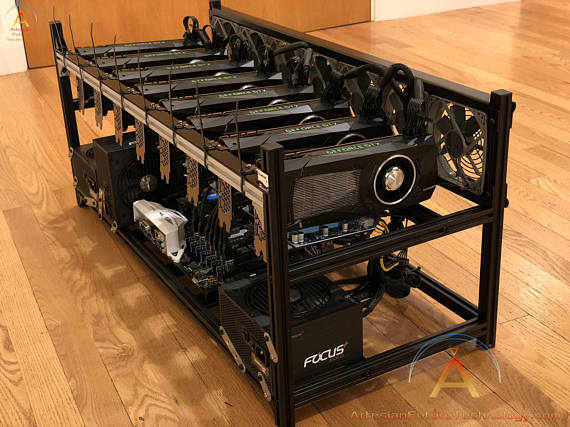
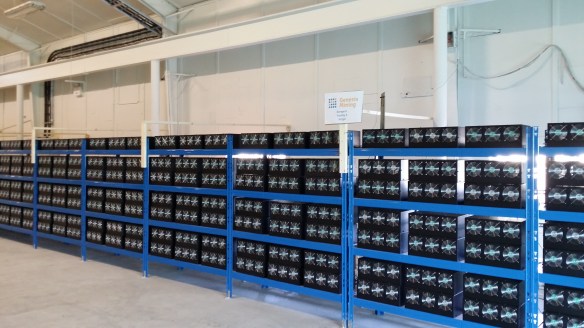
Today new bitcoins are created/earned through an energy-intensive “mining” process that uses high computing power to solve a complex mathematical equation. As a matter of fact, the equation is so complex that it is best processed not by a traditional computer CPU chip but by a multiple number of computer graphic chips (GPU’s). Graphic chips can do complex math because math is just a series of calculations that can be done in parallel, there is no “logic” type statements like a CPU handles (for example: if this, then this task). Therefore a current bitcoin rig is actually a simple computer motherboard, and a series of high level graphic cards with massive cooling. These are computer gaming cards strung together in a single “rig”. These rigs can then be slipped into large rack systems and become huge data centers. This complex math is called a “hash”, think of it as figuring a combination to a lock.

As time goes by there is a pre-established formula as to how many bitcoins will be rewarded for completing blocks. These reward rates are cut in half every 4 years, until all bitcoins have been used up. In addition, the more miners the more competition.

il_570xN.1487748259_paa6
An 8 GPU mining rig.

Cryptocurrency-Mining-Farm
A crypto mining data center.

The mining process help proves an anonymous miner used the process the network agreed upon to build a “blockchain” record of transactions. The successful miner who does all of this first then get a small fee and a tiny piece of a bitcoin as a reward for successfully completing the equation.

The average transaction fee mentioned above has fallen below 50 cents from as high as $34 in late December, according to bitinfocharts.com. If you are mining other currencies other than bitcoin the fee portion may be pennies.

If you want to make money mining Bitcoin or another crypto currency you need to compete with the big data centers. A bitcoin miner in China has very cheap electricity produced by hydropower. The rule of thumb to be able to compete with Chinese miners is to have electricity costs of 4 cents or less per kilowatt hour. Chinese miners also have an incentive to produce bitcoins regardless of cost because it allows them to send money overseas and evade the government’s capital controls. Four out of the five largest bitcoin “mining pools” in the world are Chinese, according Blockchain.com.

So before you go out and buy your bitcoin rig from Amazon:
https://www.amazon.com/Open-Mining-Stackable-Frame-Black/dp/B0777HCYVX/ref=sr_1_5?ie=UTF8&qid=1521833227&sr=8-5&keywords=bitcoin+rig

You might want to consider your electric bill, it will be huge and since you won’t be the first to solve the math equation, you probably won’t make any money after buying all of this equipment. If you are still interested you can Google search on various calculators to see estimates of income you can generate.

The Most Impactful Things I learned as a President/CEO – Part 1 – A Unique Focus on People

DSC00428
Preparing for a company meeting, we had a canvas wall covering made for the event.

I spent 30 years as a senior executive running software/service businesses. During those years I experienced almost everything imaginable from taking a tiny business from 8 to 100 employees in 5 years while going public and making INC 100 to rolling up a series of competitors to become a market leader.

During my last 15 years or so before retiring as President/CEO I made major changes in my own thinking which resulted in a complete business makeover. Most of this I learned not from seminars, books or consultants, but from my own employees and customers. They taught and I listened!

Unique Focus on People. Outsiders would always ask, what is your #1 priority, the obvious executive answer would be “the bottom line”.  I would always surprise them with “my people”. Sooner, rather than later, the success of a business will come down to its people. Over 30 years technology changed many, many times, we had multiple business cycles like the pre-Y2K boom only to then experience the 2000 market crash. Much of this was beyond my control, what I did control was our strategy and how we treated employees.

It was always my job to make sure that our managers were empowered to hire people that would fit our culture. I wanted to hire executives reporting to me that were smarter than me, at first I thought it was a little intimidating. I learned that if I was going to be the smartest person in the room, we were in trouble, I needed smarter people.

We gave people real jobs, held them accountable, and allowed them to do things they felt were “fun”. Our employees were programmers, business analyst, consultants, sales people and admin. By the way, we had NO secretaries or “assistants”! You wanted coffee, get off your butt and go get it!

Traditional turnover in technology is quite high. However, our average employee had been with the company for over 13 years, we had almost no turnover. Over the years we actually hired back many people who had left the company and wanted to rejoin. We weren’t the highest paying company, although our average salary was mid-upper 5 figures. In order to keep talented, high-performance people, we had a “fun factor”. We would ask an employee, what do you consider “fun work”, and then find ways to match them up with a job closely aligned to what was “fun” for them. If you just couldn’t have “fun” within our company, you belonged somewhere else.

It’s also about the environment, even first level managers could order pizza for their staff anytime they wanted. Every Friday was a company breakfast or lunch day. Once a month we had an “all hands” company lunch meeting across all locations with dial-in conferencing. Each department proudly presented their accomplishments, I provided the company’s complete financials, we had no secrets. I remember our annual kick-off meeting in January 2009, employees all knew friends and neighbors who were being laid-off, we were in a major recession. I told the company I had no plans for a lay-off, however they had to find a way to meet our profit goal for the year. You see, we had a profit sharing program (except executives), the employees got their profit share, before executives (including me) got our bonuses. My concern wasn’t the executive bonuses, but that the employees would earn their profit share that year.  Guess what, under difficult conditions, we again had a record breaking profit year, and the employees were very proud of the profit share distribution they earned. Employees came first, our #1 priority. Lesson learned, great employees will always make the CEO look good!

Annual Meeting of Staff. Every year we celebrated people who “stayed with the company”. You’ve probably experienced an after work party where a well-liked employee would leave the company and everyone would go out for drinks. I just could never get it, we are celebrating you quitting the team. I didn’t attend many of these events in my career. We did however throw an annual bash to honor those employees who “stayed with the company”. For every 5 year milestone with the company you were awarded a valuable gift that evening. This was always a catered event and it was a time for fun and games. The employees ran the event, I of course was always invited. Each year the teams would select a theme months ahead of time and then plan how every employee would get a novel award. We had a “Survivor” night after the TV show, a number of “super heroes” nights, etc. Each event was memorable.  Even our remote working employees were welcome to fly in and get honored. We would also invite the Chairman of the Board of our holding company and other holding company presidents. It was a fun time to “roast” our out for town executive guests. What was the message? We celebrate the people who stay with the company! I didn’t invent the Annual Meeting of Staff, but I made sure that ours was always memorable.

Awards
Years after retirement, I still cherish Annual Meetings of Staff “awards” I received.  

Training Clients & Employees.  I believed the more training people had the more they would excel and the happier they would be, and the same with my clients. The cost of training can be quite high, but there were ways to manage the costs and turn it into an investment. A key element of employee training is to first have well defined processes and procedures. People feel much more comfortable when they clearly understand the requirements of their job. We empowered employees and their managers to “own the process”. Here is what we need as the “output”, now tell us how to achieve it, let the team write their job descriptions and procedures.  Top down instructions are nowhere near as effective as teams just taking responsibility.

You will notice that I mentioned “training” clients, might sound a little strange, right. Not at all, we “trained” our customers what to expect from us, how to trust us. The customers knew that our teams would work around the clock, if necessary, to solve problems. Most of our projects were complex, yearlong engagements. These were major, mission-critical software implementations and detailed data conversions. We billed these clients both fixed fees and a lot of billable hours, but we didn’t “nickel and dime” them. I had a “no surprise rule”, if a client had a critical problem I wanted to first hear about it from my own staff, including our plan to resolve the issue. If a client ever felt the need to “call the president”, they would be impressed that I was already aware of both the issue and our plan of attack. I use to tell our customers, “if you ever get a bill from us that you think is unreasonable or a surprise, you call me immediately”! I seldom got calls, and we billed aggressively. Why no calls, the clients knew we were honest, hardworking people. The final proof of my happy-client story is that over the years we changed our terms of sale to be “payment by ACH – Debit by the 15th”. Meaning that we emailed bills to clients or they could download them from our web site, and on the 15th of the month we would reach into their bank account and pay ourselves for the entire amount of the invoice. Almost 50% of our cash flow came from ACH payments. We carried almost no accounts receivable. How many businesses could implement this program? You can if you have clients that trust you!

Perfect Attendance – The “Carriers”.  Many companies have “sick days” and the employees look at them as another form of “vacation days”. Have you heard, I think I’ll take a sick day today? Probably not sick, just needs some personal time off.  We didn’t have “sick” days, if you were sick, stay home. Yes, if you totally abused the policy the manager would come talk to you. We did provide a generous vacation policy. The costs to a business of employees being out “sick” can be pretty substantial. So, we invented the Perfect Attendance Club. If you had perfect attendance for the quarter you’d get a free lunch with the president in a conference room at one of the offices. The 2nd consecutive quarter the lunch got a little fancier, the 3rd quarter, we’d go out to a local restaurant for lunch. Now, if you had a full year of perfect attendance you would get recognized at the Annual Meeting of Staff and invited out to a very nice restaurant for an evening of “anything you wanted to order” and nice drinks. It was a major event. I use to enjoy my trips around the country doing these Perfect Attendance dinners.

The most amazing thing happened, people weren’t sick anymore! Every year we had a very high percentage of employees who made it to the Perfect Attendance Club. It was pretty much the same people every quarter and every year. We got the name “The Carriers”, we never got sick, we just “carried” the germs to all the others. In my 20 years with RainMaker I never took a sick day! If I was that sick, I’d use a vacation day, no way was I missing out on the “Club”! By the way, the costs savings to the business were substantial!

So what should a CEO’s #1 priority be? People!

They will teach, you just have to listen.

World’s Leading Oil Producer – USA …. Really!!

oil-refinery--678x381

This month U S oil production exceeded any other country in the world, yes  … including Saudi Arabia and Russia. The US now produces 10 million barrels a day and could hit a high of 11 million a day by the end of the year. This major change of events is due to US use of high technology to continually improve shale oil production, commonly called fracking. Where as many OPEC countries and Russia have cut back production to help raise the price of oil, the US has taken advantage of this gap to quickly add fracking drill rigs. The boom times are back for US shale oil, but this time the shale oil producers are cautiously watching their financials, to the delight of investors.

The US is slowly becoming a self-sufficient oil consumer, and over the next several years become a “net oil exporter” There are an estimated 7,000 additional shale wells that have been drilled but not completed, a tremendous backlog.

So what is the next step for US oil and natural gas …. major exports! Just recently the first supertanker pulled up to a Louisiana offshore oil port and did a test loading of oil. Once the process is tested and approved the US could export massive amounts of oil on these supertankers to lucrative overseas markets. These supertankers can carry 2 million barrels of oil and the Louisiana “LOOP” is the only deep-water port that can currently handle these huge vessels.

The US government lifted the ban on oil exports in 2015 and the gulf coast has responded with an increase in oil exporting. However, the use of supertankers takes this to a whole new level. In 2017 exports reached a high of 2 million barrels a day. China is the 2nd largest buyer of US oil after Canada.

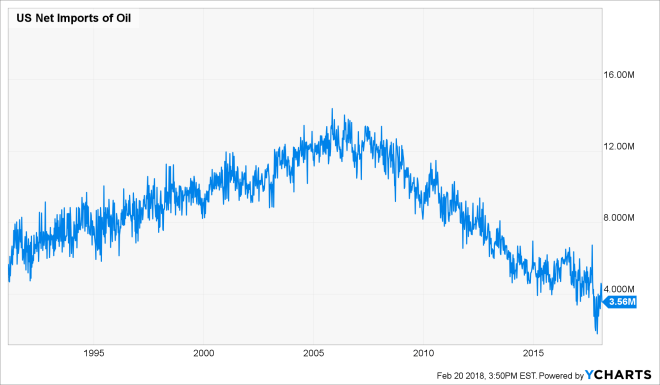
How far is the US from being 100% self-sufficient? Pretty close, currently the US is a “net importer” of oil at about 3.5 million barrels a day, that gap will close shortly.

Does this mean oil and gasoline will get cheaper for those of us in the US? No, probably not. The rest of the world set’s the price of oil and US providers have no incentive to discount the price of oil here at home when they can export it at a higher price. The good news is that at least the US is no longer being held hostage to OPEC for our sources of energy.

IUSNIO_chart

Getting “Called Away”!

rich-person

Just this last week I had my 3rd preferred stock or baby bond called away this year. I just can’t remember the last time I had a preferred or bond called away other than at an expiration date. Luckily it was a small position in my IRA, I had bought it at a discount under par a year or so ago and immediately sold it for a few pennies over the redemption price. I’ll take the 8% dividend. 

Here is the email from Fidelity:
preferred-called.jpg

As you can see the original call date was still 2 years out. So why would Star Bulk call this 8% baby bond (exchange traded debt), ticket SBLKL, which was trading at slightly above par? What they did was to anticipate a higher cost of future money and extend out the “loan” so to speak.  To do this they previously released a 8.30% senior note due 2022, ticker SBLKZ.  This new issue is callable on 05/15/2019, and matures on 11/15/2022. The transaction extended debt out 3 years at a cost of .3% extra on the interest side. 

The message here is that there is still a lot of money available even to companies out on the risk curve like Star Bulk by those of us seeking higher yields. These companies see interest rates rising in the future are willing to pay up now to lock in the cash they need. 

I took my proceeds from the sale and added to my position in Main Street Capital, ticker MAIN, a BDC with an excellent track record. The yield is a little lower but there is a lot of room for capital appreciation. Here is a pretty nice chart, and the chart does not include a 7% yield (including 1-2 special dividends every year)

Capture

GOP Tax Plan – What You Get & What You Lose

Tax Man

Here is a summary of the GOP Tax Plan, see what you lose and what you’ll be getting.

In almost all cases most of us will pay less taxes in 2018. All of this is of course subject to all sorts of changes. As of today here is a list of key items.

What you lose:

  1. All personal exemptions.
  2. All deductions are eliminated except for charitable contributions, mortgage interest (capped) and state and local taxes deduction (SALT) would be replaced by a property tax deduction with a $10,000 cap.
  3. Medical costs are no longer deductible.
  4. Adoption tax credit worth up to $13,750 per child.
  5. Tax preparation fees would no longer be deductible.
  6. Alimony would no longer be deductible by the payor for decrees issued after 2017. Anyone receiving alimony payments would still get it tax-free.
  7. Teachers can no longer write off the cost of supplies they buy.
  8. Sports fans would no longer be able to deduct 80% of the cost of donations to colleges if they are made only to become eligible to buy seats for games or get preferences such as prime parking spots.
  9. Moving expenses, moving 50 or more miles to take a new job is no longer deductible.
  10. Student loan interest is no longer deductible
  11. Repeal a rule that allows you to reverse or “recharacterize” Roth IRA conversions.
  12. Vacation or 2nd home mortgage interest deduction would eliminated.
  13. Tuition discounts for college workers would become taxable income.

What You Get, or Keep:

  1. $24,000 for standard deduction, married filing jointly.
  2. Lower tax brackets, married filing jointly, No tax on AGI $0-$24,000, 12% on AGI portion from $24,000 – $90,000, only 25% on AGI portion $90,000 – $260,000.
  3. Repeal the Alternative Minimum Tax.
  4. Maintain the “step-up” in basis, which allows heirs to receive stocks at the market value on the day the original owner died. For example, they sell immediately and pay NO taxes on gains.
  5. The American Opportunity Tax Credit (college costs) would be extended from four years to five, gives you another $1,250 credit for a fifth year.
  6. Same rules apply to dividends and capital gains.
  7. Small business “pass through” income maximum rate is 25%.
  8. 401K, IRA and HSA contributions can still be tax-advantaged.

One of my Favorite “SWAT” Retirement Stock – Reality Income (O)

Sleep Well At Night Stocks

download


Years ago I started planning my retirement, I tend to become almost obsessive over these things. I calculated that after I started receiving my Social Security at age 70 and a few small pensions that I would need about $30,000/yr. to fill my “income gap”. The “income gap” is the difference each year between my guaranteed income and my life-style income.

I also decided that I only wanted to use my IRA and never touch my taxable account that would someday go to my loved-ones. My taxable account is the result of years savings, good investment choices and the sale of a business.

As I got closer to retirement I wanted to make sure that my IRA could easily generate my “fill the gap” income AND let me “Sleep Well At Night”. I wanted to invest in SWAT stocks and ETF’s.

Here is a great example of one of my long time holdings, Reality Income, ticket symbol “O”. Reality is a commercial REIT, it pays about $2.54 per share in annual dividends.  This represents a dividend yield of 4.67%, a fair bit above the average dividend yield of 3.27% in the general financial sector.

The company just announced its 568th consecutive monthly dividend! Even during the Great Recession, the company paid its dividend! Furthermore, it has increased its dividend 93 times since going public in 1994. Pretty good track record.

This is what I call a SWAT stock.

Reality Income has about 5,000 freestanding, single-tenant properties located in 49 states and Puerto Rico, leased to 251 different commercial tenants, and doing business across 47 industries. I would say that this is pretty well diversified. These properties are leased under very long-term, net lease agreements with the average remaining lease term of 9.6 years.

Here is how Reality Income has done as compared to the S&P 500, see the chart below. It has outperformed the market for at least the last 10 years, and that Does NOT include the dividend!

This stock represents about 2.5% of my well diversified IRA portfolio. The portfolio generates about $38,000 a year in dividends and about 6% in total annual returns (dividends and price growth). I’ll publish more of my SWAT stocks in my IRA later.

O Stock

Why I’m Celebrating the 10 Year Crash Anniversary & President Trump!

Stocks

First I’ll tell you why I’m celebrating the stock market crash, then I’ll celebrate the President!

Ten years ago in 2007 the stock market peak, then proceeded to tank 40% and the economy went into the Great Recession. On March 9, 2009, the QQQ traded at $25.74, the bottom. QQQ is an ETF representing the NASDAQ top 100 stocks.

Many panicked, sold at the lows and vowed to never again risk their hard-earned money in the “casino” called the stock market.

However if you weren’t recently retired and forced to take out distributions and just stayed invested in good quality company’s your have done very well. Fidelity Investments just published information comparing retirement plan savers who stayed with stocks grew their investments by an average of about 240%, that’s about 50% more than investors who bailed out of stocks at any point in 2008 or the beginning of 2009.

What did I do in 2008-2009, when many of my friends thought I was totally crazy? Here is a list of things.

  1. I felt just as bad and went sleepless like everyone else. But I didn’t panic.
  2. I did sell off some speculative stocks as they kept going down. This was to me just good housekeeping. Even today, as a buy & hold investor, if the story changes on a stock I own and I don’t like it anymore I sell immediately!
  3. I knew that some day top companies would rebound. I kept all my core holdings both stocks and bonds. Many of these I still own today.
  4. I didn’t have to check because I had always maxed out on my contributions to my work 401K plan. Unfortunately because of income restrictions I couldn’t contribute to an IRA (pre-tax). Many people were cutting back on their contributions
  5. I started buying as much blue chip stock as I could afford, GE for under $8, Microsoft at $16, etc.  It was very painful at the time and I didn’t catch any of the lows. But by 2010 or so I was already up HUGE. Then as I re-balanced my portfolio I got wacked with significant capital gains taxes.
  6. Oh, by the way today the QQQ ETF trades for $151, an 600% increase over the bottom, not including all the dividends it paid.

So why celebrate, because I survived the 2nd worse recession ever, chances of another one like this in the next dozen or so years is pretty remote. Secondly, I didn’t panic and invested wisely. Today I use that same lesson to deal with the normal market craziness.

How did my business RainMaker Software do during this time? Actually pretty good. Early on in the downturn I clearly communicated to my employees, they were all afraid we’d have to cut  back head count or reduce salaries, that unless we had a real catastrophe I wouldn’t lay-off anyone. If some one resigned or retired we would not replace them. I then told them that they (the employees) had to find ways to reduce some expenses so that we still made our profit share numbers for the year. Free daily breakfast at the deli next door would get reduced to Friday only, etc. The bottom line was that my team really stepped it up, so much so that we had record profits in 2007 and thereafter. We never missed a single management bonus or employee profit share payment. Happy employees do wonders for a business, I always knew they had the answers to all of our problems, many CEO’s would just never listen. I listened closely.


A Message to President Donald Trump
Dear Mr. President,

I voted for you, I wanted a business man to be president for once. So far I’m not happy with you being on Twitter (I’m not).

However, I couldn’t be happier that since you have become president my investments are up over 25%! This is with all the crap that is going on in Washington and all the fake news.

I’m also hopeful that if you can get a tax reduction bill through Congress, lower corporate tax rates, allow corporations to bring home about $3 trillion in cash my investments will compound by another 25%. That too would make me very happy.

Keep up the good work Mr. President as dysfunctional as it may appear.

A Buy & Hold Investor,

Jim Hammond


Understanding Dividend DRIP’s and Total Returns

download

At our community Investment Club meeting last week a member asked for a description for how DRIP programs work for dividends. Answers were provided and I thought this would be a good topic to write on since there are some misconceptions. 

If you are an investor you should understand what a DRIP is, an automatic “dividend reinvestment plan”. Let’s take a look at your choices in dealing with stocks, ETF’s or mutual funds when it comes to dividends.

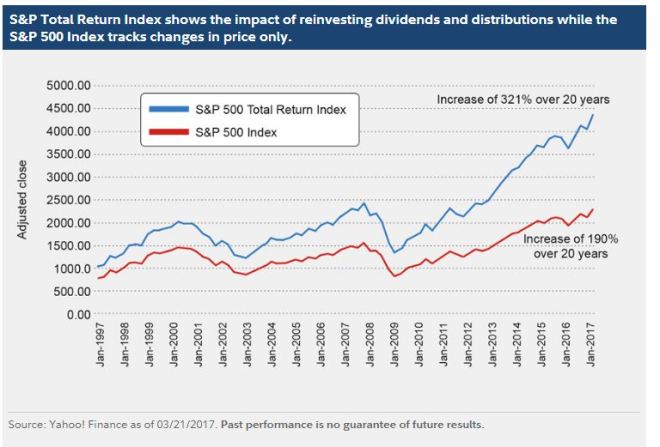
Dividends offer long term investors with the opportunity to improve their total returns over time. How important are dividends, check out this chart showing “returns” from 1997 to 2017, for the S&P 500 index.

Total returns

When dividends of the S&P 500 were reinvested back into the index the power of compounding took over and increased the total return from 190% to 321% over 20 years.

A DRIP (dividend reinvestment plan) will allow you to automatically have your brokerage provide you with new shares of stock, instead of a cash dividend deposited into your cash account. 

Let’s look at a simple example of how this works. Let’s say you have a stock with a current price of $40/share and this quarter you get $150 in dividends. Most of the time, the amount you receive as a dividend won’t divide evenly to buy only whole shares with nothing left over. Therefore your dividend reinvested will buy 3.75 shares. The brokerage adjusts the number of shares you own in whole numbers and shows a 0.75 fractional share. At the next dividend date, if the same thing happens you will be credited with another 0.75 share. It will look a little strange to see that you own 103.75 shares of Apple, but your broker will handle all of this.

Now, behind the scenes it isn’t your broker doing all of the work, in fact the company/fund/ETF you own shares of must have a DRIP program in the first place. Most do. Your brokerage just makes it easy for you to participate, most not charging any fees or sales commissions on the new shares.

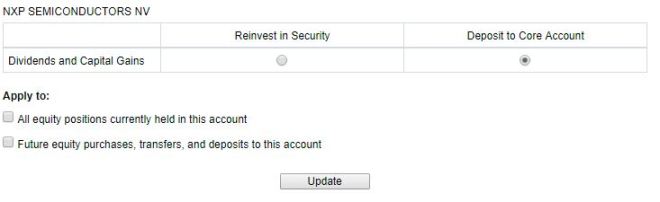
How difficult is it to set up a DRIP for your stocks, funds or ETF’s, it should be very simple. Here is an example on my Fidelity account:

Div -1

In Fidelity just go to Accounts/Trade – Account Features – Brokerage & Trading – Dividend and Capital Gains. This will show you, by each account which stocks are eligible for DRIP’s.
Div -2

After selecting a stock, just choose “Reinvest in Security” and choose Update. As you can see in the above example, on NXP stock I have DRIP turned off, therefore all dividends are just deposited into my cash account.

I noticed that the majority of my dividend stocks and ETF’s had DRIP capabilities. I also noticed that none of my preferred stocks allowed it and a few BDC’s did not allow it either. 

Benefits of DRIP’s:

  1. It helps buy more shares of an investment.
  2. Compounding dividends may help you reach your investing goals.
  3. Your brokerage house will track your “costs basis” on all new shares for determining tax treatment (in a taxable account) when you sell any shares.
  4. Most brokerage houses, like Fidelity do not charge any fees or commissions on this transaction. If you have a lot of dividend stocks, over a period of time this is a substantial costs savings.
  5. Company’s save cash by providing dividends as shares of stock. 

Why You Might Not Want To DRIP:

  1. By using DRIP you give up the ability to reinvest dividends in another stock or fund, for example you may already have a full allocation in Apple and want to use the dividends to buy something else.
  2. You may need the cash, for example in your IRA you’ll want to maintain a cash balance to handle your RMD (required minimum distribution) withdrawals.

Tax’s:
There is no free ride on dividends held in a taxable account. When dividends are awarded to you, whether in cash or as additional shares you will owe taxes on them. If you are sensitive to paying taxes on dividends and capital gains for mutual funds in a taxable account you may want to consider receiving your dividends in cash and reinvesting yourself into a more tax friendly investment. For example, a mutual fund or ETF may provide a high percentage of its dividends as regular dividends (not Qualified Dividends), these regular dividends are taxed at your ordinary income level, vs. the special rate for “qualified dividends”.

In any case a conservative investor may want to hold a sizable portion of their portfolio in dividend generating stocks and reinvesting the distributions to enhance the Total Return.

It’s Really Simple Why The Rich Get Richer – Others Don’t

Growth

There are some really simple reasons why “High Net Worth” people get richer faster than middle or lower net worth people. Much of this disparity has to do with the tax system we’ve had for years now. In addition we continue to get confirmation that, “high earners” save a much higher % of their earned income and are less effected by inflation over the years. Those still working that earn more today will probably earn much more tomorrow, those down the income scale will see flat increases.

Conclusion – the faster you build your net worth to a higher level, the better off you are in having that net worth increase faster than people with lower net worth. Also being a high income earner isn’t necessary enough!

High Net Worth is defined as having $1 million – $10 million in liquid assets, we won’t include home equity is this definition since it is anything but “liquid”. Notice I’m also differentiating between “high income earners” vs. “high net worth”.

Let’s first look at some anomalies in our tax system and understanding how to build wealth. Here is an example.

A CEO makes $300,000 in annual income, a retired high net worth person shows $300,000 in income. Do they pay the same amount of tax this year? Absolutely not, the working person’s income is taxed based on normal brackets and pays over TWICE the amount of tax on the same amount as the retired person. Why, the retired person is holding his money is tax beneficial vehicles. His income is a combination of Social Security (only taxed at 85% max.), capital gains, qualified dividends, muni-bonds, inheritance, etc.

Right after World War II the top dividends tax was between 70 – 80% (wow!). Then President George W. Bush’s tax cuts dropped the top rate on dividends by half.

See the table below to see how taxes on Investments has drastically changed over the years. Today we have a pretty good thing going.

Taxes

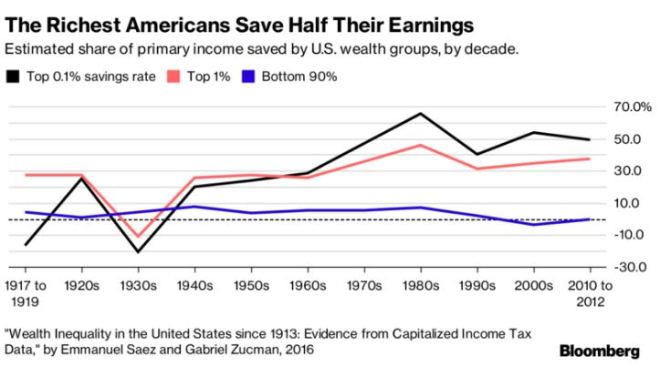
The old adage “the more you make, the more you spend” isn’t true for everyone. The richest American’s save a far higher % of their income than the bottom 90% of our population. As a matter of fact, 90% of our income earners by and large don’t save anything at all.

Savings

In mid-September the Census Bureau released its annual report on household income data for 2016. Last year, the median (middle) household income rose to $59,149, a 4.1% increase over 2015 and a record high. The mean (average) household income set a new high of $83,143.

So, you would think that we are all doing pretty well then, everyone is getting “richer”, these are all time high’s. But wait, let’s adjust for inflation using the Consumers Price Index based on 2016 dollars. Now we see a much different picture of wage earners in different quartiles. Even if your household is in the 2nd Quartile, making $95,000 in 2016, your after inflation “income growth” has been flat for many years. If you are in the $200,000 – $400,000 income range you have seen much higher growth!

Income

No wonder Warren Buffett, CEO of Berkshire Hathaway said, “Through the tax code, there has been class warfare waged, and my class has won”.

So what is the bottom line? Earn more money, save more money, smartly invest more money and get to High Net Worth as early as possible. The 1st million of Liquid Net Worth is much harder to reach than the 2nd million, 3rd million etc.!


Don’t Be Worried – The Fed Unwinding Balance Sheet

untitled

At last week’s Federal Reserve meeting as expected the Fed announced that they would start unwinding their $4.5 trillion balance sheet in October. Some are worried that this will have a harmful effect on our “sugar-high” economy. This is just a subtle form of tightening – taking money out of the market. Probably nothing to be concerned about.

Here is a simple explanation of how all of this works. Since the great recession, our Fed has been buying both Treasuries and mortgage backed securities from Frannie Mae and Freddie Mac. Now they will stop buying new securities as the old ones mature and sell off some additional ones. In effect the Fed “created” the cash to buy these out of thin air in the first place, therefore a method of adding cash to the banking system. When they stop and start selling these securities, cash comes out of the system, therefore tightening. There is too much money in the system today, it needs to bleed out slowly to more normal levels.

Frannie Mae and Freddie need to sell their new securities to someone or the home mortgage market crashes. This however is not a problem as there is about $2.2 trillion sitting idle around our banking system. The nice interest rate paid by these two always draws interest, and they are 100% insured by the US Gov’t. Our Fed will probably unwind the balance sheet down to maybe $3 trillion over the next 4 years and hold steady. That’s a measly $300 billion a year. This is just part of the normalizing process. This winding down does not affect the Fed’s overnight interest rates or its slow increase.

Some Americans had been quick to panic that our Fed was holding way too much on its balance sheet in the first place, but this is not the case. So our Fed holds $4.5 trillion as the world’s largest economy, however the Peoples Bank of China hold $5.2 trillion, the European Central Bank holds $5.1 trillion and Bank of Japan holds $4.7 trillion! Considering the US is by far the world’s largest economy, by a wide margin, our % of balance sheet to GDP is way down. Furthermore, we are tightening, and they are continuing to pump more cheap money into the global system. We are in pretty good shape!

So where else will huge chunks of cash come into our economy from? The rest of the world of course. As other nations choose to either buy their national securities at negative or .5% interest rates, they can buy the US 10 year at 2.25 -2.5% yield. This is exactly what will happen, it’s often called the “carry-trade”. Borrow money at very low rates in your country like Japan and use that cash to buy US treasuries, pocketing the difference as profit. This has been going on for many years.

So, what does this mean to all of us workers and retirees? Our economy is strong based on fundamentally good corporate earnings worldwide, especially in the US. With this very slow unwinding and equally slow Fed rate increases over the next several years our GDP growth will remain equally as slow, inflation almost non-existent and overall stock market returns muted. The fixed income market will continue to be lower yielding!