A Conservative Way to Enhance Your Income – Selling Covered Call’s on Your Existing Stocks

Concept for good investment

Concept for good investment and money making

In my last posts I explained how Selling Put’s can be used by the conservative investor to buy stocks at a lower price, or how to make an income selling them on a regular basis. See the articles here and here.

In this article I’ll talk about how a very similar process, Selling a Covered Call on your existing stocks to enhance your income.  It’s called “Covered” because you already own the stock in your account.

Summary

  1. When you “Sell a Covered Call” you give someone the right to buy your existing stock at a certain price (Strike Price), while collecting an immediate cash premium.
  2. Conservative investors use this trade to enhance their income on stocks they already own, like getting an extra monthly dividend.
  3. Using Facebook (FB) stock as an example. I already own Facebook in my account, it has been a great performer. Today April 29th Facebook is trading at $116.50/share, after a recent jump in price.
  4. I’m looking at the May 20th $121 Call Option, it pay me a premium of $1.07 per contract (100 shares).
  5. Therefore, if I Sell these Call’s I get $107 immediately in my account per contract. I am looking for the price of FB to be below $121 by the May 20th , the Expiration Date.
  6. If the price of FB is at or above $1210 on May 20th I must either sell my stock, or just buy out of my Call position.
  7. Another way to look at this is if my shares get “Called Away”, I will get $5.57/share in profit. $1.07 was the Call Option Premium, plus $4.50 from the price increase from $116.50 to $121 per share. That is a 4.8% return in 30 days or about 57% annualized.
  8. My favorite web site shows that this trade has an 73% chance of “expiring” which I want it to do, and my return is .91% for 30 days or 15.81% annualized.
  9. As a sanity check I check out the FB stock chart and see that the stock is trading at about an all-time high after a recent increase.
  10. This might be a nice safe little trade.

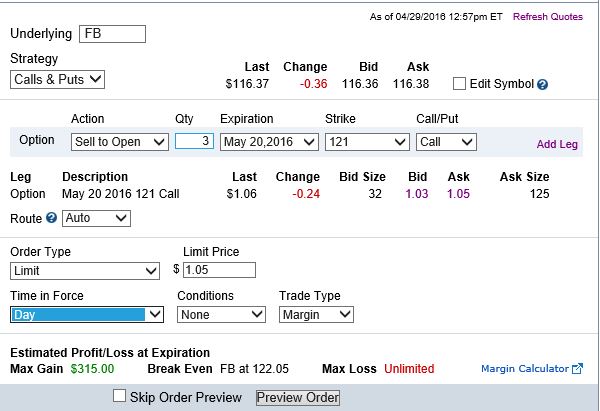
Here is what a Call contract looks like in your account. This contract is FB 160520C121, it looks cryptic but it’s actually easy to understand. FB (the stock) 160520(Expiration Date of 05/20/16), C121 (means a Call with a $121 Strike Price).

Here is what a Fidelity order entry screen looks like for a 3 contract transaction.
FB Call Order.JPG

I always double check my Call Options trades with my favorite Options site: http://www.stockoptionschannel.com , here is what it said.

Options Channel FB.JPG

Here is what Facebook’s stock chart looks like:

FB Chart

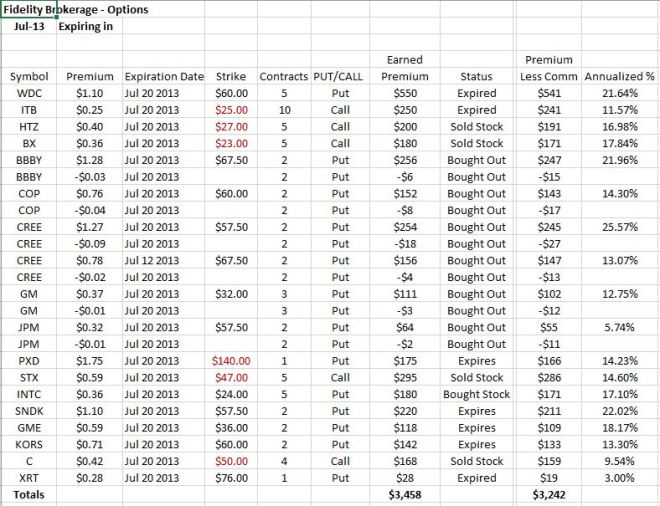
So, can you make money doing this, yes, once you understand it. Here is a copy of my monthly Options Trading spreadsheet for July 2013. You can decide how much risk/reward you are willing to take. Look at the Call Options.
Example of Trades


How to Make a Living – Selling Put’s for Income

Options

In my last post I explained how Selling Put’s can be used by the conservative investor to buy stocks at a lower price during almost any market conditions. You can read that story to better understand how Selling a Put works.

In this article I’ll talk about how to either make a living or supplement your income by Selling Put’s for a profit.

Summary

  1. In this case we want to Sell Put’s on stocks what we just want to collect the premium on, and not necessarily want to own the stocks.
  2. Using Regeneron (REGN) stock as an example, the current price today April 20th is $400/share.
  3. I’m looking at the May 20th $360 Put’s, paying a premium of $5.50 per contract (100 shares).
  4. Therefore, if I Sell these Put’s I get $550 immediately in my account per contract. I am looking for the price of REGN to be at or above $360 by the May 20th Expiration Date. This is roughly 10% below the current selling price.
  5. If the price of REGN is below $360 on May 20th I must either buy the stock, or just buy out of my Put position. My favorite web site shows that this trade has an 81% chance of “expiring” which I want it to do, and my return is 1.42% for 30 days or 17.24% annualized.
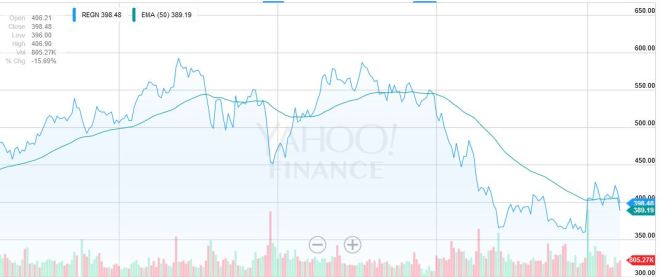
  6. As a sanity check I check out the REGN stock chart and see that the lowest price in the last 12 months has been about $359 and the stock has bounced off its bottom and is above its 50 EMA.
  7. This might be within your risk tolerance.

Here is what a Put contract looks like in your account. This contract is REGN 160520P360, it looks cryptic but it’s actually easy to understand. REGN (the stock) 160520(Expiration Date of 05/20/16), P360 (means a Put with a $360 Strike Price).

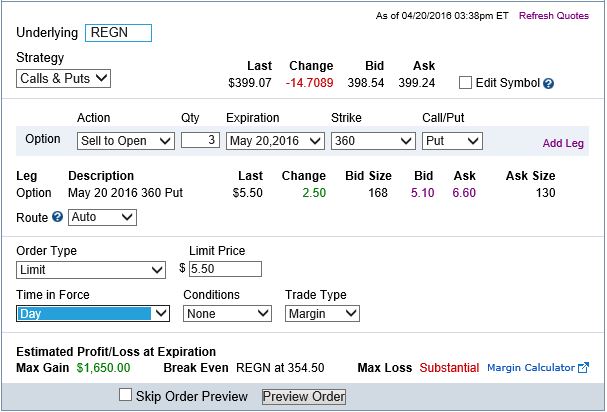
Here is what a Fidelity order entry screen looks like for a 3 contract transaction.

REGN Fidelity Pic

Here is what the REGN stock price chart looks like, notice the move above the 50 EMA live, a positive sign.

REGN Chart

I always double check my Put Options trades with my favorite Options site: www.stockoptionschannel.com , here is what it said. This trade has an 81% chance of “expiring” worthless, which I want it to do, and my return is 1.42% for 30 days or 17.24% annualized.

Stock Options Channel

So can you make money doing this, yes, once you understand it and manage your risk. Here is a copy of my monthly Options Trading spreadsheet for July 2013. You can decide how much risk/reward you are willing to take.

Example of Trades

You’ll notice that the above sheet also shows some Call Options, I’ll explain these in a future article.


Get Paid to Buy Stocks at Lower Prices – Selling PUT’s Explained

Options

Selling Puts (Options) can be used by a conservative investor to either buy stocks at a lower price or generate income during almost any market conditions. In this article I’ll talk about buying stocks at a lower price.

Summary

  1. As a conservative investor, you can get paid to buy your favorite stocks at lower prices.
  2. Using Apple stock as an example, the current price was $109.34/share, I wanted to buy it at $105/share, I made $116 in 2 weeks waiting for it to drop.
  3. In this case it did not drop to $105, so I got to keep the $116 and try again. If Apple would have dropped to $105 or less by my Expiration Date, I would still keep the $116, and my order would have been processed for 100 shares of Apple @ $105. My actual cost for the Apple stock would only be $103.84 ($105 less $1.16).
  4. This process is quite simple, it’s called “Selling a Put” option
  5. One Options Contract is 100 share of stock

Here is how it works: 

Selling a Put – This pays you an immediate Premium ($$) for agreeing to buy shares at a future date (Expiration Date) at a specific price (Strike Price). You cannot lose the premium, you get it immediately posted to your cash account. The Put allow you to buy your favorite stock at a lower price and get paid until it hits your price. Selling a Put is also called “Writing a Put”.

Here is what a Put contract looks like in your account. This contract is AAPL 160408P105, it looks cryptic but it’s actually easy to understand. AAPL (the stock) 160408 (Expiration Date of 04/08/16), P105 (means a Put with a $105 Strike Price).

apple.png

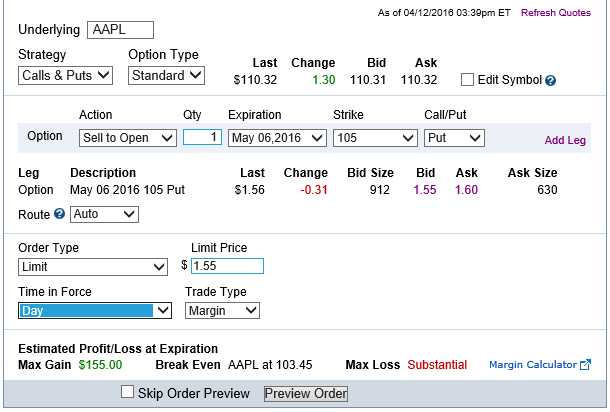
Here is what a Fidelity order entry screen looks like.

Order Entry

  1. The top portion shows the current stock price for Apple (AAPL).
  2. The Action is “Sell to Open”, this means you want to open an options position, by “selling”.
  3. Quantity is the number of Options contracts, keep in mind that an options contract is always 100 shares of a stock. 1 contract = 100 shares of Apple.
  4. Pick an Expiration Date, this is when the contract will expire, on these kind of trades I usually keep the date to 3 – 6 weeks.
  5. Strike (price) is the price you’d like to buy the stock at, in this case I’d like to buy 100 shares of Apple at $105/share, it was $110.32 at the time.
  6. Notice the Bid and the Ask Price. This is the amount of premium you will get, you’d like the highest amount you can get. I always use a Limit Order and wait for a decent price.

In my next post I’ll discuss how to use Selling Put’s as a way to make additional income, assuming you don’t want to actually own the stock, just collect the premium on each trade.

What Small Business CEO’s Do Wrong

Business plan

Summary
Business of all sizes need clearly defined business and financial plans. The business plan needs to identify why the company is in business, a customer profile, what differentiates the business from competitors and what the metrics for success are for the next two years. For a start-up this can be a 5-6 page document. As a business gets much larger as in my former software business this became an annual “event” with all employees involved and a 25-30 page notebook.  

The financial plan can be as simple as a monthly cash flow projection over the next 18 – 24 months. Seek help with this plan since you’ll need to factor in the offsets to cash collections for accounts receivable and credit card transactions. A revenue projection model needs to be reasonable and achievable. The CEO needs to make sure he/she eventually understands both a simple Income Statement and to some extent a Balance Sheet. As a company get larger, the financial plan flows up from both the costs and revenue centers of the business where mid-level managers take responsibility for their areas.  

I spend a fair bit of my time mentoring small business CEO’s and entrepreneurs as a Score Mentor and Board Member. Most of these businesses are very small, usually under $2M in annual sales.  

The single biggest shortcoming these business owners face is the almost complete lack of both a business and financial plan. Most of these owners do a fair job on the sales and operations side of their business. This allows them to initially maintain a “survival” mode, they found a way in most cases to become cash flow positive. However, their ability to maintain survival mode and then grow begins to deteriorate as they experience the normal changes that take place in the market. In more established businesses the CEO has already experienced and survived these expected changes. A benefit of a small business is flexibility, it’s easy to modify product and service offerings, redeploy people and get decisions made.  

When I meet with new start-up entrepreneurs, they typically want to discuss things like; how do I set up an LLC, how do I maintain “cash accounting” books, what records do I keep, and so forth. These are quite easy to answer of course. What’s a little harder for the business owner to do is to; clearly identify a mission statement, provide an exact profile of their proposed customers, define exactly what their business differentiator is, provide an analysis on why their competitors have been successful, and so forth. 

Small business owners and entrepreneurs can easily get help with these issues and many more by locating their nearest Score organization and meet with a certified mentor.


What Should You Be Doing In The Stock Market Now?

The major stock market indexes, S&P, Dow and NASDAQ continues to rebound from the 10% correction of late 2015 and first two months of 2016 back to about where they were on January 1st. If you were like me I upped my cash position to about 15% in late 2015, as I saw the market correct. This is the largest cash position I’ve held for years.

Lately I’ve been buying back into some of my favorite stocks, or those on my list. I tend to be a longer term investor in any stock unless the story changes or there is an entire sector decline that drags them down. If a stock gets into trouble I sell 3-5 days after the first big drop, there is usually a bounce back before heading lower.

Now is the time to just sit tight, hopefully you didn’t sell in a panic earlier this year, you would have missed the 10% rebound.

Here are some of my thoughts:

  1. Don’t pay Federal Taxes if you can help it. Since I won’t start taking my Social Security until I’m 70 (2 years), I basically live off of my savings and therefore pay $0 Federal Taxes each year, this also allows me to convert an certain amount every year from my traditional IRA to my ROTH IRA. This is easy to calculate, just add your standard deduction and exemptions on your 1040. Tax rates are higher than savings rates, makes sense, no taxes.
  2. Always have your shopping list ready to go. I keep a list on my desk of the next 5 – 10 positions I want to add, some are current holding, others are new names that I’ll buy if I can get a good entry point. For example, I got out of Apple in December at about $115, I had a huge gain that I needed for tax reasons. I’ll wait until Apple sits around $105 – $110 for a while before I get back in.
  3. My strategy is to generate more interest in my IRA’s annually than is needed for my MRD beginning when I hit 70 years old. I’ll never touch the principle.
  4. Forget trying to pick a top or bottom in a stock, it’s only a fool’s exercise. Only buy on an upward chart (daily chart) and then only buy on a market down day.
  5. I’m careful to always keep tax ramifications in mind when deciding to buy or sell in a taxable vs, tax deferred account. My ROTH IRA account only has high yield equities in it.
  6. Other than a single ETF I do not have any bonds in my portfolio, I however have plenty of high yield preferred stocks, REIT’s and BSD’s in my IRA. If corporate or government bonds ever yield 5-7% again, I’ll start “laddering” my bond purchase and forget about them.
  7. I almost never buy mutual funds, I prefer ETF’s. CEF’s (Closed End Funds) bought at a discount to NAV without energy exposure and with high yields look pretty attractive right now, look for 7-8% yield.

Below is my current Sector Allocation, you’ll notice that I like strong Consumer stocks followed by the combination healthcare and Biotech’s. I’m completely out of all Financials until the Fed Rate starts to increase again.

Capture

Preferred Stocks – 7% – 9% Safe and Stable Income

Barclays Pre

The stock market has been very volatile for the last 6-9 months. So, what is a nice safe investment to add to your portfolio?

As I wrote in a previous blog posting, “This Stock has been flat for 3 years – You’ll just love it!” preferred stocks can generate a very nice yield and still have a margin of safety.

Most investors don’t understand preferred stocks. Preferred stocks are positioned between common stocks and bonds. Most commonly preferred shares carry no voting rights but have a higher claim to earnings than common share and are usually less volatile than common. When the S&P 500 fell 37% in 2008, for example, the iShares preferred fund fell only 24%. Preferred shares are next in line to bond holders in the capital chain of any company. Investors can easily choose from preferred stock ETF’s or individual stocks.

I happen to like the safety of bank preferred stocks.

Here are my favorite preferred stocks:

  • Ladenburg Thalmann Financial Services (LTS-PA) 9.75% yield
  • Barclays Bank (BCS-PD) 7.7% yield
  • Wells Fargo (WFC-PL) 7.5% yield, AND a convertible option

Please note that most preferred shares are lightly traded and the best thing to do is to enter a limit order with your price and let the order come to you.

By allocating a portion of your portfolio to some of these high-yielding investments you’ll be able to improve your cash flow while waiting for the next Facebook or Apple investment to come along. In future posts we’ll discuss the pros and cons of these investments and some helpful tips.


Kicking Off 2016 – How to Build Your Required Minimum Distribution Plan

To DoWe are all faced with the dilemma of taking Required Minimum Distribution from our IRA accounts when we turn 70 years old. If you have accumulated large IRA’s (including transferred 401K accounts), this can be a problem.
  • First you may not need the approx. 4% annual amount you are required to take out
  • The RMD when added to your pension and Social Security might put you in a much higher tax bracket, Social Security might be taxed at a higher rate
  • You have to pay income tax on the RMD as “ordinary income”, not getting any preferred tax rate break

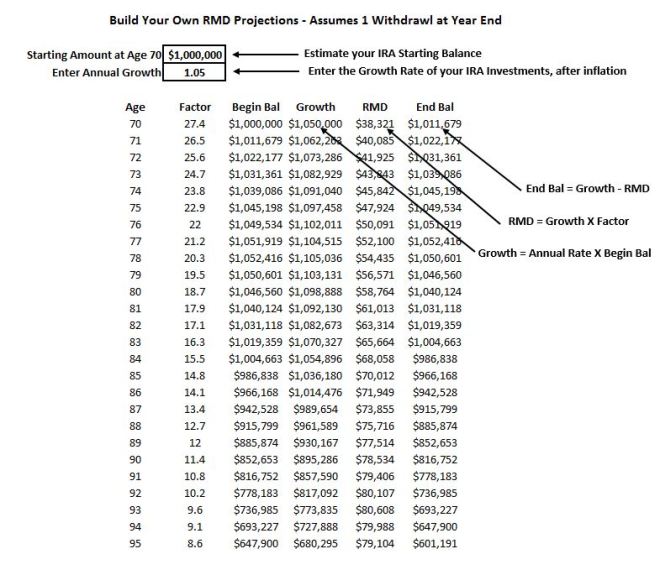
So, here is how you can build your own RMD spreadsheet to project exactly want your annual withdrawal might be, including the ability to analyze “what if” possibilities.

You might want to adjust the Annual Growth Rate to be something conservative.

The “Factor” shown in the model is from the IRS.

RMD Model


Dealing with the IRS in 2016

1040

There are changes in 2016 as to how you can deal with the IRS to improve your tax filing experience.

  1. Thankfully, in 2016 if you actually try and call the IRS you might get through to a real person. In 2015 only 38% of all calls actually reached a person at the IRS, even after very long wait times. An astonishing 8 million calls to the IRS in 2015 ended in what they call a “courtesy disconnect”, they just hand up on you. Thanks to a getting an additional $290 million from Congress the IRS plans to hire about 1,000 additional people. I guess that is good news, but if you just start hiring them now, how experienced will they be this tax season to answer your questions?
  2. Did you know that the IRS provides access to FREE TAX FILING SOFTWARE and electronic submissions? It’s called the IRS Free File program, check it out HERE. There are some income restrictions and the IRS estimates that 70% of all taxpayers will qualify for the free software.
  3. It is in your best interest to get your taxes filed electronically as soon as possible, especially if like me you live in Florida. Why? Well we’d all like to get refunds faster, but the real reason is to combat identity theft. About 110 million taxpayers will file for a refund this year. In 2013 about 1 million fraudulent filings were made and these were worth $5.8 billion! The IRS says they are getting better at spotting fraud, we’ll see. In prior years the IRS accepted fraudulent returns from people who deposited up to 50 tax returns checks into the same exact bank account! This year the limit is 3 deposits into the same account.
  4. Tax audit rates will continue to drop again due to budget issues. More bad news is that when the IRS does an audit it is usually 2-3 years behind and difficult for the taxpayer to recall all the details.

My Top 12 Income Producing Stocks for 2016

Those of us who are retired or near retirement are looking protect our investments with well-diversified portfolios. A portion of my tax deferred portfolio, is dedicated to income generating stocks, no bonds at this point, to help handle the MRD that will kick in when I turn 70 ½ years old. My preferred holdings are good stable businesses that I’ve come to trust over the years, they basically don’t go up or down. In 2015 I started again adding mortgage backed REITs like AGNC to my other long time REIT holdings. My newest edition in 2015 was Nordic Atlantic Tanker, with the world awash in oil and no place to store it daily tanker rates are going sky-high. 

Here is my list of Income producing stocks for 2016.

Income.


All Investors Must Read This and Act Immediately – or You Could Have a Nasty Tax Bill

IRS%20Tax%20Bill

Summary:

  1. Since 2015 has been a very volatile stock market and year to date the overall market is about flat. This means a lot of buying and selling, but little gain.
  2. This puts investors in a position for a major tax shock from large distributions but flat performance.
  3. You will get socked with a hefty capital gains distribution that is taxable, but your overall investment might be flat or down.

What to Do Now:

  1. Examine mutual funds in your taxable accounts, looking for early December announcements that show expected distributions.
  2. Decide whether you are better off selling your stock for a gain or loss, before the distribution
  3. DO NOT buy any mutual fund just before a distribution date, “normally called buying the distribution”, it can be a big tax mistake.

Here is a classic example from last year:

Fidelity Select Biotechnology Portfolio (FBIOX) is a well-respected mutual fund consisting of popular biotech stocks such Gilead, Biogen, Alexion etc.

Let’s say you bought 300 shares of this mutual fund in February 2014 @ $226/share = $67,800

On December 4, 2014 the stock price was $239/share, a $13/share gain

However on December 5, 2014 Fidelity declared a capital gains distribution of $23.84/share, you received $7,152 or another 30 shares. You now own 330 shares. Due to this distribution on December 5th the stock closed at $218.42.

Therefore on December 5th you have 330 shares @ $218.42 = $72,078

Your total investment went up by $4,278

However you will pay Capital Gains tax (possibly short-term gains) on $7,152, and you haven’t sold any shares yet.