The Real Yield on Bonds – You’ll Be Surprised

Dividends

If you listen to listen to conventional wisdom (I don’t) and invest a fair portion of your portfolio in bonds you’ll need to understand how to calculate the real yield, not what a broker or financial advisor can advertise.

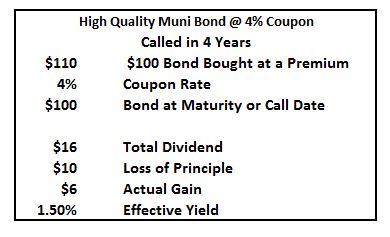
Your financial advisor suggests that you buy a high-quality Muni Bond, because of its quality you of course pay a premium, $110. This is not at all unusual. The bond coupon is 4%, your financial advisor is allowed to advertise this rate, and you’ll make $4 a year. This looks to be a pretty good yield and a safe investment. You might also notice that today Barclays Muni Bond Index yields 2.2%, you’re getting a better deal with no additional risk.

Maybe not, let’s do some math.

Bond

You have owned this bond for 4 years. Each quarterly brokerage statement shows a 4% yield and will show that you are getting your portion of the $4 annual dividend. Now the bond gets called early or matures and you get back $100. In the 4 year example your actual gain was only $6, or 1.5% yield.

Here is what you need to know.

  1. Brokers and financial advisors operate under an industry self-regulator called Municipal Securities Rulemaking Board and it allows them to the yield based on the bond sale price on each statement.
  2. A mutual fund or ETF falls under federal accounting and tax rules and will report the yield based on what you’ll actually get.
  3. If you buy a bond ask your broker or advisor to calculate a “yield to worst” return. If he/she won’t do some math yourself.
  4. Check your bond for a “callable” date, if it is still many years out it may help in your calculations.

It always pays to become educated in what you’re investing your hard earned money in.

DIY – Save a Lot of Money on Simple A/C Preventive Maintenance

01b62e9ad701256ff08622a5a0187e59cf39c3795c

This posting is a departure from my normal financial and retirement planning articles.

Simple A/C repairs can cost you a lot of money. Just recently my A/C Company quoted me $175 to replace each capacitator, I have two units, I bought them for $20/ea. on Amazon and installed them in less than 20 minutes with simple tools. I did both units for a savings of $310. Last year I replaced my A/C power contacts for an even larger cost savings.

My house has two separate central A/C units, upstairs and downstairs. These units are about 10 years old and seem to be running OK. However, there are some common replacement items that can improve the life of your units. These replacement items are easy to install, even for the novice DIYer.

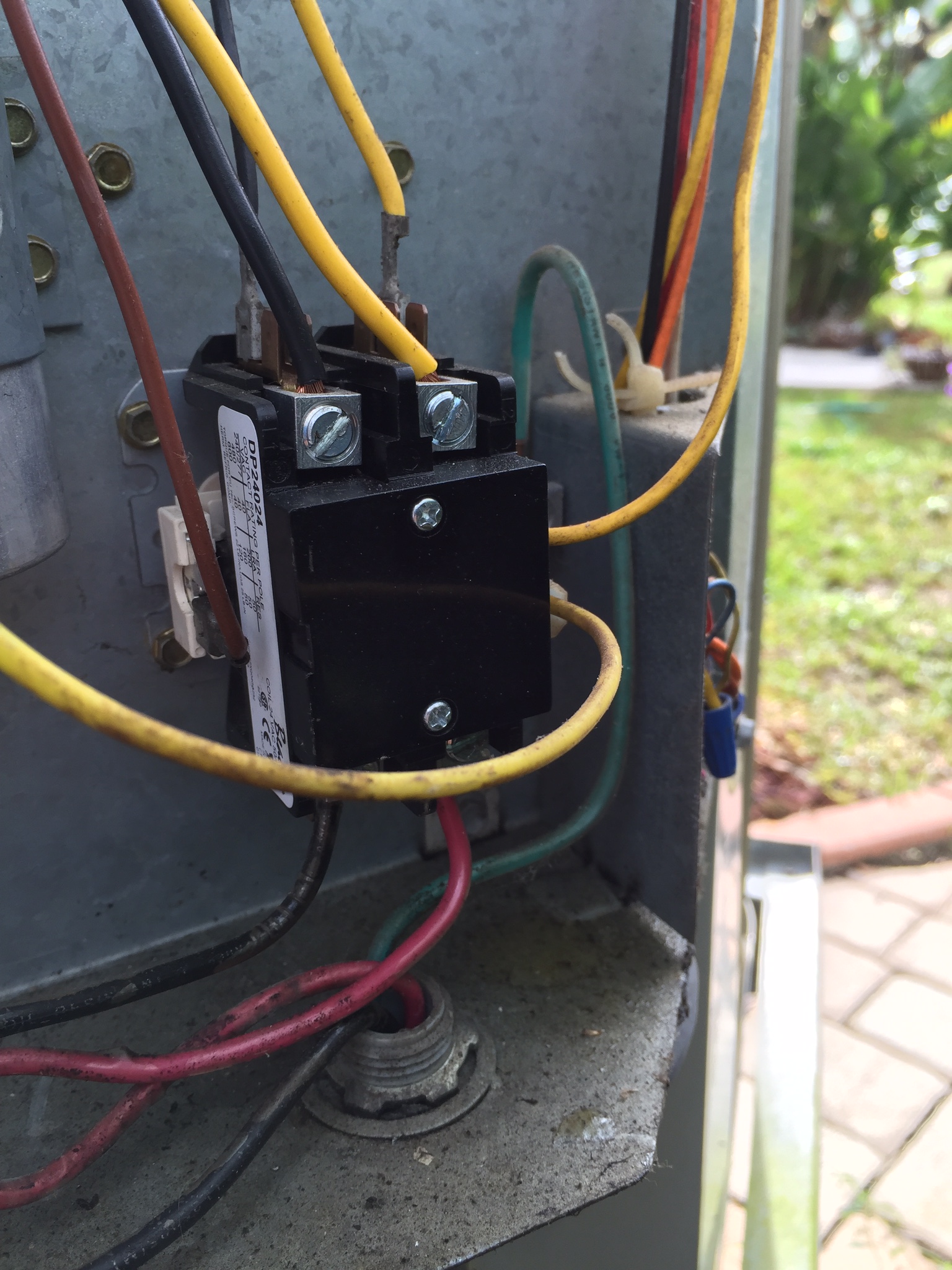
Last year I replace the main power contactors, these turn on/off the main power to the compressor and the cooling fan. My units both had 24 volt coil, 2 pole, single-throw contactors with specs that allowed me to shop for equivalent parts, I found Beacon Components brand, but could have used other brands. These contacts open and close every time the A/C unit cycles on and the actual contact tips will burn-off over time. This is probably the #1 electrical maintenance item on an exterior A/C unit. Here is the contactors I replaced last year.

01dd4b29a92da76e5c609d2fd001e22a02d43144e5

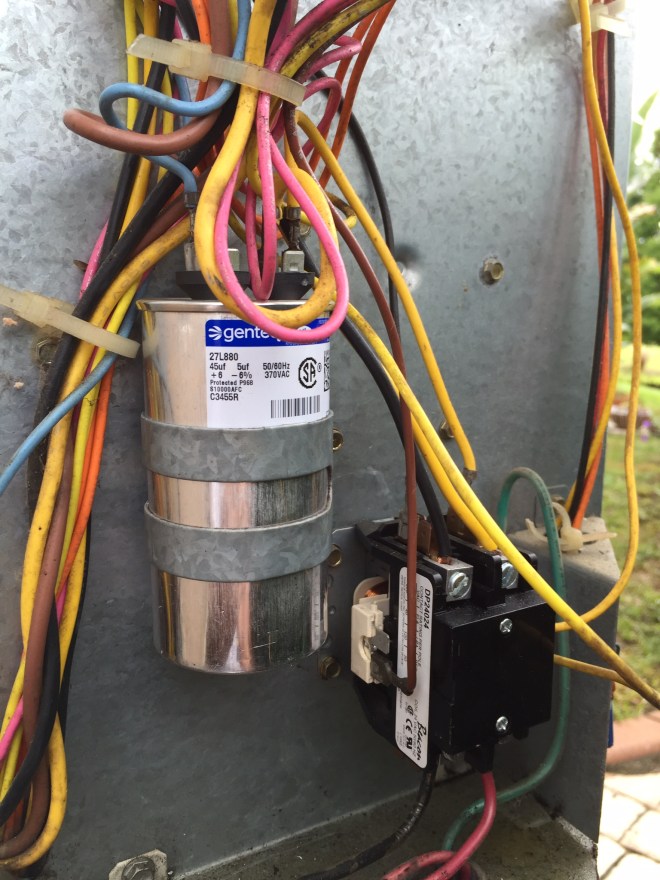
Today I replaced my two capacitors. Probably the 2nd most replaced item. What does the capacitor do in you’re A/C unit? A capacitor is like a storage battery, it charges and stores electricity, then when prompted it quickly discharges with a lot of power. This power is used to start an electric motor spinning so that the normal windings in the motor can take over and keep it turning. The same thing happens with a compressor. If you ever hear you’re A/C unit “humming” but the fan isn’t moving, or if your air is on but not blowing cool air, you may have a bad capacitor, or bad contactors. Over time capacitors, like contactors will deteriorate and need to be replaced. You will probably find that your A/C unit has a dual capacitor, to start-up both the fan and the compressor.

Here is how to replace the capacitor.

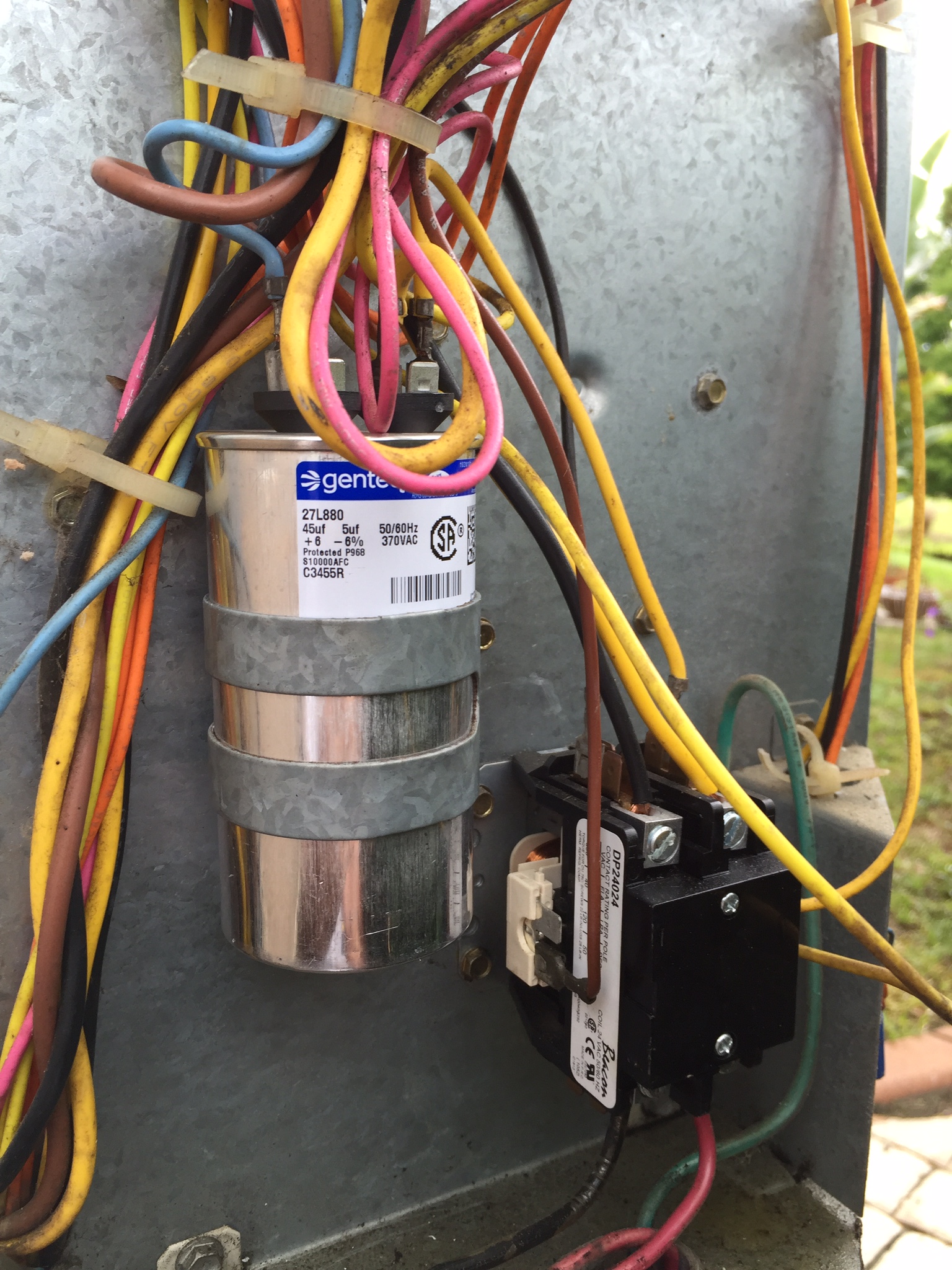
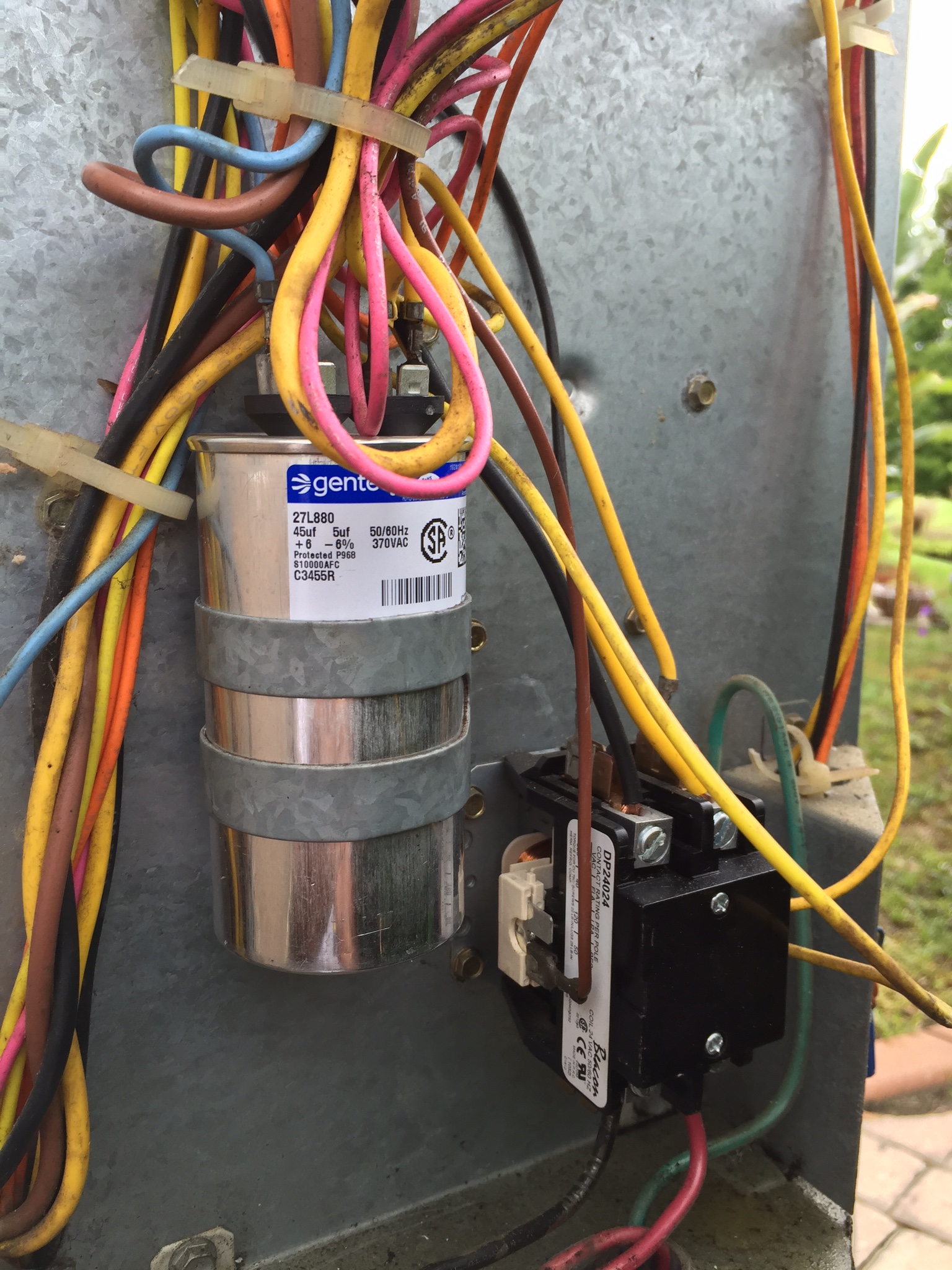
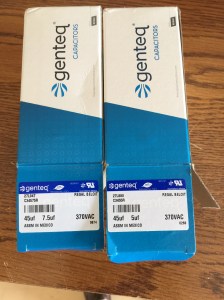
  1. Buy the Right Replacement Part. Take pictures of your current capacitor with your phone and use this picture to buy the equivalent capacitor on line. Capacitor are specified by voltage, most air conditioners and heat pumps have compressor and/or fan motors that require either 370VAC or 440VAC to start. Mine were 370 volts. Another measurement is called micro-farad, make sure the replacement capacitor has the same micro-farad ratings (shown as MFD or μF) as your old one. For dual capacitors, the capacitance is shown as “45/5” or “45+5” MFD, which means the compressor side is rated at 45 μF and the fan side is rated at 5 μF. Each of my capacitors were slightly different. Amazon had them both. See pictures.
011a237b713a47b6bf155e8a94de7e81222699e06d

2. Turn off the power. I do this two ways, at the temperature thermostats in the house I change the mode to “off”, I also pull the external circuit breaker for each unit. See picture.

018dbf1ed17ea7c2ef1fdda4d15bc350f21cbc742a

3. Remove A/C side panel where the capacitor (and contactors) are located. Now, before touching the capacitors wires it’s important to ground the terminals first. Remember, capacitors charge electricity, just take any screwdriver and touch each of the top 3 connectors to each other and to the steel on the A/C unit itself. Your capacitor may not be charged, but I never take this chance.

01cfd2e2d29f773b9295b57249c4e289353e890447

4. Take the screws off the metal housing that holds the capacitor in place. This will allow you to carefully remove the wire clips to the terminals on the end of the capacitor. Mine were marked Fan, C (common) and Herm (hermetically sealed compressor). I took a picture with my camera to make sure I got the wiring straight.

017b545bd0e31bc76de05dc978cd9fb214dc26cd6f

5. Just plug the wires into the terminals on the new capacitor, reassemble the metal housing back on the A/C unit, put the panel back on, re-insert the circuit breaker and you are finished.

You just saved a bunch of money and the frustration of having you’re A/C unit fail at the worst time.


7 Steps – 2015 Year End Tax Planning

Taxes

If you are like me, you are either retired or close to it. One quick shock on the day you retire is that you no longer have that pay check you’ve been use to getting most of your adult life. If you’ve done a good job of planned your retirement in advanced you can be celebrating instead of worrying. While in retirement you can set new goals, one of might be to pay the smallest amount of federal income tax as possible. Is it possible to appear “poor on paper” yet live a comfortable lifestyle? Yes!

Here are some items for your consideration.

  1. Manage your 2015 tax bracket. For example, if you just started receiving Social Security this year, consider returning it and delaying payments till you are 70 ½. There is no penalty for doing this. Some of this will be taxable. This might give you a chance to live off savings (cash) while paying little if any tax.
  2. Contribute the maximum amount you can to an HSA account, this will provide a credit to your Taxable Income.
  3. If possible, maximize your deductible items such as medical expenses by getting those new eye glasses, dental cleaning and so forth this year instead of early next year. Consider prepaying your property taxes.
  4. One big issue can be stock market opportunities in your taxable account. With the recent volatility in the market consider selling stocks, ETF’s or fund’s with short-term losses. These losses can then offset gains. You can also carry forward a maximum of $3,000 into future years. Just make sure you watch out for a “Wash Sale” on stocks sold for a loss if you put this money back to work in the market. When you use a loss to offset a gain you also get the benefit of re-setting your “cost basis” for the stock. This will benefit you if you buy back and then sell this stock for a gain in the future.
  5. Also regarding your taxable brokerage account, try and maintain “qualified-dividend” stocks which get preferred tax treatment or no tax at all if you can find a way to stay in the 15% tax bracket. Keep in mind that if you are in the 10% or 15% tax bracket there is 0% tax on “qualified dividends” and Long Term Capital Gains.
  6. If you’ve done a good job being “poor on paper”, you can also convert some of your IRA into a Roth IRA. Just keep an eye of your plan so that you don’t jump into a higher tax bracket.
  7. If you hold Equity Mutual Funds watch for the December “Distribution Date”, consider selling before that date if a large capital gain is expected. Otherwise you will be surprised by paying tax on a distribution you don’t actually get (the fund price, in theory is lowered by the distribution amount).


The Right Way to Buy Stocks and ETF’s

In an earlier post I discussed how to avoid problems when buying Mutual Funds. In this posting I’ll discuss the best way to but stocks and ETF’s.

 Let’s examine how people normally buy a stock or ETF, they just enter the number of shares and hit “Buy”. This is what is called a “Market Order”. You agree to buy at whatever the current “ASK” price is. Here are some suggestions on how to buy at the right price regardless if you are a short term or long term investor. 

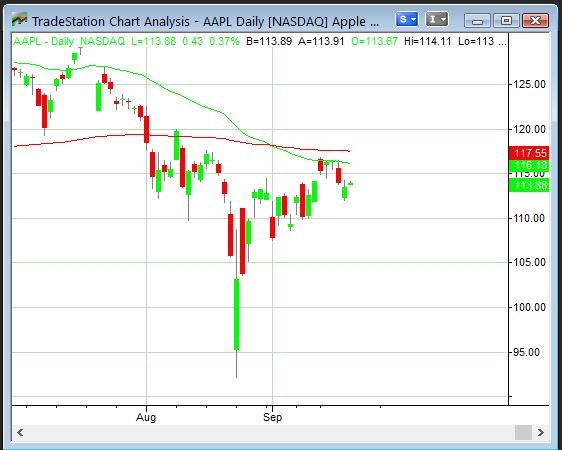
Do not place a buy or sell order after hours or over a weekend. Early morning volatility can be huge. Large institutional blocks can get moved during the 1st and last hour of trading every day. This results in the little investor, you and me getting our orders priced at a less preferred level. Take a look at recent Apple trading ranges in just 1 day.

AAPL 

Here is a morning spread showing market large gaps between the “Buy and Sell” prices for a common stock.

Bid-Ask 

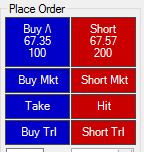
Always use “Limit Orders” when buying and selling. A Limit Order allows you to specify an exact price you want to buy or sell at. It provides some level of protection. For a long term investor you can easily place an order for your “watch list” stock at a recent low and just wait for the price to come down. You can choose “good till canceled” GTC to wait for your price.

Here is an example of a Limit Order.

Limit Buy


Warning – Understand Cut-Off Times When Buying Mutual Funds

104018545

A lot of investors in the last week or so have been very disappointed when they tried to buy mutual funds late in the day to capture great bargains, only to find out they didn’t get them. 

Here is what you need to know. Mutual Funds are priced every day at 4PM. You decide that want to buy 100 shares of a mutual fund and you place an order at 3PM, one hour before the market closes. The current price that day, the NAV was down to $100/share, you think you just paid $10,000. However, you check back a few days later and notice that the “buy” price was actually $110/share, 10% higher. How could this happen? Easy, you need to understand the CUT-Off time for both your broker and the actual fund.  

For example, here is the policy on the Ameritrade web site. Trading Cutoff Times “Cut-off times for the purchase and redemption of mutual fund shares can vary from 2 p.m. ET to 4 p.m. ET, and are subject to change at any time. Orders placed after the cut-off time will be processed the following business day” 

So you might place a mutual fund order at 2PM on September 8th, thinking you’ll get the 4PM price that day, however you might actually get the 4PM price on September 9th at 4PM. In the meantime the market has either dropped or rallied substantially. 

Stocks and ETF’s are not like this, they are priced and confirmed within seconds of order execution. Actual Bond are altogether different and much more mysterious.

Maximizing Your Marketing Dollars

images2G2Y9O4C

Although I don’t profess to be a marketing guru, I have spent a good deal of time in my 40 years of work experience drafting or approving marketing budgets and coming up with creative strategies to stretch the value derived from the dollars spent. Here are some observations I have made in my own business that have helped to take a more hands-on and individual approach to marketing. I hope these practical strategies help you as well.

  1. Make Sure to Measure This is listed as point #1 for a reason. So many businesses blindly run marketing campaigns because, a. it’s the way it’s always been done and, b. because it’s an afterthought. Measuring responses through to new clients will help you keep track of each initiative while justifying the effort and dollars spent.
  2. Social Networking is Worth It I’ll start out by saying most social networking mediums are free. With this said, it’s imperative that a business doesn’t take a carte blanche approach and slap whatever they feel like up on the web. Make sure what you communicate via LinkedIn, Facebook, Twitter and blogs is educational, valuable and most important consistently done.
  3. E-Communication From the mid-1990s on, e-newsletters and digital communication has become a leading way to get in touch with prospects. The only downfall is obvious; people are sick of it. This is why targeted messaging is so important. Avoid poor execution and watered down information by knowing your audience(s). Educate them, don’t “sell” them.
  4. Try Some New Stuff Many businesses are afraid to branch out a bit and go outside the norm. Although I’m not advising that you throw away all sense and decorum and send out smoke signal messages in the center of Times Square, sometimes utilizing existing mediums to “test” new concepts such as special event invites or a survey may be the best way to see what works without blowing the budget. It’s also easier to track success rates and interest this way.
  5. Repurpose and Outsource As Needed Ramping up your marketing campaign can be expensive, no matter how thrifty and wily a marketer you are. Sometimes it may be best to outsource a campaign and some of the grunt work. It may sound crazy when you’re trying to save money, but often freelancers can do things quicker and with quality because, simply stated, they have practice.

Whatever you do, make sure your marketing money is spent with purpose. So often it’s easier to do things because competition is doing it or because it’s a challenge to come up with creative marketing solutions. Do your research and cross your fingers that it will pay off.

Some Men Start As Failures

untitledI’ve done a little research and found out some interesting facts about a certain persons business failures. A guy we all know by now had to file for bankruptcy after a failed project. He left town with $40 in cash, and an imitation-leather suitcase containing only a shirt, two undershorts and two pairs of socks. He suffered what he called, “a heck of a breakdown.” He was anxious about the ability for his projects to really deliver serious profit. The breakdown included sleepless hours in bed at night. He even plunge into crying spells at a moment’s notice. He was forced to dissolve his company and at one point could not pay his rent and was surviving by eating dog food.


One more point of interest. When Walt tried to get MGM studios to distribute Mickey Mouse in 1927 he was told that the idea would never work– a giant mouse on the screen would terrify women. The man I described above is, of course Walt Disney.

Tell Me It Isn’t So – Uber for Underwear!

womens_boy_briefCome on ladies, REALLY? REALLY?

There appears to be an “uber” type business for everything these days, need a doctor to make a house call, need groceries, need whatever …..

Yes, now for the ladies there is an “uber” for underwear. No, seriously there really is.

I read about this “must have” service for women at the following site: http://www.marketwatch.com/story/startups-gamble-on-the-lazy-and-entitled-2015-08-06

Here is the actual web site: https://www.underclub.co/

Even the San Francisco Chronicle has picked up on the story.

If you just want to buy ladies Uber underwear you can go here.

Maybe next their will have their own pink cars delivering them right to your door front.

Develop an “In Case of Emergency” Plan & Document

IMG_0097Yesterday a very nice house in our gated community was struck by lightning and exploded into flames. Fortunately the owners of the house were out of town when the lightning struck and there were no injuries. The house was totally destroyed. See the video here.

Standing there watching the firemen and the shocked neighbors I couldn’t help but wonder how protected my family would be if this had happened to our house and I was no longer around to handle all of our needs.

My New Year’s resolution this year was to fine tune our “In Case of Emergency” plan and update all of our documents. I’ll share this with you and you are welcome to download it and make the changes necessary to fit your needs.

Most Important Issues:

  1. Do you have an updated Revocable Living Trust?
  2. If not at least an updated Will. (See these issues with Wills. Also see issues with Widow taxes)
  3. Make a written 3 year financial, income, tax and expenses plan the includes the loss of income from any spouse and the effects on the family.

The “In Case of Emergency” document is a complete explanation of everything someone (like my wife, family or executor of my estate) would ever need to know about everything in my/our lives. It also includes immediate specific steps to take in case something happens to me or “us”. Keep in mind that the emergency may not be your death, but may be you becoming incapacitated, there is a difference.

It is an on-going document that is constantly being updated and enhanced. This document is stored on my computer, on a secure web site and in our safe deposit box. Every family member knows about it and understands what it is.

A “In Case of Emergency” document should include:

  1. The location and attorney involved with the creation of:
    1. Revocable Living Trust,
    2. Individual Wills,
    3. Durable Powers of Attorney, Healthcare Surrogate and other legal documents.
  2. The names, account numbers, and contacts information for all:
    1. bank accounts,
    2. investment accounts,
    3. pensions, and past/current employers
    4. Annuities, life insurance policies
    5. Also confirm the structure of each asset and in the case of IRA’s the beneficiary since these may fall outside of your Revocable Living Trust.
  3. How income is generated, what steps are necessary to keep income coming in. Budget for living income and expenses. If you are still working, who at work to contact and what benefits might a spouse of a deceased worker get, like unused vacation pay, life insurance etc.
  4. Location of safe deposit box and the location of the keys. It might be best to give multiple family members access to the box.
  5. Business owned (if applicable) with complete details on tax and ownership structure, location of stock certificates and other important documents.
  6. Birthdates, social security numbers and contact information for all family members.
  7. The location of tax records, past returns and contact information of tax preparer.
    1. If your spouse has never done taxes before explain any complicated items.
  8. Social Security information. Explain if any benefits are currently being provided and the strategy for future benefits including how to file for Survivor benefits.
  9. Your digital information including all login and passwords information, it’s best to have a software program or web site where these are stored and protected. All family members email accounts, your digital photographs, music, key documents on your computer and location of all back-ups.
    1. Best practice – stored ALL your documents on a service like DropBox that can synchronize with multiple devices. If your house goes up in flames quickly, you’ll never get your computer and back-up devices out in time.
  10. Your home information:
    1. Mortgage holder (if applicable), how payments get made, contact
    2. Account information for utilities, trash collectors, newspapers, landscaping and other service providers. How property, school and other taxes are paid
  11. Insurance information, including location of policies, account numbers, contacts, etc. Be sure to include homeowners, car, healthcare and life insurance
  12. Automobile information, including loans (if applicable), location of title, registration #’s, license plate #’s etc.
  13. List all healthcare providers like family doctors, insurance policy renewal information and an updated history of healthcare issues. Reference any Durable Powers of Attorney, Healthcare Surrogates and other healthcare information.
  14. Credit Cards, loans and other obligations. List all account numbers, and toll free numbers to call to cancel cards or pay off balances.
  15. Family cell phone accounts and structure of plans.
  16. Churches, Clubs and organizations along with contact information
  17. Neighbors and friends that should be notified with full contact information.

Finally, include a list of specific steps to immediately take in the days after an emergency.

Step #1 …………………..

Step #2 ………………….

Step #3 ………………….

You can download a copy of this Emergency Document here.


It Isn’t What It Appears To Be – NASDAQ 100

imagesThe NASDAQ 100 has is up about 284 points year to date, about 7%. However not all stocks in this index are treated equally. This index is 100 of the largest non-financial companies listed on the NASDAQ. It is a modified capitalization-weighted index.

Capitalization-weighted tends to reflect the movement of the largest companies based on “market capitalization”.

Therefore here is how the NASDAQ 100 really performed:

Amazon: 86 points – 30% of the 284 points


Google: 66 points – 23% of the 284 points


Over 50% of the entire NASDAQ rise in 2015 has been in just 2 stocks.