Beware Congress may “kill – off” the “Stretch IRA” for your Heirs

Stretch IRAIn my last post I discussed Understanding Death and Taxes – Your Taxable Account . I also mentioned there was a big difference between investments inherited in a taxable account vs. an IRA or 401K account.

Currently if you bequeath investments held in a traditional IRA or 401K account your heirs will have to pay tax on the account(s). Currently the holdings are drawn down over a lengthy period of time and taxes areas this occurred, hence the term “Stretch IRA”.

If Congress kills the Stretch provision, your heirs would have to draw down the investments over 5 years and probably get hit by very large tax bills (drawdown plus their normal income). The Whitehouse tried to eliminate the Stretch in 2013 and again this year. Sooner or later this may get eliminated.

What might you do to anticipate leaving your heirs with a huge tax burden?

  1. Consider withdrawing money from your IRA to live on instead of the conventional wisdom of withdrawing from a taxable account. Maybe calculate out the amount that will still say keep you in the 25% tax bracket.
  2. Consider converting some of the IRA to a ROTH IRA (which is never taxed). Yes you again will pay taxes on the conversion but your heirs will pay less.
  3. Consider purchasing life insurance so that your heirs can use the proceeds to pay tax bills.


Understanding Death and Taxes – Your Taxable Account

Taxes

The current “death tax” threshold is $5.43 million; many people therefore feel they don’t need to worry about a death tax. Of course there is no such thing as a “death tax”, it is actually called the Federal Estate Tax. Not to be confused with complex State Estate Taxes.

Here is what you need to know.

When you die and leave stock in a taxable account to someone the “cost basis” value of that investment is reset to the current market value upon your death. This can be a huge advantage for your loved ones. For example, if you bought 500 Apple (APPL) at $100/share years ago and then it split 7:1 and is now trading at $127. Your “cost basis” is $50,000, the current value is $444,500. If you sold it you would be paying a huge capital gains tax on the $394,500 gain. However if you die and leave the stock (not cash) to say family members, the “cost basis” becomes $444.500. Therefore, If the person(s) inheriting the stock immediately sold it there would be NO TAX. This is called a “step-up in cost basis”. You can use this information in your overall estate planning.

Beware of the “stretch IRA” law change! Notice I mentioned taxable account, it is completely different in a retirement account, either IRA or 401K. I’ll explain this in my next blog posting.

5 Simple Reasons to Sell an Investment

In my last posting “The Easiest Way to Lose Money in the Market – Selling” I discussed how the average investor unfortunately sells when stock prices are dropping and panic sets in.

There are however some simple rules that you can use to determine when is a good time to sell an investment, including stocks, bonds, funds or ETF’s. These rules aren’t for day traders; they are for long term investors.

  1. Rebalancing. Investors need a plan that includes diversification. The larger the portfolio the more diversification makes sense. Let’s say that you determine Healthcare should be 10% of your portfolio. At the end of a quarter you review your holdings and see that your Healthcare has gone up so much that it is now 15%. This is just too high and you decided to sell some of your holdings in this sector and “rebalance”.
  2. The Story Changes. You always need a specific reason to buy or sell a stock. I started buying Airline stocks in early 2014 when I saw that oil prices were dropping and each of my airline stocks had a unique story. American Airlines was bought by US Airways, Delta bought a refinery in Philadelphia, JetBlue announced a restructuring. At the same time I started selling my Utilities in late 2014 to lock in my gains as it became clear that the Federal Reserve would start raising rates in 2015 and Utilities would not be a good place to be for the next 12 months.
  3. Look at the Technical’s. Technical’s refer to stock charts. It is really important that you know how to read and understand stock charts. If you are a long term investor you might want to look at the 12 month “daily” chart. On this chart you can plot the following comparisons:
    1. 50 day EMA (exponential moving average), this is 2 trading months
    2. 200 day EMA, this is roughly 10 trading months
    3. SPY, the industry standard ETF normally referred to as “the market”

Death Cross

Here is an example of a strong selling indicator, a “death cross”. One of my past holdings was AEP, American Electric Power, one of the largest and best run utilities in the country. In the last few days AEP’s stock price ( had a “death cross”, a clear broken trend. The 50 day EMA (black Line) crossed below the 200 EMA (green line). In addition, AEP (blue line) was already trending below the overall market SPY (purple line). Sell, sell, sell! 

4. Play with House Money. When you make a lot of money in a speculative stock, sell some on an “up day” to take some profits. This is especially true in a tax sheltered account like an IRA or 401K plan. Jim Crammer always preaches this.

5. Moves by the Federal Reserve. Never fight the Federal Reserve, as the saying goes, it will bite you in the backside. The upcoming rate hike by the Fed has been telegraphed now for almost a year. This means that most interest rate sensitive stocks or bonds will get hammered. Sell your bonds now, they are already dropping in price and you will lose much more in principal that the very small dividends they pay.


The Easiest Way to Lose Money in the Market – Selling

The average American spends more time researching what’s on TV tonight or their favorite team’s upcoming schedule than their investments. Some do what I call “buy and forget”, others listen to friends and own the latest fad stocks, and finally there is the group that trust someone else to make decisions like financial advisors.

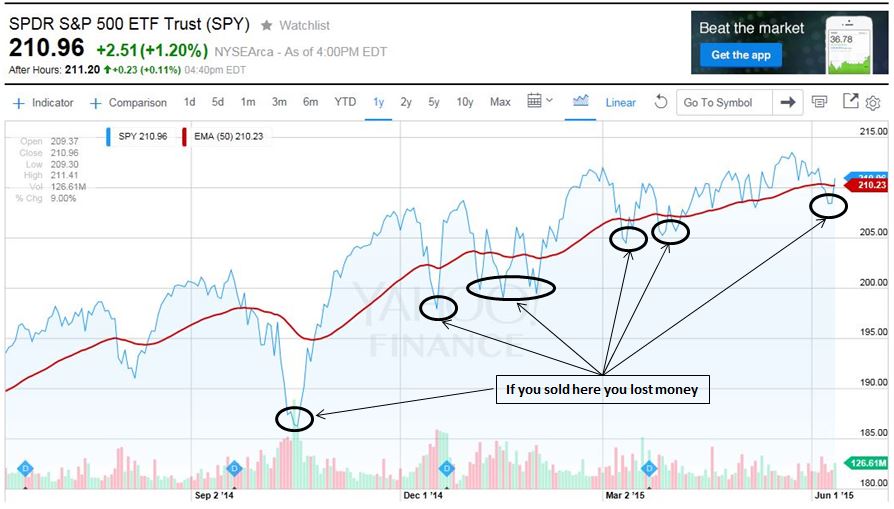
The biggest reason people lose money in their investments isn’t due to a recession, the Federal Reserve or a “bear market”.  The reason they lose is really simple, they sell low! It is impossible to “time” the market, all the experts and talking heads on CNBC have no idea whether the market will go up or down in the short term. Short term being a day, a month or a quarter. In the longer run, stocks always go up, you just need to be patient and do a little homework. The problem isn’t as much buying high, it’s selling low based on your panic.

Take a look at the attached chart, it shows the market over the last 12 months (SPY is the S&P 500 ETF, commonly referred to as “the market”). The blue line is the SPY, the red line shows the 50 days moving average of the stock’s price.

Market

It is easy to see that people who sold their stocks or funds in a panic, lost money. You can use any stock choice you want, the analysis is the same. You are your worst enemy, you sell or switch funds when the market goes down. I really pity the people who sold their stocks in 2008-2009 at the low points when the stock market was demolished. They then sat on cash, CD’s or bonds and missed one of the greatest rebounds in stocks in our lifetime. Along with your homework, time is the most important factor in your ability to make large returns on your investments.

Want some proof? Warren Buffet is currently worth about $73 billion is 84 years old. He made $70 billion of that after he turned 60 years old.  Your wealth will grow exponentially if you just follow some simple rules and don’t panic! Warren buys and sells based on fundamentals and investing in value. He buys low and sells (or holds) when the price is high.

In my next blog post I’ll give you some ideas when to buy and when to sell your investments.

Should You Hire an Overqualified Candidate?

dreamstime_s_21410231Given the current economy this may be an important topic in your business. I saw an interesting story written by Amy Gallo in the Harvard Business Review that indicated conventional wisdom of not hiring “over qualified” candidates may not hold true in all cases. The assumption of course is that an over qualified candidate will be underutilized, become bored and leave.

Point #1: What is over qualified anyway, the person’s skills exceed the requirements? Education is not experience and may not include the required skills. Previous experience may not be a good indicator since the required skills for the new job might be different. Meeting the candidate personally and addressing the reason the candidate is interviewing for a job that one might think he/she is “over qualified” for. In the early 80’s, I left a senior sales management job at a big national company to join a very small software company, I was viewed as very over qualified. Why, I wanted to get into the software industry when it was still young. It turned out to be a win/win for both parties. Look past the resume.

Point #2: Hire for more than the current job. Many businesses are growing and the hiring manager should be looking for someone that can move up in the organization, beyond just the current requirement. There can be no guarantees and the manager should communicate this to the candidate. Growing businesses always need people to promote, hire them now, before you need them and see what happens. Your biggest problem is that managers won’t hire people they view as being better or more skilled than they are.

Point #3: Don’t under pay. It doesn’t do any good to under pay a new employee just because of a down economy. What will your expectations be when the economy turns? People know what a fair salary is and your goal is to keep employees and pay them for performance. If your salary range is quite a ways from the normal pay for the level candidate you’d like to hire address the issue heads-on with the candidate. Again, there may be common ground that will allow you to bring on this “over qualified’ person.

The bottom line is that hiring and training new employees is very expensive. As they say in sports, “pick the best athlete” in the draft, then worry how to fit them in.

Like Safe, Stable Income – Look to Preferred Stocks

Concept for good investment and money making

As I wrote in a previous blog posting, “This Stock has been flat for 3 years – You’ll just love it!” preferred stocks can generate a very nice yield and still have a margin of safety.

Most investors don’t understand preferred stocks. Preferred stocks are positioned between common stocks and bonds. Most commonly preferred shares carry no voting rights but have a higher claim to earnings than common share and are usually less volatile than common. When the S&P 500 fell 37% in 2008, for example, the iShares preferred fund fell only 24%. Preferred shares are next in line to bond holders in the capital chain of any company. Investors can easily choose from preferred stock ETF’s or individual stocks. Investors should also understand that most high-yield stocks are affected by rising interest rates, similar to bonds.

Here are some examples of preferred investments you should consider:

  • iShares U.S. Preferred Stock ETF (PFF) 5.11% yield
  • Ladenburg Thalmann Financial Services (LTS-PA) 9.75% yield
  • Barclays Bank (BCS-PD) 7.7% yield

By allocating a portion of your portfolio to some of these ultra-high-yielding investments you’ll be able to improve your cash flow while waiting for the next Facebook or Apple investment to come along. In future posts we’ll discuss the pros and cons of these investments and some helpful tips.

My Top 5 Explosive Growth Stocks for 2015

GrowthEvery diversified portfolio needs an allocation of explosive growth or momentum stocks. These tend to be volatile and should have a great growth story behind them. You can’t pick these stocks based upon a single day or even a month’s performance. They also have a life span that is somewhat governed by technology or major market themes.

Ambarella (AMBR) This is a video chip company whose products are used in the leading wearable helmet camera GoPro (GPRO). They are also a leader in automotive backup cameras. It has a huge upside because, beginning in July 2018, all US made cars and light-duty trucks must have backup cameras. In addition they are a leader in ultra-high-definition TV, a next generation TV that we’ll all have someday. Last quarter, their 4th quarter they beat their revenue and earnings forecast. I bought this stock in late 2014 and it is up 60%. It is up 400% in the last 12 months and trades at a 55 P/E, not too bad.

AMN Healthcare Services (AHS) This company provides staffing and staff management services to the healthcare market. Obama Care has put pressure on hospitals and other healthcare facilities to both find qualified nurses and physicians and manage costs. The healthcare market will continue to grow for years to come and this company is well positioned to enjoy excellent growth. They are up over 100% in the last 12 months and trade at a 33 P/E. I first bought this stock in late 2014 and have added to my position a few times when it hit its daily 50-day EMA.

NXP Semiconductors (NXPI) This chip company provides “near field” communications for products including the Apple iPhone and Samsung phones and tablets. This technology is behind mobile payment systems like Apple Pay and competitive brands. They just recently signed up Chinese consumer electronics maker Xiaomi and acquired Freescale Semi in March. Freescale is a leader in automotive chips for keyless entry. The stock is up 100% in the last 12 months and trades at a 80 P/E. I bought this stock in late 2014 and it is up 40%.

Palo Alto Networks (PANW) This company is a leader in enterprise cyber security. This stock is in my basket of cyber stocks that include FireEye and CyberArk. They all have been hot for the last 6-9 months. Cyber threats will continue to be a hot topic for years to come. PANW and FireEye actually lose money but they continue experience substantial growth. PANW is up over 200% in the last 12 months when I started buying it.

Skechers (SKX) This is a shoe and apparel company. When I moved to Florida a year ago I found that I needs more casual shoes that were very comfortable. I bought a few pairs of Sketchers and I love them. After some research I bought the stock and after flat performance in 2014 it has really picked up. I’ve also seen the 2 founders on Jim Cramer’s Mad Money and they tell a convincing story. The stock is up 90% in 2015 and have overtaken Addidas and New Balance to become the #2 footwear provider in the US. The stock trades at a 32 P/E.

Invest in China – My Top 5 Selections

ChinaAs the US economy goes into a slow growth mode I’ve been increasing my exposure to China. Currently my direct China investments only hold a 4% allocation in my portfolio. My goal is to increase this to 6-7% by mid-summer. I’d like to have 15% allocation to the combination of Europe and China. My actual exposure to China is more than 4% because some of my other holdings have substantial China exposure, like Apple (APPL) my largest single holding alone representing 5% of my investments. In the most recent quarter, Apple sold more iPhone’s in China than in the US.

My strategy in China is to go with the sector winners where possible. Here are my picks; all have provided double-digit returns in the last 12 months.

Baidu (BIDU): Baidu is the “Google” of China, it services including maps, news, video and encyclopedia searches. Baidu completely dominates China just as Google does the Western world. Google has only 3% of the China search traffic and 90% of the rest of the world. I’ve held Baidu for a number of years.

Ctrip International (CTRP): Ctrip is the “Expedia” of China. As a matter of fact Ctrip just acquired a 38% equity stake in eLong, a Chinese competitor, some of this stake came from Expedia another investor in eLong. This stock just hit its 52 week high on Friday, up over 100% in the last 12 months. Ctrip’s mobile app has over 800 million downloads and in Q1 about 70% of all of the company’s online transactions were mobile.

iShares China Large Cap ETF  (FXI): This is my catch-all for all the large corporations in China that trade on the Hong Kong Exchange. FXI track the FTSE China 50 Index which includes the 50 largest companies in the Chinese equity market that are available to international investors. It currently is trading close to its 52 week high, yet only has a P/E of 13. It has returned over 70% in the last year. If you are going to only own one Chinese stock, this is the one to own.

NetEase (NTES): NetEase, operates an interactive online community across multiple areas, including Online Game, Advertising, E-mail and E-commerce.  Similar to Yahoo in the US, it offers news, information, community and communication services, such as photo albums, instant messaging, online personal ads, and online video. Their e-mail services are used by a lot of large corporations. It too is now trading close to its 52 week high and has gone up more than 100% in the last 12 months.

Vipshop Holdings (VIPS): Vipshops has a unique on-line “flash sales” business that really doesn’t have an equivalent in the US. I’ve held VIPS for many years and it’s gone through a recent stock split. This is a controversial stock and can be volatile. They are also a regular discount retailer with many of their own brands, maybe like a smaller version of Amazon or WalMart.com. This is probably the riskiest China stock that I own, and my cost is so low that I really don’t want to sell it and pay a substantial capital gains. This stock can easily return 10-15% or more a year and is a great “trading stock” if you have a short-term outlook.

Please Buy My Golf Course!!!!

GolfOK, let me just share my frustration. I bought a nice house in Florida on a beautiful golf course and the week we moved in, the golf closed. That was one year ago and the course is still not open. From my pool deck I now see weeds instead of golfers. We live in a nice gated community with a HOA that isn’t sure what to do. Some are in the hope and pray mode! Many would just like the grass cut and hedges trimmed around the club house. A few of us on a special committee are trying to be more proactive and develop plans to better control our future.

This can only be a discussion about MONEY and COMMUNITY – Not Golf! 

We are being told by the real estate agent that a mysterious (to us) buyer has an offer accepted by the bank and is in the “due diligence” process. We are suspicious because a last “deal” fell through, and this buyer has thus far made no attempt to contact the HOA or anyone in the community. If I was going to spend millions, I surely would want to talk to my potential customers before inking the contract. That’s just me and the way I think.

The golfing business just isn’t the same any more, it seems to have not recovered from the 2007 recession along with the fact there are just less golfers today than 10 years ago. However, the law of supply & demand must still work. There are well run golf courses throughout Florida, some owned by HOA’s and some by private owners. It appears the secret to success is professional management, not a bunch a golfers who think they should own a course (the previous owners).

Our HOA could potentially buy the course and then hire a top notch professional to run it. We have over 800 households in our community and the cost to buy and operate would be a fraction of the costs we’ve already suffered in home values.

The problem is that it is tough to build consensus (on almost anything, including golf). Of course the non-golfers vs the golfers is a losing battle. Only a small percentage of any community, even ours, actually play golf. The non-golfers will immediately point out that they aren’t going to subsidize the guys in pink shirts, drinking beer and cruising along paths. It appears that most of these comments come from those without lots that directly face the course. They don’t seem to express any vision for the future other than “we need to do something”, or “we hope someone buys it”.

But, as I said earlier ……. This can only be a discussion about MONEY and COMMUNITY! Our losses in property values could already buy at least a few courses. Hopefully our special committee can present a plan that solves the problem, but we can’t just rely on only the golfers.  

We have a really nice golf course for sale!


It Far Less Expensive to Keep than Lose Good People

E,ploteeIn my last posting I identified how to hire the right people and who you might want to avoid. In this post we’ll discuss keeping good people. Some businesses just seem to suffer from continual turnover of the staff, others appear to be training grounds for other businesses in their field.

One fact of business …. it is immensely cheaper to keep good people than to find good or better replacements. First we’ll take a look at the top 5 reasons why people might leave in the first place.

Top 5 reasons why employees leave.

  1. Higher Pay. Surveys consistently show that the overall #1 reasons employees leave is compensation. It is interesting to note that many times this is a result of “pay compression”. This compression exists when there appears to be very little difference in pay between top, mid and bottom performers. You know the scenario, everyone gets an automatic 3% raise and there are little in terms of substantive evaluation. The job only appears to be worth a tight salary range. Add all sorts of benefits into this discussion of total compensation.
  2. Below Market. This is very similar to the one above but looks a little different to the employee. In this case the employee has access to surveys that show they are paid well below market rates. Many times you don’t need a survey, just find out what newly hired employees in the same company are being paid for the same job. Not surprisingly, the employee finds out that their 7 years of loyalty and excellent appraisals pays much less than risky new hires.
  3. Over or Under Managed. In this case it’s either they are being micro-managed and there is little room for growth, or they have little communication and direction from a manager. It’s no mystery that employees actually like to be properly managed and crave for leadership. To me, excessive turn-over is a manager problem.
  4. Overall Communication. Communication or the lack of, is one of the key reasons employees feel dissatisfied with their job. How well am I doing? I have no idea because no one tells me. All employees from top to bottom like to know both how they are performing and how the overall business is doing. Why, it’s a matter of safety to them. It builds trust when these things are communicated.
  5. The Environment. What is the workplace like, is the employee comfortable, is it professional? Is there too much drama, employee in-fighting and low moral? If so I can guarantee you’ll lose good people quickly.

Ways to keep good people

  1. Actually it’s quite easy, just deal with the top 5 reasons why they might leave.
  2. Let’s tackle Higher Pay. Although employees might say this is the number one reason for leaving, it may not have started them looking in first place. Communicate to each employee upfront and on a continual basis what the business’s overall compensation plan is for the position being discussed. Can the company provide a growth path for excellent performers?
  3. Many employees will sacrifice pay for other items they feel are valuable to them. For example, the security of a long term job, with a company that “treats them well”. This tends to be the case for small or mid-size firms who just can’t match the compensation for big city, big companies. There are many non-compensation factors that keep good people on-board.
  4. Give employees “real jobs”, those that have responsibilities, the ability to be recognized publically for a job well done. Provide the best management you can, don’t knowingly let a poor manager cost you people.
  5. Have fun, employees what jobs that are fun. I know it sounds corny and you run a professional business that is just too “out-of-place” to allow “fun”. You are wrong. Every business can find ways to allow their employees to become engaged in fun activities and functions. Conduct a contest, hand out simple goofy awards, those types of things. Kool-Aid at lunch contests. Just ask some of your more outgoing employees what might be fun and let them run with it.
  6. Never stop communicating. It’s just amazing that all business people believe they are good communicators, that communication is essential and that employees what consistent communications. Then they just don’t do it, they are just too busy to consistently communicate. Hold regular company meetings; allow both managers and staff to talk about accomplishments. Constantly tell them what is going on, good news and bad news. They are much better off hearing the good and bad from you than others who will get the details a little wrong.