Is NASDAQ 5000 Like the Crashing Bubble of 2000?

Not to be too picky, but the actual high was 5049. To refresh your memory, when the NASDAQ hit its high it held it for just 31hours before it dropped 80% over the next 2 ½ years. Will the same thing happen again in 2015?

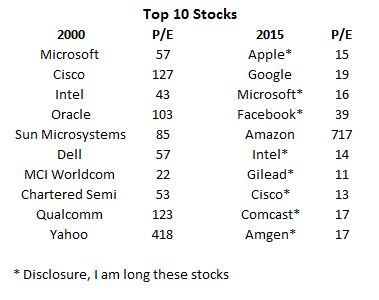
I don’t think so for a number of reasons. This is why things are different, even though both the Dow and S&P are at all time high’s.  First of all, in 2000 the NASDAQ traded at 100 times earnings (P/E) multiple, today it trades at about 21, only slightly higher than the S&P 500 18 x earnings. Secondly, Apple accounts for almost twice the market weight of the next biggest stock. Apple is probably one of the most financially sound companies in the world. By the way, Apple only trades at a 14 P/E, far less than the overall market. Of the 240 point rise in the S&P this year, Apple accounts for about 130 weighted points of the increase. A good reason that the number 1 stock in all equity hedge funds and equity index’s is Apple (APPL).

You might be interested in the difference between the top company’s then and now, just check out the “bubble” P/E’s of 2000.

Nasdaq 5000


Things look a little different, however Amazon sure looks like a 2000 bubble stock!


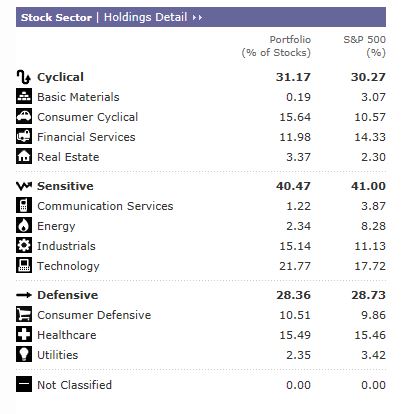
My Current Allocations – Well Balanced for Growth


I was recently asked to publish my current portfolio allocations; I’ll share them with you with the caveat that everyone’s situation is different.

My current investment goals include:

  1. Provide security while taking advantage of market growth.
  2. Consistently outperform the market (SPY) in “total returns “on both a quarterly and annual basis.
  3. Pick best of breed performing stocks and ride the winners.
  4. Exit positions when the economic cycle changes or an individual stock story changes
  5. Rebalance the overall portfolio as necessary.
  6. Maintain a tax-friendly environment; pay the least amount of fees as possible.
  7. Maintain a small exposure to bonds, but include “bond-like” equity’s such as REIT’s and higher yielding S&P stocks.
  8. Reinvest all dividends and maintain 5-7% cash for buying opportunities.
  9. Always has a “buy” list and quarterly update a “sell” list.

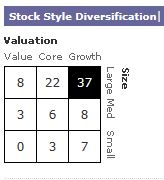
Below is a series of charts showing my portfolio including a few Morningstar analysis of my portfolio. In future articles I’ll further discuss my strategy and some best of breed choices.

Morn-1Allocations

Mon-2Mon-3


A Fixed Income Dream – A Dividend Increase Every Year for Over 35 Years

Dividends


Investors either in retirement or planning on retiring in a few years are always looking for ways to insure they have a secure and steady source of income.

Here are some facts for your review:

  1. The use of bonds for fixed income has been a favorite option for many years. However, bond yields since the 2009 financial crisis have fallen so far they may no longer be a viable option.
  2. Investors may need to generate 6-8% a year in total returns to make sure they won’t out-live their money. Bonds yielding 2-3% just won’t do that for you, especially given the guarantee that bond prices will fall as future rates start rising.
  3. Here are 5 blue-chip stocks that you will recognize, they have not only paid dividends for over 35 years, but have also increased their dividends each year for over 35 years.
    1. Procter & Gamble (NYSE:PG) currently pays a 2.99% dividend and has increased its dividend each year for the last 58 years.
    2. Altria Group (NYSE:MO) currently pays a 3.80% dividend and has increased its dividend each year for the last 44 years.
    3. SYSCO Corporation (NYSE:SYY) the largest food distributor in the US currently pays a 3.03% dividend and has increased its dividend each year for the last 43 years.
    4. PepsiCo (NYSE:PEP) currently pays a 2.83% dividend and has increased its dividend each year for the last 42 years.
    5. Clorox (NYSE:CLX) currently pays a 2.72% dividend and has increased its dividend each year for the last 37 years.
  4. Each of these blue-chip stocks have a high probability of increasing their dividends each year during the years of your retirement.
  5. The nice thing about owning these blue-chip stocks, not only do they pay consistently increased dividends, they may also have capital gains over the years.


Disclosure: I am long PG, MO,PEP and plan on adding CLX in the near future.

I Promise this will Change Your Life – Learn from Boeing

One thing I can promise you, after reading this book you’ll never have a medical procedure without first asking the doctor about their “check list” …just take my word for it. This is one of my favorite books, The Checklist Manifesto How to get things Right. The author,  Atul Gawanda,  is a surgeon and associate professor at Harvard Medical School. This book was so meaningful that I have bought quite a few copies for my friends and associates.

So what does this have to do with Boeing? Just keep reading.

In 1935 at Wright Patterson air field in Dayton, Ohio the US Army held a flight competition for the next generation of long-range bombers. Boeing was assumed to be the winner since they showed up with an aluminum alloy plane that could carry five times as many bombs and fly twice as far as the Army spec had required. There was a potential order for 65 or more of the winning aircraft, the Boeing entry was dubbed the “flying fortress” because of its size. So on that October day as all the executives and Army brass watched, the 103 foot wingspan plane with 4 engines, taxied down the runway, climbed to 300 feet, stalled and crashed. Two of the five crew members died including the pilot.

The investigation revealed that there was nothing mechanically wrong with the advanced plane; it was “pilot error”. The new plane had tons of new features and the newspapers said it was “too much plane for one man to fly”. Maybe the plane needed a few more pilots and more training ….. not really. This plane became one of the most successful planes ever used in combat logging over 1.8 million without a single accident; it was called the B-17 “Flying Fortress” and was in instrumental in the Second World War.

The only thing that Boeing did to successfully fly the B-17 was develop a pre-flight checklist. Keep in mind that even in 1935, asking a pilot to use a check list would be like asking you and me to use a “back the car out of the driveway checklist”. No good pilot would ever use one, why should they, they already knew how to fly. With the Pilot’s checklist being used the Army ended up buying almost 13,000 of these planes that were deemed “too much plane for one man to fly”. So what might have been on the checklist, dumb stuff like flip this switch, check this gauge, close the window, release the brakes. Not a single item on the checklist was difficult or beyond what all pilots thought they did everyday on every flight. Even today not a single military or commercial flight takes off without the pilot and co-pilot going through the pre-flight checklist, as dumb as it might sound. Why, even simple mistakes and oversights can have a very large impact, like the crash of the first Boeing B-17 test plane.

In addition The Checklist Manifesto points out many other real life examples of doctors, hospitals, and architects that use checklists of simple everyday tasks that in fact save lives or costs lives when not followed.

All businesses and many of things we do in our lives can benefit from the lessons learned in the Boeing B-17 story above. We all work on simple, complicated or complex matters all the time and many times simple things that get overlooked have huge consequences.

Airline Company’s today have extensive checklist to handle every possible contingency. An emergency onboard a flight, the engine flames-out, the pilot immediately grabs the huge catalog, looks for the checklist on engine flame-out and follows the process exactly. Why is this different in a law firm, it isn’t.

Just as a side note: not only did I buy The Checklist Manifesto for many of my past employees; they took it on themselves to begin using checklists within my former business. They had checklists for dozens of everyday processes; they too just don’t want to make mistakes that effected customers.

 

Billions of Dollars to Burn – No Really!

Cash

Each year the Fed destroys billions of dollars*. This currency is taken out of circulation because it is old, wore out, torn or otherwise unfit for use. In the past most of it was shredded and dumped in landfills. If you visit many regional Federal banks or Bureau of Engraving and Printing you may get a souvenir bag of shredded money.

 The Federal Reserve in now looking to “go green” with the disposal of all this cash. United Fibers LLC in Chandler, AZ uses shredded cash for home insulation. The Philadelphia Fed sends cash to a local power plant to generate electricity. The Sanitation Districts of Los Angeles burns about 400 – 500 tons of cash a year. Every now and then the Fed’s approve special request for the disposal of cash, including cash to fill luxury dog beds.

What would do with a pile of shredded cash?

 *As reported in the Wall Street Journal

Guess What’s Coming Back – Hula Hoops, Betamax, 8-Track Tapes or Vinyl Records?

Record


If you guessed vinyl records you are correct. The sales of old fashion LP vinyl records is up 49% in 2014. Younger people think they are cool and like the idea of a needle riding the grooves. The problem is that there are almost no one can press vinyl records anymore. There is just one company who supplies 90% of the raw vinyl used for these records. A small Connecticut factory with a dozen employees is working overtime just to supply the steel molds that press the vinyl into shape. Record labels are waiting months to get their orders filled. Pressing machined only make 125 records per hour and many of very old these machines are running around the clock.

 Don’t get rid of those old records quite yet, they are on their way back.


What is the Real Price of Gasoline – $1.78/gal

Gasoline prices have been falling almost every day now. As of the date of this posting AAA reports the national average price for gasoline is $2.71/gal. A year ago the average was $3.52/gal. So who actually determines the price for gasoline and how can you predict what the future price?

 The actual price of gasoline is mostly determined by both the price of oil and more specifically the RBOB futures. RBOB is a futures market benchmark that is traded on the New York Mercantile Exchange, the CME Group’s Globex and ClearPort electronic trading platforms. RBOB stands for “Reformulated gasoline Blend stock for Oxygen Blending”, you and I just call it gasoline. A single futures contract of RBOB represents 42,000 of gasoline delivered to the port of New York in a future month. RBOB contains 10% ethanol and is prepared so that a purchaser can get another 10% ethanol added right at the point of delivery. The price of RBOB is quoted in US dollars. A strong dollar tends to lower the price of oil and gasoline. The US dollar is on a real up trend compared to all other world currencies.

 RBOB


The above futures chart shows the trading history of RBOB since September 2014. Today “front month” contract (January 2015 delivery) is about $1.78/gal. If you look at the RBOB futures contract price for January – June 2015 you’ll see that at the moment the market thinks we’ll have really cheap gas for the next 6 months. Of course, the price of RBOB could become quite volatile based on the price of oil and geo-political events. But for now we’ll enjoy it.

 Now that you know the core cost of gasoline you can start determining whether your local area is giving you the best deal. There are places in Oklahoma currently selling gas for $1.99/gal, our local price here in Florida is $2.69 and seems to drop every few days. Keep in mind that the “costs” of your gasoline includes taxes, transportation costs and retail profits. I can already tell that our local price of $2.69 will continue to drop before January to possibly the $2.40 – $2.50/gal range.


Retirement Planning Part 1 – A Disaster

The average American does not have an adequate retirement plan. Why, because he/she isn’t ready to retire yet. The problem is that by the time you begin thinking about a retirement plan it may be too late to effectively craft one. Most people in their 50’s are enjoying their lives and are in their highest earning years. Yet their retirement plan is basically to keep contributing to their 401K plans at work, save some money and continue to spend based on their increased income. So, what’s the problem? Times have changed and many people are facing a disaster when it comes time to retire.

Here is what is different:

  1. Here is what is different:
    1. The days of pension plans are almost gone; they have been replaced by Defined Contribution Plans, like your 401K at work. There is a big difference. A pension plan was an annuity, your company paid the entire principle and you were guaranteed a set income for life. Your 401K plan probably won’t last you a lifetime and the underlying investments are not guaranteed. Ask the people who retired in 2007-2008 and had to dip into their investments when the market hit bottom.
    2. Your 401K plan has contribution limits and is, in many cases loaded with internal fees and costs. Typically they are not self-directed and offer limited choices for investments. Many of the investment choices have little or no visibility in what the core equities or bonds are. Financial institutions that manage these make their money on both fees and “turns”.
    3. Many people have IRA’s and taxable brokerage accounts where they invest their savings. They choose mutual funds, stocks, bonds and ETF’s they think will appreciate over time and match or beat the overall market. However, they have no idea when to buy, when to sell and how to pick the right investments to match their goals. The majority of investors don’t re-balance their holdings, don’t under tax efficiencies and actually buy high and sell low. A real disaster.
    4. Savings are great, but most really safe retirement type investments are yielding a fraction of what they traditionally yielded. In past years you could just put your money into secure bonds and collect your 6-8%, these are now yielding 2-3%. Your savings account, less than 1%. How could you possibly withdrawal 4% a year in retirement if you are only making 2-3%, paying tax on it and having it be subject to inflation.
    5. You are going to live a whole lot longer than prior generations, and may very well out-live your money. Our excellent healthcare system is going to make sure you are both healthier and poorer.
    6. Owning a home is no longer a piggy bank or a guaranteed investment. Safe shelter may be a requirement but may not guarantee you the kind of appreciation it did in the past.
    7. People today just find it hard to save, or easy to spend. Take your pick.
    8. Many people believe they can live on 80% of their pre-retirement income levels, they probably can. However, they don’t know how much they will need to fund the 80% for the next 30-40 years. If you are an average 50 year old male today you have a 25% chance of living past 92 years. Many of us have relatives that are already that old.

There are ways to plan for your retirement that are simple to follow and will at least help you plot a course. It’s your job to plan for the security of your retirement. In upcoming posts I’ll give you some helpful suggestions on how to do this.

What Boxes are Your Investments in?

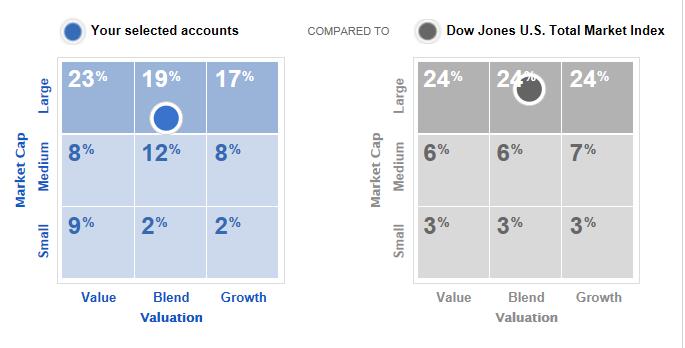
In a previous post I discussed the need to re-balance your portfolio on a regular basis. One of the first steps to doing this re-balance is to first determine the make-up of your current mix of investments. There are a variety of free tools that let you accomplish this. In this post we’ll talk about the “9 Boxes” or Style Box popularized my Morningstar.

The Style Box will allow you to visually map your portfolio into the 9 categories of:

    • Large value
    • Large blend
    • Large growth
    • Medium value
    • Medium blend
    • Medium growth
    • Small value
    • Small blend
    • Small growth

The horizontal rows represent “valuation” and the vertical columns represent market cap. Here is an example comparing a portfolio to the Dow Jones US Total Market Index.

9 Boxes Example

As a point of further reference let’s compare the above example with the Market Barometer on Morningstar’s web site today (August 29, 2013).

9 Boxes Example-2

In this comparison it shows that in the last 3 months and 12 months small cap stocks, ETF’s and mutual funds have out-performed the large caps. Therefore we might want to consider re-balancing some of our portfolio into small or even mid-cap investments.