My Top 12 Income Producing Stocks for 2016

Those of us who are retired or near retirement are looking protect our investments with well-diversified portfolios. A portion of my tax deferred portfolio, is dedicated to income generating stocks, no bonds at this point, to help handle the MRD that will kick in when I turn 70 ½ years old. My preferred holdings are good stable businesses that I’ve come to trust over the years, they basically don’t go up or down. In 2015 I started again adding mortgage backed REITs like AGNC to my other long time REIT holdings. My newest edition in 2015 was Nordic Atlantic Tanker, with the world awash in oil and no place to store it daily tanker rates are going sky-high. 

Here is my list of Income producing stocks for 2016.

Income.


Stock Exchange Eliminates Stop Loss and Good till Cancel Orders

AppleThe New York Stock Exchange has announced that on February 26, 2016 they will no longer accept a Stop or Good till Cancel Orders. Many investors use “stop orders” to protect their investments, or so they think. There are many forms of “stop” orders, such as Stop Loss, Stop Limit, Training Stop Loss, etc.

Here is an example, you bought 100 shares of Apple (AAPL) @ $90/share awhile back, and it is now $118/share. You want to protect some of your gains so you entered a Stop Loss Sell Order, Good Till Cancelled @ $100/share. Therefore if Apple drops to $100/share it will automatically sell and you’ll have a profit of $10/share. You can also set a higher sell price, for example, if Apple hits $125/share sell automatically to lock in your profits. The old theory was that every time you buy a stock or fund you also enter a high and low sell price.

However, here is why this doesn’t work so well.

The Stop Loss price, $100 in the above example is not necessarily the price you will get on a volatile daily drop. What happens behind the scenes is that as the stock hits your Stop Loss price of $100, it becomes a “market order” and sell at the immediate “market price”.

However, on a very volatile day like the “flash crash” in August 2015 a momentary, intra-day sharp drop in prices triggered an avalanche of selling and all these Stop Loss orders were hit, but not at the price you would expect.

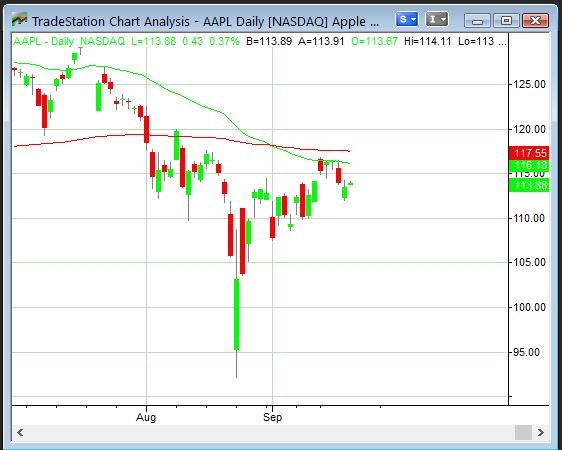
During a momentary flash crash your $100 Apple Stop Loss price, became a “market order”, but because of the crash the momentary price for Apple dropped below $90, even for a few moments. You stock would have sold for maybe $80, far below what you thought was “a protected” price. Of course moments after you stock was sold for $80, Apple jumped right back up to $108 price for that day. See the Apple daily stock chart above.

In theory the Stop Loss concept was very good, however in the current day of computer trading with 60% of daily volume coming from high-frequency trading there can be unintended consequences.

Don’t fear however, even though the NYSE won’t accept Stop Loss and Good till Cancel orders next year, most major brokerage houses will offer internal systems that should handle your orders in a similar way.


All Investors Must Read This and Act Immediately – or You Could Have a Nasty Tax Bill

IRS%20Tax%20Bill

Summary:

  1. Since 2015 has been a very volatile stock market and year to date the overall market is about flat. This means a lot of buying and selling, but little gain.
  2. This puts investors in a position for a major tax shock from large distributions but flat performance.
  3. You will get socked with a hefty capital gains distribution that is taxable, but your overall investment might be flat or down.

What to Do Now:

  1. Examine mutual funds in your taxable accounts, looking for early December announcements that show expected distributions.
  2. Decide whether you are better off selling your stock for a gain or loss, before the distribution
  3. DO NOT buy any mutual fund just before a distribution date, “normally called buying the distribution”, it can be a big tax mistake.

Here is a classic example from last year:

Fidelity Select Biotechnology Portfolio (FBIOX) is a well-respected mutual fund consisting of popular biotech stocks such Gilead, Biogen, Alexion etc.

Let’s say you bought 300 shares of this mutual fund in February 2014 @ $226/share = $67,800

On December 4, 2014 the stock price was $239/share, a $13/share gain

However on December 5, 2014 Fidelity declared a capital gains distribution of $23.84/share, you received $7,152 or another 30 shares. You now own 330 shares. Due to this distribution on December 5th the stock closed at $218.42.

Therefore on December 5th you have 330 shares @ $218.42 = $72,078

Your total investment went up by $4,278

However you will pay Capital Gains tax (possibly short-term gains) on $7,152, and you haven’t sold any shares yet.


Fidelity’s 20 Favorite Stocks – Which Do You Own?

Fidelity

According to Jim Lovell’s Fidelity Investor here is a list of Fidelity’s Top 20 Favorite Stocks – the most owned, and hence most liked, by Fidelity’s top managers. This is an interesting list, it includes 3 of Jim Crammer’s “FANG” recommendation, Facebook, Amazon, Netflix (not included) and Google.

I own the bold highlighted stocks. I haven’t liked bank stocks for a long time since I don’t see them making any real money until we have substantial rate hikes. I own Master Card instead of VISA and I should have bought Microsoft and GE before their big move up, I’ll have to wait for them to go on sale.

Which of these do you own?

#1) Apple (APPL)

#2) Alphabet Google (GOOG)

#3) Facebook (FB)

#4) Gilead Sciences (GILD)

#5) iShares ETFs

#6) Wells Fargo (WFC)

#7) JP Morgan Chase (JPM)

#8) Biogen (BIIB)

#9) Berkshire Hathaway (BRK)

#10) Visa (V)

#11) UnitedHealth Group (UNH)

#12) Salesforce (CRM)

#13) Microsoft (MSFT)

#14) Amazon (AMZN)

#15) Allergan (AGN)

#16) Disney (DIS)

#17) CVS (CVS)

#18) Bank of America (BAC)

#19) General Electric (GE)

#20) Starbucks (SBUX)

Obamacare Penalty More than Doubles in 2016

obamacare-hurtWhen I was preparing taxes returns as an IRS certified volunteer with Pasco County United Way earlier this year I had a number of families with large tax bills due to Obamacare.

If you or any member of your family does not have an Affordable Care Act (ACA or Obamacare) compliant healthcare plan you could be looking at a large penalty in 2015 and an even bigger one in 2016. In short, you owe the penalty for any month you, your spouse, or your tax dependents don’t have insurance that qualifies as minimum essential coverage. You can find coverage that counts here.

Let’s look at the history of this penalty:

  1. In 2014 the penalty was the higher of:
    1. 1% of household income, maximum of average Bronze plan, or
    2. $95/adult, $47.50 per child under 18, maximum $285
  2. In 2015 the penalty is the higher of:
    1. 2% of household income, maximum of average Bronze plan, or
    2. $325/adult, $162.50 per child under 18, maximum $975
  3. In 2016 the penalty will be the higher of:
    1. 2.5% of household income, maximum of average Bronze plan, or
    2. $695/adult, $347.50 per child under 18, maximum $2085

Based on these 2016 calculations a married couple, with 2 children and $70,000 in income would pay a $2,085 penalty when they file their 2016 taxes.

I just dread informing families that are struggling to make ends meet that not only won’t get that refund they were anticipating, but they will owe money for Obamacare.

The Real Yield on Bonds – You’ll Be Surprised

Dividends

If you listen to listen to conventional wisdom (I don’t) and invest a fair portion of your portfolio in bonds you’ll need to understand how to calculate the real yield, not what a broker or financial advisor can advertise.

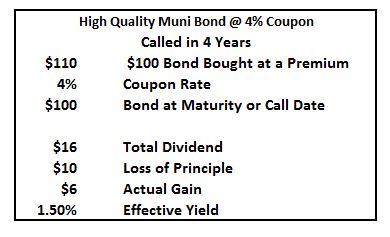
Your financial advisor suggests that you buy a high-quality Muni Bond, because of its quality you of course pay a premium, $110. This is not at all unusual. The bond coupon is 4%, your financial advisor is allowed to advertise this rate, and you’ll make $4 a year. This looks to be a pretty good yield and a safe investment. You might also notice that today Barclays Muni Bond Index yields 2.2%, you’re getting a better deal with no additional risk.

Maybe not, let’s do some math.

Bond

You have owned this bond for 4 years. Each quarterly brokerage statement shows a 4% yield and will show that you are getting your portion of the $4 annual dividend. Now the bond gets called early or matures and you get back $100. In the 4 year example your actual gain was only $6, or 1.5% yield.

Here is what you need to know.

  1. Brokers and financial advisors operate under an industry self-regulator called Municipal Securities Rulemaking Board and it allows them to the yield based on the bond sale price on each statement.
  2. A mutual fund or ETF falls under federal accounting and tax rules and will report the yield based on what you’ll actually get.
  3. If you buy a bond ask your broker or advisor to calculate a “yield to worst” return. If he/she won’t do some math yourself.
  4. Check your bond for a “callable” date, if it is still many years out it may help in your calculations.

It always pays to become educated in what you’re investing your hard earned money in.

Major Changes to Social Security – The Budget Deal

SS

The Congress passed a new Federal Budget deal (Bipartisan Budget Act of 2015) this week that makes some significant changes to Social Security and the strategy of “file and suspend”. Just as background, many of us senior citizens have filed for Social Security but “suspended” benefits until we hit 70 years old. Why? Because we get about 8% per year in additional benefits. See my previous article about this here.

So what are the Social Security changes that might affect you?

  1. The Deemed Filing Rule. Today you can file for a “restrictive application”, you let your benefits grow and just file for spousal benefits (1/2 of your spouse’s retirement benefits). If you will be 62 or older as of 1/1/2016, there will be no changes to this deemed filing rule or to the restricted application strategy. However, if you are younger than that, two changes take place. First, the restrictive application goes away. If you file for any benefit, at any age, spousal or your retirement you will be “deemed” to have filed for all benefit types. Secondly, deemed filing now starts immediately for anybody when they become eligible for either spousal or their own retirement benefits if they’re already collecting one of these benefits (spousal or their retirement). This eliminates the restricted application strategy for those who have planned on it and will costs them a bunch of money. This was all along just a loop-hole but people took advantage of it and it costs all of us taxpayers a lot of money.
  2. File and Suspend Strategy. As I mentioned above it is a great strategy to file and suspend and earn 8% each year. Today, while you “suspend” your retirement you can get a spousal benefit. Under the new rules, suspension of benefit requests that are submitted more than 180 days after enactment of the bill, assume 4/27/2016 or later, there will be three changes: a) While your benefits are suspended, you cannot receive a spousal benefit, b) While your benefits are suspended, nobody (your spouse) can receive a benefit based on your work record, and c) You’ll no longer be the able to retroactively unsuspend (this is a little more complicated).

I guess the bottom line is that the government can change the rules at any time regarding those who get Social Security. In the above cases the changes are probably the right thing to do so that people to “game” the system, but it was a legitimate strategy.


DIY – Save a Lot of Money on Simple A/C Preventive Maintenance

01b62e9ad701256ff08622a5a0187e59cf39c3795c

This posting is a departure from my normal financial and retirement planning articles.

Simple A/C repairs can cost you a lot of money. Just recently my A/C Company quoted me $175 to replace each capacitator, I have two units, I bought them for $20/ea. on Amazon and installed them in less than 20 minutes with simple tools. I did both units for a savings of $310. Last year I replaced my A/C power contacts for an even larger cost savings.

My house has two separate central A/C units, upstairs and downstairs. These units are about 10 years old and seem to be running OK. However, there are some common replacement items that can improve the life of your units. These replacement items are easy to install, even for the novice DIYer.

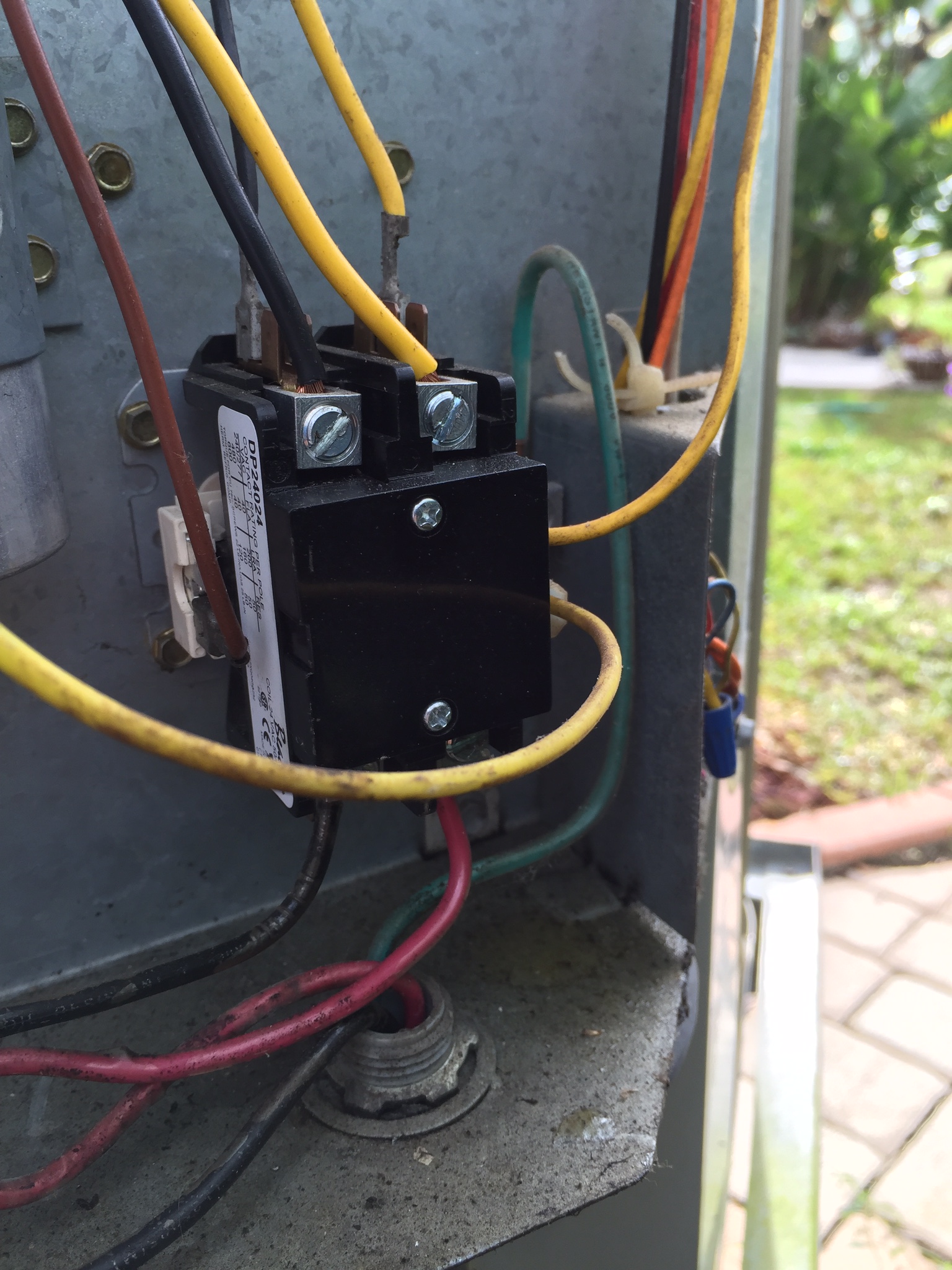
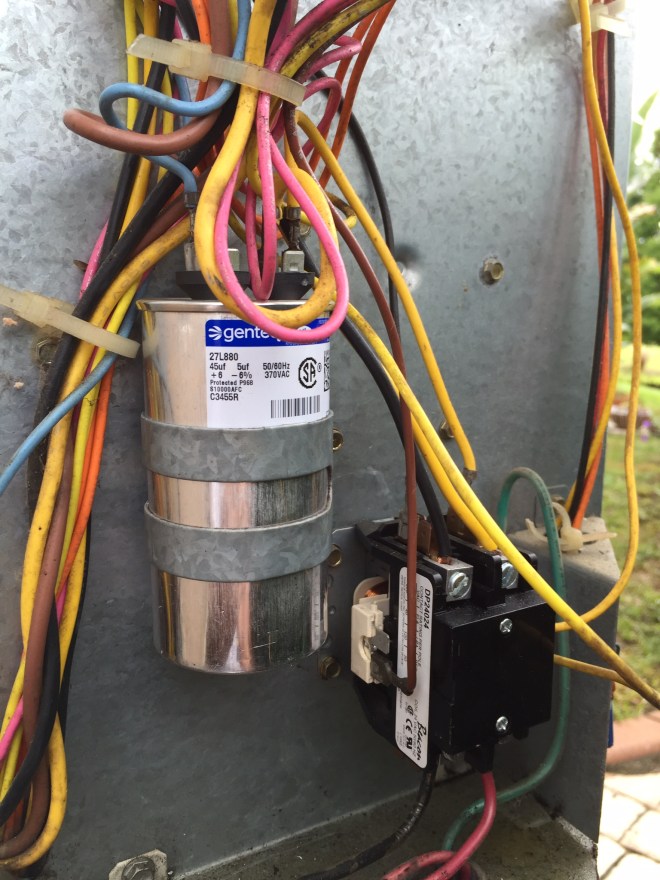
Last year I replace the main power contactors, these turn on/off the main power to the compressor and the cooling fan. My units both had 24 volt coil, 2 pole, single-throw contactors with specs that allowed me to shop for equivalent parts, I found Beacon Components brand, but could have used other brands. These contacts open and close every time the A/C unit cycles on and the actual contact tips will burn-off over time. This is probably the #1 electrical maintenance item on an exterior A/C unit. Here is the contactors I replaced last year.

01dd4b29a92da76e5c609d2fd001e22a02d43144e5

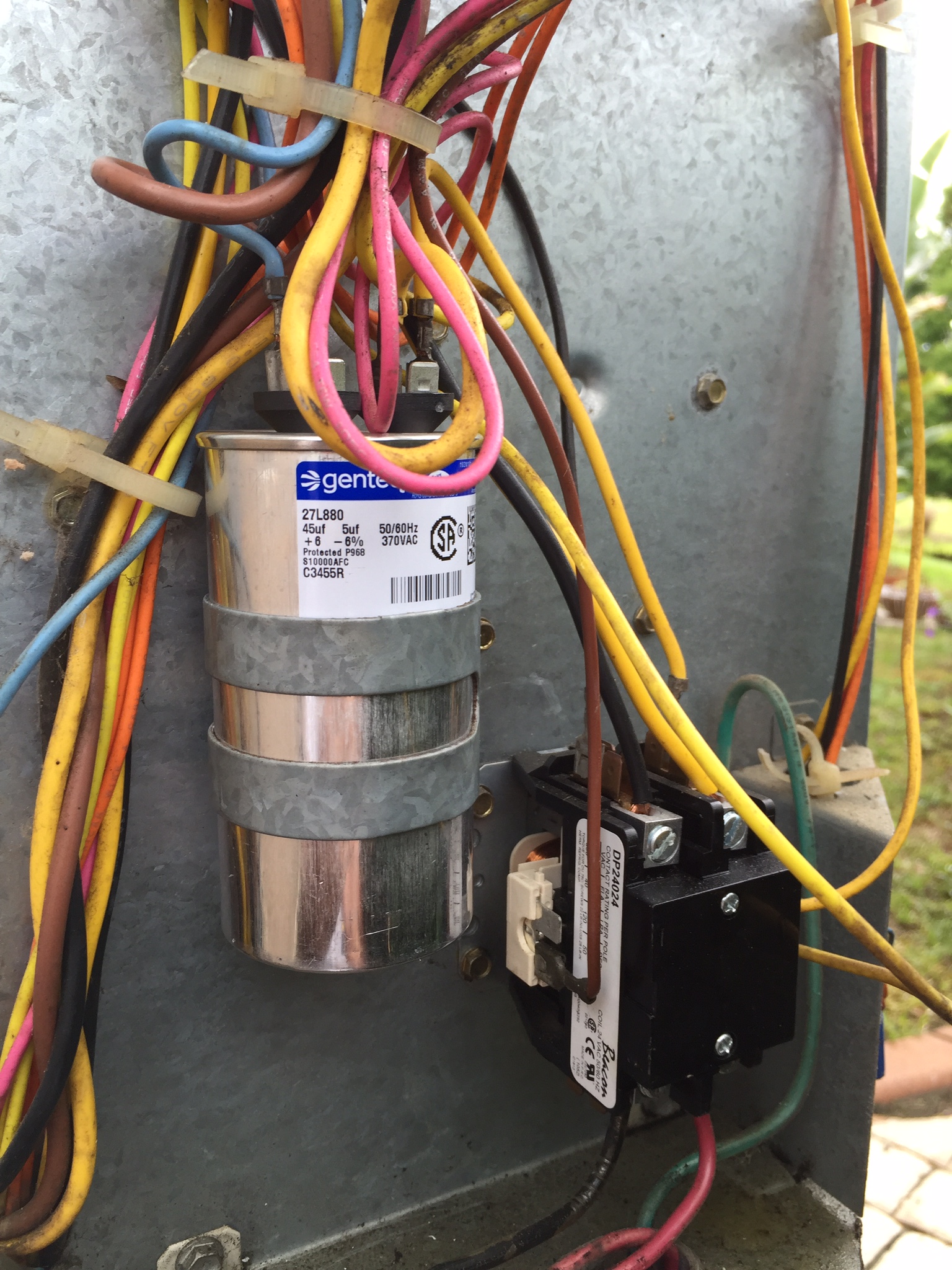
Today I replaced my two capacitors. Probably the 2nd most replaced item. What does the capacitor do in you’re A/C unit? A capacitor is like a storage battery, it charges and stores electricity, then when prompted it quickly discharges with a lot of power. This power is used to start an electric motor spinning so that the normal windings in the motor can take over and keep it turning. The same thing happens with a compressor. If you ever hear you’re A/C unit “humming” but the fan isn’t moving, or if your air is on but not blowing cool air, you may have a bad capacitor, or bad contactors. Over time capacitors, like contactors will deteriorate and need to be replaced. You will probably find that your A/C unit has a dual capacitor, to start-up both the fan and the compressor.

Here is how to replace the capacitor.

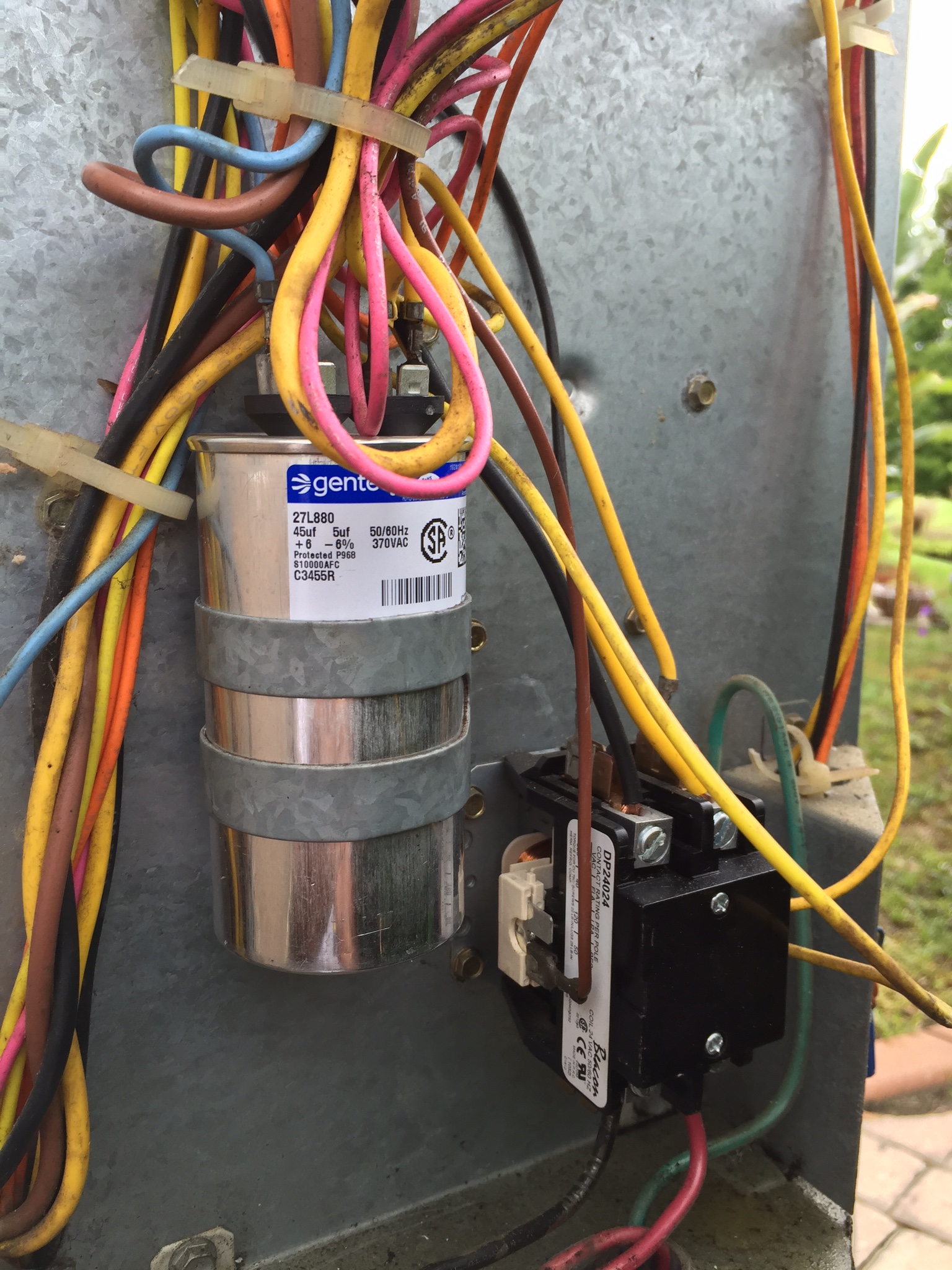
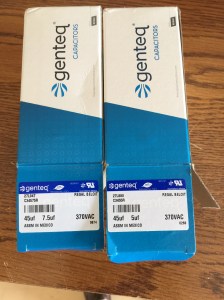
  1. Buy the Right Replacement Part. Take pictures of your current capacitor with your phone and use this picture to buy the equivalent capacitor on line. Capacitor are specified by voltage, most air conditioners and heat pumps have compressor and/or fan motors that require either 370VAC or 440VAC to start. Mine were 370 volts. Another measurement is called micro-farad, make sure the replacement capacitor has the same micro-farad ratings (shown as MFD or μF) as your old one. For dual capacitors, the capacitance is shown as “45/5” or “45+5” MFD, which means the compressor side is rated at 45 μF and the fan side is rated at 5 μF. Each of my capacitors were slightly different. Amazon had them both. See pictures.
011a237b713a47b6bf155e8a94de7e81222699e06d

2. Turn off the power. I do this two ways, at the temperature thermostats in the house I change the mode to “off”, I also pull the external circuit breaker for each unit. See picture.

018dbf1ed17ea7c2ef1fdda4d15bc350f21cbc742a

3. Remove A/C side panel where the capacitor (and contactors) are located. Now, before touching the capacitors wires it’s important to ground the terminals first. Remember, capacitors charge electricity, just take any screwdriver and touch each of the top 3 connectors to each other and to the steel on the A/C unit itself. Your capacitor may not be charged, but I never take this chance.

01cfd2e2d29f773b9295b57249c4e289353e890447

4. Take the screws off the metal housing that holds the capacitor in place. This will allow you to carefully remove the wire clips to the terminals on the end of the capacitor. Mine were marked Fan, C (common) and Herm (hermetically sealed compressor). I took a picture with my camera to make sure I got the wiring straight.

017b545bd0e31bc76de05dc978cd9fb214dc26cd6f

5. Just plug the wires into the terminals on the new capacitor, reassemble the metal housing back on the A/C unit, put the panel back on, re-insert the circuit breaker and you are finished.

You just saved a bunch of money and the frustration of having you’re A/C unit fail at the worst time.

7 Steps – 2015 Year End Tax Planning

Taxes

If you are like me, you are either retired or close to it. One quick shock on the day you retire is that you no longer have that pay check you’ve been use to getting most of your adult life. If you’ve done a good job of planned your retirement in advanced you can be celebrating instead of worrying. While in retirement you can set new goals, one of might be to pay the smallest amount of federal income tax as possible. Is it possible to appear “poor on paper” yet live a comfortable lifestyle? Yes!

Here are some items for your consideration.

  1. Manage your 2015 tax bracket. For example, if you just started receiving Social Security this year, consider returning it and delaying payments till you are 70 ½. There is no penalty for doing this. Some of this will be taxable. This might give you a chance to live off savings (cash) while paying little if any tax.
  2. Contribute the maximum amount you can to an HSA account, this will provide a credit to your Taxable Income.
  3. If possible, maximize your deductible items such as medical expenses by getting those new eye glasses, dental cleaning and so forth this year instead of early next year. Consider prepaying your property taxes.
  4. One big issue can be stock market opportunities in your taxable account. With the recent volatility in the market consider selling stocks, ETF’s or fund’s with short-term losses. These losses can then offset gains. You can also carry forward a maximum of $3,000 into future years. Just make sure you watch out for a “Wash Sale” on stocks sold for a loss if you put this money back to work in the market. When you use a loss to offset a gain you also get the benefit of re-setting your “cost basis” for the stock. This will benefit you if you buy back and then sell this stock for a gain in the future.
  5. Also regarding your taxable brokerage account, try and maintain “qualified-dividend” stocks which get preferred tax treatment or no tax at all if you can find a way to stay in the 15% tax bracket. Keep in mind that if you are in the 10% or 15% tax bracket there is 0% tax on “qualified dividends” and Long Term Capital Gains.
  6. If you’ve done a good job being “poor on paper”, you can also convert some of your IRA into a Roth IRA. Just keep an eye of your plan so that you don’t jump into a higher tax bracket.
  7. If you hold Equity Mutual Funds watch for the December “Distribution Date”, consider selling before that date if a large capital gain is expected. Otherwise you will be surprised by paying tax on a distribution you don’t actually get (the fund price, in theory is lowered by the distribution amount).


The Right Way to Buy Stocks and ETF’s

In an earlier post I discussed how to avoid problems when buying Mutual Funds. In this posting I’ll discuss the best way to but stocks and ETF’s.

 Let’s examine how people normally buy a stock or ETF, they just enter the number of shares and hit “Buy”. This is what is called a “Market Order”. You agree to buy at whatever the current “ASK” price is. Here are some suggestions on how to buy at the right price regardless if you are a short term or long term investor. 

Do not place a buy or sell order after hours or over a weekend. Early morning volatility can be huge. Large institutional blocks can get moved during the 1st and last hour of trading every day. This results in the little investor, you and me getting our orders priced at a less preferred level. Take a look at recent Apple trading ranges in just 1 day.

AAPL 

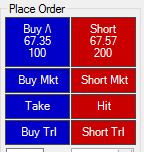
Here is a morning spread showing market large gaps between the “Buy and Sell” prices for a common stock.

Bid-Ask 

Always use “Limit Orders” when buying and selling. A Limit Order allows you to specify an exact price you want to buy or sell at. It provides some level of protection. For a long term investor you can easily place an order for your “watch list” stock at a recent low and just wait for the price to come down. You can choose “good till canceled” GTC to wait for your price.

Here is an example of a Limit Order.

Limit Buy