Score Presentation Event


img_0961.jpg

I did a presentation today down in Sarasota at a District Score meeting for central Florida chapters on our upcoming Academy for Business Development. I’ll be kicking off the Academy with a session on “Understanding Financials for a CEO” starting June 3rd at Rasmussen College. 

Always nice to be recognized for your volunteer services as a consultant, presenter and board member.

What Money to Withdraw First In Retirement?

Roth

Many retirees aren’t sure what money to withdraw first in retirement to cover routine living expenses. I’ll cover your choice of accounts including; taxable, Roth or your IRA/401K.  The idea is that in retirement you will need to supplement your income from Social Security, pensions and maybe an annuity (which I don’t necessarily like) with money you’ve saved in various accounts. I call this filling the GAP. If you want to know more about determining your GAP just click here and read my article. Much of your consideration on withdrawals is based on tax planning.

Here are some helpful tips:

1.       First off if you are over 70 ½ years old you MUST meet your RMD (Required Minimum Distribution) from your IRA accounts. This is a requirement and the IRS tax penalty is quite high.

2.       Secondly, take money from a taxable account, for example your brokerage account.

3.       Lastly, spend money from your Roth account, IF your current tax rate is HIGHER than what you expect it to be in the future. If not do not spend from your Roth, but instead spend from your IRA account.

Now, some of #3 needs a further explanation and you may need to consultant a tax adviser. By the time you get to option #3, each dollar withdrawn makes a tax difference.

Another strategy to consider. If you have done a good job of tax planning and you don’t need money from your Roth, save the Roth for larger unexpected expenses. This way if you need to say cover an unexpected $20,000 expense in retirement, withdrawing this amount from either a taxable or IRA account could be a substantial tax hit, but there will be no extra taxes if you use your Roth.


Understanding Equal vs. Price vs. Market Weighted ETF’s – It Makes a Difference

investments-choices

Many investors don’t understand exactly what they are buying when they look at Index ETF’s or funds. Investors should know the differences in “weighting” of stocks in an index or ETF. Weighting is the method that an index or ETF uses to determine what % of the index goes to buy each stock. Investors may think they are buying a highly diversified fund or ETF and not realize how “top heavy” they are in a few larger or higher priced stocks. Buying an Equal Weight ETF might provide an investor with more diversification.

Furthermore, many investors may be looking for diversification across multi-sectors yet don’t know for example that a NASDAQ index, like QQQ has no financial stocks. Or if you buy both the SPY and QQQ ETF’s you’ll end up with a big investment in Apple (APPL).

Sector Allocations

QQQ – Non-financial stocks 57% technology, 21% Consumer Cyclicals (78% total)

SPY – Well balanced Technology 21%, Financials 15%, Healthcare 14%, Consumer Discretionary 12% Industrials 10% (72% total)

Summary

Dow Jones: Price-weighted (DIA)

NASDAQ: Market capitalization-weighted (QQQ)

S&P 500:  Market capitalization-weighted (SPY)

Russell 2000: Market capitalization-weighted (IWM)

Guggenheim S&P 500:  Equal-weight (RSP)

Details

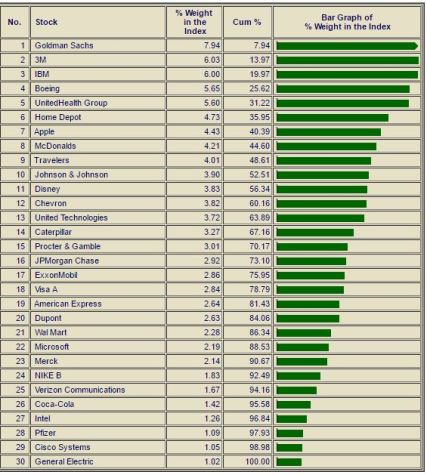
A price-weighted index (Dow) uses the price per share for each stock included and divides the sum by a common divisor, usually the total number of stocks in the index. Example, Goldman Sachs is a high price stock about $240/share, Cisco, a much larger company has a $31 share price. If you buy $1,000 of DIA, you get $80 worth of Goldman and only $1 worth of Cisco.

dow

 The market capitalization weighting is a stock market index weighted by the market capitalization of each stock in the index. A larger company account for a greater portion of the index. Most indexes are constructed in this manner, like the S&P 500, NASDAQ 100 and Russell.

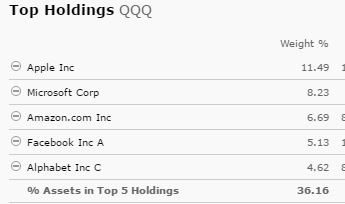
Apple for example, makes up 11% of the NASDAQ top 100 (QQQ), and 3.5% of the S&P 500 (SPY). In the case of QQQ, the top 5 stocks make up over 1/3 of the value of the 100 total stocks, very top heavy.

Here is a list of the top 5 holdings in the NASDAQ 100

qqq
Investment Option – Equal Weighted  Index

Guggenheim S&P 500,  Equal-weight (RSP), this ETF is an equal weighted index. Each stock gets the same weight. Over a period of time the RSP has provided a better return than the SPY. In addition the RSP provides a larger exposure to small-mid cap equites and more diversification.


Should you do your Own Tax Returns?

Tax Man

I’ve had a few people lately ask me if they should do their own tax returns or take them to a professional. As a certified IRS volunteer tax preparer (VITA), I’ll provide you with my opinion and some items to consider.

First off, if you have a complex return such as owning a LLC type business and needing to produce a form 1065 and a K-1 for the business and then do your own 1040, you should probably seek professional help. If you just own a sole proprietary business and file with a Schedule C, you might want to be adventurous.  Otherwise keep reading below.

The case for doing your own return is based on the fact that all tax preparers today use software to prepare taxes. The software used by a professional is almost identical to the software you might use as a DIY-er. In the IRS VITA program we started using TaxSlayerPro this season, they signed a 3 years agreement with the IRS. For the last several years we used TaxWise. At home I’ve used Intuit TurboTax for many years. These software products can be operated in a Q&A mode or a more direct entry mode. Many of these software programs will automatically import your W-2 information and your brokerage 1099-R’s. This further simplifies the process. The software does routine analysis, looking for missed entries, or outright errors. The software has help screens, sometime on-line chat and you can always Google for reliable answers to many tax questions.

The biggest case for DIY is the ability to understand how all the pieces of a tax form effects your taxes due and therefore how you might plan to pay less taxes or none at all. Most of the people I do taxes for just bring in all the forms, hand them over and have no understanding of how the calculations work. If you are retired, and live off a pension and Social Security, fine … not much you can do to affect your return. However, parents with kids in college, stock market investments, HSA accounts, mortgage interest etc, this is a different story. In our case before we even start a tax return the client fills out a detailed questionnaire. We are also trained to look over all their materials and ask questions that might affect their filing. At the end of every tax return I do for a client I take the time to explain every entry on their 1040, I ask if they have any questions. However, for the most part, the client just doesn’t want to know more that their return is being filed and they will get a direct deposit.

If you are in your 50’s or 60’s and planning for retirement, tax planning can have a huge impact on your future income and retirement plan. Over the last 10 years as I got real serious about retirement planning (I just turned 69) I spent a good deal of time structuring an overall plan to pay the minimum tax required. As things changed in my life I updated my strategy, the results have been very financially rewarding. Tax and investing strategy have allowed me to pay no taxes for several years and thank you Obama Care, actually get back a substantial refund each year. My overall retirement plans, in my case postponing my Social Security until I’m 70 (next year!!!), have worked out very well. I have a pretty good investment strategy, highly tax efficient, a fixed income designed IRA that will provide ample funds when I start my MRD also next year. In addition I have my tax plan already done for the next 3 years (based on 2016 rates). This is part of my SWAN strategy, Sleep Well At Night, enjoy my life during the day!

Understanding even basic concepts like Tax Brackets, Deductions vs. Credits, Qualified Dividends vs. Ordinary Dividends and Ordinary Income can make a big difference to you and your loved ones.

I can tell you that if you do your own taxes for the first time, you’ll learn an awful lot. Your goal is to get the same results as a professional preparer, save a lot of money and get educated.

Good luck getting your taxes filed!

2016 Market Performers – My Fixed Income Portfolio

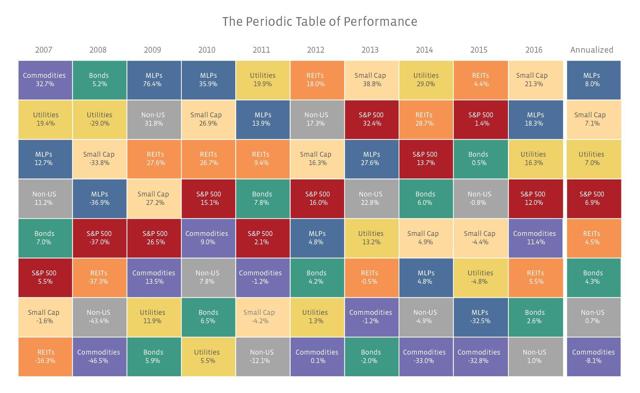
Each year as part of my year-end evaluation of my different portfolios I study the Periodic Table of Performance. This table is most helpful in my Fixed Income IRA portfolio that I will use to cover my income “Gap” when I start taking Social Security next year at age 70. To learn more about calculating your “Gap”, just click here.

In this Fixed income portfolio I’m looking to balance dividends vs. risk, my current portfolio generates 7.81% average returns.

Here is the Periodic Table of Performance provided by Alerian:

saupload_blinking_charts_-_updated_colors-01_thumb1

The table is comprised of the following benchmarks:

  • MLPs are represented by the total return version of the Alerian MLP Index (ticker AMZX)
  • Utilities: S&P 500 Utilities Index (a composite of utility stocks in the S&P 500) 
  • Commodities: S&P 500 Total Return World Commodity Index
  • Bonds: Barclays US Aggregate Total Return Bond Index
  • REITs: Real Estate 50 Index (a supplemental benchmark to the FTSE NARIET US Real Estate Index Series)
  • Non-US: MSCI Daily Total Return EAFE Index

My IRA Fixed Income portfolio has the following sector allocations:

ira

Over the last several months I have made a few adjustments to my long-term holdings.

I’ll publish an updated list of my holdings in a future post.


All Ready to do Taxes for United Way!

tax-cert

One of the highlights in my “volunteering life” is the opportunity to do income tax work for Pasco United Way. I’ve been doing this since retiring and moving to Florida a few years ago. It is such a rewarding experience to help people get their taxes filed, many time discovering they are entitled to refunds they weren’t expecting. The United Way provides this service at no charge. Our local team operates on Thursdays and Saturdays from January till April 18th. Yes, your 2016 income tax filing isn’t due until Monday, April 18. 2017!

Each year we go through extensive training and testing before being certified. I take the highest level of certification available “Advanced Exam”, in addition I also get a specialty certification in HSA (Health Savings Accounts). 2017 will be an especially interesting year since we will be using new IRS provided software and Obamacare is always fun. 


Should You Worry About The National Debt – Don’t, Here’s Why!

download

Is our national debt so high that it’s a major issue to American’s? Is America going bankrupt? In this article I’ll try and put our national debt into perspective that most people can understand.

First let’s understand what debt actually is, it’s the rental of money. The rent payment is like interest. Almost all American’s have experienced this, they take out a loan to buy a house or car. Maybe they use credit cards. Corporations too have experience here, they borrow money, through RLOC (Revolving Line of Credit) loan’s and bonds. If you generate enough income, debt can easily be handled. Some debt is very long term, like a home loan, say 30 years. Without debt our economy would come to a screeching halt.

The primary issue in measuring debt is, how healthy is the payer and how does the debt compare to the assets. People usually don’t think about the assets involved. Corporations track their Debt to Equity (shareholders equity). This is also known as Leverage Ratio. Debt can also be measured as compared to Assets (accounting period). Let’s take a look at Apple, Dec 2015 Apple had a Debt/Equity ratio of 129%, $171 Billion in Debt, $119 Billion in shareholder equity. However, in the same accounting period, Apple had 59% debt ratio (debt to assets). Would we all admit that Apple is a pretty health company, you bet!

Saying that the US Government debt is $20 trillion is a worthless piece of information. Why, because what is the US debt being compared to? Let’s keep in mind that the “US Government” is all of us and more. The US Government has a lot more flexibility that any family or corporation, they control the currency, interest rates and the ability to raise money. Some people will indicate that the national debt represents 102% of US GDP, sounds pretty scary, right? It shouldn’t. Let’s look at an average USW household with a $168,000 mortgage and $55,000 in income, their debt to “personal GDP” would be more than 300%! So the main issue isn’t necessarily the amount of the debt, but the ability to make payments.

Last year the US total interest payments on the national debt was about $225 Billion, but the government pulled in $3.2 trillion in revenue. Therefore the debt payment was about 7% of revenue! That doesn’t sound so bad, right!

Furthermore, some of the $19 trillion in debt is owed to the US Treasury and other parts of the government. For example, Social security buys Treasuries, the Federal Reserve holds about $2.5 trillion of the $19 trillion of total debt. However, the vast majority of US debt is owed to American institutions and us citizens. Pretty much all of us hold US debt through bonds held in our retirement and stock funds. By comparison, the Chinese ONLY hold about $1.4 trillion of our debt, yet we all hear how dangerous this is.  If China was to further dump US debt (they have been sellers in 2016) they would take a huge hit as most bond investors well know.

The government loans money to itself and us American’s. We love US debt as does the rest of the world, that’s one reason why the dollar is so strong. Our bonds pay a very safe, higher yield than the rst of the world.


Think about it this way, if the government spends $1 billion more than it receives in taxes, that money doesn’t just disappear. It flows into the hands of workers or companies or institutions. Even if you think this is wasteful spending, the fact is these dollars are moving from the public to the private sector.

All things being equal, many economists believe it’s preferable to have rising government debt and private-sector surpluses than the other way around.

US debt is an important issue but make sure you put it in prospective!


My Consulting Client Wins Annual Growth Award

img_0056

RECOGNITION of ACHIEVEMENT
Small Business Growth Leader – 2016
The Decker Group

(Sara Decker shown in the photo)

It was such an honor to present my consulting client with our annual SCORE award at our annual luncheon. This award covered Pasco and Hernando County, Florida in recognition for Small Business Growth. It was good to see various leaders from SBA, Pasco EDC, and local Chamber of Commerce’s attend our luncheon to honor our achievements.

The Decker Group is a great example of how small businesses create jobs and expand our economy. Founded 2008, they have installed over 10,000 units in large scale construction projects, unites being mostly granite countertops. They differentiated their business by being able to provide high quality, uniquely colored granite from China. Getting marble from China to a job sites in Minnesota on time is not for the faint of heart.

They have now expanded into Colorado and Iowa for commercial work and recently opened their first retail store in Hudson, Fl.

It’s been a pleasure helping them navigate the growth process.

I was personally recognized for leading Pasco Hernando Score in Total Consulting Hours in 2016.


The Almost Impossible Struggle – Bringing Back our Golf Course

pp-golfThe day before I moved into my new Florida house, the golf club closed. Now what?

Summary:

  • Bringing back a closed community golf course in Florida is almost impossible
  • It’s hard to get a super-majority of an HOA to agree on anything
  • Leadership skills got the job done
  • The focus has to be property values, golfing gets in the way
  • Homeowners have to protect their investments
  • Business principles trump enthusiasts
  • Only deal with people who have their own money, not investors
  • Efforts to get political help was fruitless
  • Our lovely course, Irish pub restaurant and mini-golf are now open
  • My community is very happy and I hope we’ll never forget

Details;

What are the odds of reopening a Golf Course that has been closed for 2 ½ years in Florida? Probably about the same as winning the lottery. All through the last 2 decades developers in Florida built really fancy, private, gated communities around equally fancy golf courses. It was a no-brainer investment, put $2.5 million into a golf course, let it wind through a 750 – 1,000 home community and sell $400M – $500M worth of houses, asking substantial premiums for “golf course lots”. Once all the houses are built, sell the course to someone and move on. Duplicate this model all over Florida.

That’s what happened to our 821 household community, Plantation Palms in Land O Lakes, FL, north of Tampa.

Being newly retired, in late 2013 I began looking for our dream house in Florida. Leaving our 20 year home outside Philadelphia would be easy, especially after a few brutal winters. We really liked the gulf coast area, so I focused on Tampa where I had traveled to many times. My needs were simple, I wanted palm trees, a large caged-in pool, 3 car garage, gated community, on a golf course. I’m not a golfer, but thought it would be a good investment. After 6 months and multiple trips we found our house and bought it. The day before our moving truck arrived, the golf course/club house closed.

What went wrong? In less than 15 years there had been 3 separate owners. The then current owners, 3 partners had defaulted on the entire government backed loan for $2.2M. The course and restaurant had never been profitable and they had no golf course experience. Compounded by the fact that, there are less golfers today than in previous years and our course had followed many others into closure. Most former course were gobbled up by land developers who fight the legal zoning battles to put in multi-unit housing, retirement homes, small professional office parks and housing. This would obviously be the natural track in our community.

The month after I moved in I went to my first monthly HOA Board meeting to ask them what they would do to fix this problem, my view of the 8th fairway and green was already becoming obscured with tall weeds. The response was that the golf course was private property and the HOA Board couldn’t/wouldn’t do anything. The board did agree to appoint a committee to study “land options” and I would be part of that committee. The 4 of us on the committee held 3 community meetings, attracting a hundred or so people. We had ideas like a pet cemetery, park lands and so forth. But everyone really wanted the golf course back, somebody with lots of money to just buy it. To me it became really clear that this entire issue should become focused on our property values, not golfing. This was just an old fashion business problem, ardent golfers just complicated the logic. Our community property values totaled well over $250M, a 10% drop in values was a lot of money, far more than the cost of the course.

Being a retired CEO and having been involved in numerous acquisitions, this appeared to be a solvable problem. Maybe we should just have the HOA buy the course. Along with being retired I was a new resident and a lot of time on my hands. I just decided this would be an excellent project to keep me busy. I might have been a little naïve too!

So my journey began.

In the summer of 2015 I started a community initiative I called the BBOC, Bring Back Our Course. My first efforts were based on figuring the economics of buying and operating a country club. After a lot of meetings, calls and research I was able to develop a pro-forma for the purchase of the club and 5 year operating costs. Although I developed this plan and presented it to our HOA Board and community gatherings, it was primarily used to show that buying and running a golf club was not a highly profitable business. The cost of funds was a huge factor, if you tried to borrow the money, the interest expense would be a killer. At least the HOA could, in theory, get free money, just raise dues. I also discovered that the entire leisure golf market was falling. Whereas our club had 37,000 rounds of golf in 2007, by 2010 it had dropped to 26,000 and would continue to drop.

Here was my BBOC “business plan”:

  • I had to drive the entire process, or nothing would get done under tight time constraints
  • Form a small committee of helpers who could provide advise
  • Find a close friend to be my partner, I did, thanks Simon Fitzpatrick
  • Develop a “block captains” network that could go door to door
  • Provide a weekly email newsletter and a blog site to communicate and engage the community
  • Get HOA Board support, without becoming a Board member
  • Become a trusted advisor to the real estate listing agent
  • Deal directly with the Federal Government at all levels
  • Work quietly behind the scenes, yet communicate with the residents
  • Get the Board to pay for an independent feasibility study
  • Find a buyer who was focused on long term ownership
  • Find a method to have the community invest money in a final deal
  • Get a deal done before the property went into foreclosure or to a tax deed sale

Here were the major financial issues:

  • A $2.2M defaulted bank loan, backed by the Bureau of Indian Affairs
  • Multiple years of unpaid back taxes to the county, tax deed sale pending
  • Approx. $400k+ of commercial liens against the past owners
  • $1.2M, the potential asking price for the sale of the property by the government
  • $1 – $1.5M, cost to renovate and open the course approx.

After many false starts with “buyers” who in fact could never come up with financing, the government was getting frustrated. During the last half of 2015 and first half of 2016 I was in constant contact with the Bureau of Indian Affairs, Department of the Interior and then the Justice Department. The government was under pressure to dispose of this mess, they had a $2.2M defaulted loan and a “short sale” was challenging, compounded by the fact that the 3 defaulted owners had some protection as American Indians. They were structured as an LLC and we needed all 3 partners to approve a deal. The government was hoping to get $1.2M plus the payment of back taxes and liens.

It would costs more to buy this closed course and completely rehab it vs. just buying an existing successful course, with little risks. This was already a dead end.

To me this was just a money issue, a matchup between a really qualified buyer and the government’s ability to take a really big “hair cut”. So after months and months of efforts, sleepless nights and a lot of prayers, things started falling into place.

There was hope.

• I and two of my BBOC associates were voted onto our HOA Board of Directors, I became President. The Board would now fully support the BBOC efforts.

• A very qualified buyer, Ace Golf was willing to buy the course for a very low price of $700,000 cash, no due diligence and immediate close. This was a net number.

• Ace Golf would then invest about $1.5M in the club, adding a night driving range, 4,000 sq ft of planned new banquet rooms/larger patio, a Mini-golf course and a Mulligans pub. Ace Golf was locally owned and had a great track record of reopening other courses.

• The HOA community voted (70% approval) to sign a Services Agreement with Ace Golf for $625,000 over 5 years, giving all residents a Social Membership. This made the Ace Golf deal viable.

• The government would agree to pay all back taxes, settle all liens and take a large “hair cut”.

• We feared that the county was days from conducting a tax deed sale and sell the property on its court house steps.

With tons of drama and threatened law suits, the local Tampa Justice Department lawyer presented the entire package to the Department of Interior for final approval. As if a guardian angel was looking over the transaction, the final decision was made by a gentleman in the Department of Interior, who had been my main contact all along. He had taken my calls, put up with my emails and pleadings throughout the entire process. He had all along said he was not the decision maker, in the end he was.

With still more last minute drama and resurfacing older buyers, the deal with Ace Golf closed on Monday, May 16, 2016. Two months ago our Mulligan’s pub opened and this week our golf course opened. Our community has been celebrating almost non-stop for the last few months. Property values have rebounded and I can again see a lovely fairway and green from my back yard.

Local Tampa TV station reports on our success.


Smartest Guys in the Room – eh, eh, Underperform – Really!

download

Extensive studies now prove that most of the claimed “smartest people” underperform when it comes to picking stocks and running Mutual Funds and ETF. A recent Wall Street Journal article “The Dying Business of Picking Stocks” clearly provides proof that MOST of the people who claim to be the “experts” can’t even outperform a simple Index, like the S&P 500 index. Most of the big name mutual funds do not outperform the dirt cheap Vanguard 500 Index Fund.

picking-stocks


I’ve been watching these people on CNBC and other channels for many years, they use big words and show complex charts telling us to buy this, sell that and yet they underperform! Pension funds, 401K retirement plans and so forth are dropping Hedge funds, Actively Managed funds and general stock pickers. Actively Managed funds use fancy stock picking methods and always charge higher fees to pay all these “stock pickers”, yet they underperform.

Fact: Over the last decade ending June 30th, between 71% and 93% of active US stock mutual funds have either closed or they have underperformed the index they are trying to beat.  San Diego County Employees Retirement Association recently moved 25% of its assets into index funds averaging just .05% fees, vs. the previous 1.1% fees.

How much are you paying in fees for your Mutual or ETF funds?

picking-stocks-fees

Analysis of My Accounts:
I did an analysis of all of my holdings for 2016, factoring in dividends for total returns. I compared month by month my accounts performance vs if I had just started the year with all my money in either QQQ (PowerShares Nasdaq top 100 stocks) or SPY (SPDR S&P 500 ETF).

Here is what I found in my accounts.

  • My taxable account, thru September performed slightly better than the QQQ Nasdaq, and slightly less than the SPY S&P 500 Index.
  • My IRA accounts out performed both, only because I invest in high yield, averaging almost 7% dividend yields, and have had nice appreciation this year. However, I view this account as a future “Income” account and I’m not looking for price appreciation, just income. A concept that some people have a hard time understanding.

What should you do?
Follow the rest of the money, examine your Mutual funds, ETF’s and stocks you own. Compare them to the performance of a very inexpensive S&P 500 ETF like Vanguard VOO with .05% fees, or the Vanguard VFINX Mutual fund. Unless you have special stock picking skills or need special dividend needs you might want to have a large portion of your investments in a simple index fund.