Europe is on Fire (Sale) – Time to Travel

Time to visit Rome, Paris or Barcelona and save a bundle.

Rome

Monumento Nazionale – Rome

You’ve seen in my past posts how strong the US dollar has become. One major benefit is that that Europe, especially Eurozone countries are on sale. Many times we have been jealous of Asian visitors to the US because the dollar was dirt cheap, now it’s our turn. As of today, the dollar is over 30% stronger than Euro in just the last 12 months.

Here are some facts:

  1. The dollar will continue to be strong as the Fed raise interest rates
  2. The dollar will benefit from the huge glut of oil especially in the US.
  3. The Euro will weaken even more as they just start their quantitative easing.
  4. The European economy is still weak and even without foreign visitors prices will be down.
  5. European hotels are now priced a little less than American equivalent hotels, this is a major reduction.

The world just loves to see us flash those US dollars around.

Valuable Tax Items I’ve Seen People Miss

Taxes

I’ve been doing 2014 tax returns for the last 6 weeks as an IRS certified volunteer and I thought I’d share with you some tax items that some people are missing.


  1. Education Credits. These are a tax credit (better than an income deduction) available to a self-supporting student or a parent assisting with educational expenses. The American Opportunity Credit offers up to $2,500 per student per year covering tuition, required enrollment fees and course materials. The Lifetime Learning Credit offers up to $2,000 credit per “return” and can be even be used for just picking up an educational course not related to any specific degree.
  2. Child and Dependent Care Credit. If you pay someone to watch your children (under age 13) or for a spouse or dependant who can’t care for themselves so that you can work you can qualify for a Credit. You’ll need either a tax ID or the social security number of the person you paid for these services.
  3. Married Filing Separately. This is a really lousy tax filing status and will be costly to both parties. Even filing as “Single” may result in lower tax burdens. The best situation if you are married as of the last day of 2014, is to agree to file a joint return and just split any taxes due or refund.
  4. Not understanding who must or should file. Parents are often unsure if their dependents should file their own taxes. In general if the dependent is under age 65 and had earned income over $6,200 they must file a federal tax return. From a practical point of view if they worked any job that withheld any tax from their pay, they should file just to get this back.
  5. You can’t negotiate a dependent. I’ve seen parents say that they had a young adult son or daughter still living with them, they paid for ½ of their expenses but say they will allow the son or daughter to claim themselves as a dependent. Sorry it doesn’t work that way, if your son or daughter “can be” claimed by you, they cannot claim themselves on their own return.

Taxpayers who do their homework ahead of time may be able to save money be either getting a larger refund or owe less tax.


Getting Ripped Off on the Price of Gasoline (Again)!

Gas


For those that follow my blog you know that I explained back on December 5, 2014 how the real price of gasoline is determined, by the RBOB futures market.

The price of gasoline is supported by the price of oil. The US is swimming in oil, we have a major oil storage problem. On Wednesday each week the U.S. Energy Information Administration releases the weekly crude oil inventories. This week the forecast was for 4 million barrels in storage, instead we actually had 10.3 million barrels. We have a crude oil glut and just can’t seem to turn it off.

Based on just a little bit of math it’s real easy to see that the refiners are making a ton of money on the spread between the price of oil vs. the price of gas (RBOB). Here are the numbers:

December 5, 2014    WTI Oil   $65.89      RBOB Gas $1.78

March 6, 2015           WTI Oil   $49.84      RBOB Gas $1.88

In the last 90 days oil has dropped 24%, yet the price of gasoline has gone up.  

The Gascalc site has an interesting tool that calculates the price of gasoline based upon the price of oil. It says that if oil is at $50/barrel, gas should be $1.64/gallon at the pump. The price at the pump can be  $.50 – $.80 higher than RBOB due to shipping costs, gas station profits and all the taxes.

Here are the excuses (reasons) why gas is so high:

  1. About 7,000 members of the United Steelworks are on strike at various US refineries.
  2. Refineries usually shut down in the spring to switch to summer gasoline blends, however it usually takes place a little later than this.
  3. A secret government conspiracy. (I just made this up)

The real reason that gasoline is so expensive is that the refiners have slowed down production, creating an artificially tighter supply of gasoline and are therefore making huge margins on what they are producing.


How Important is the US Dollar to World Trade?

Obama Dollar


We hear the stories now and then that some people, outside the US, propose that we change the world currency from the US dollar to say the Swiss Franc, the Euro or even the Chinese Yuan. This talk usually starts after moves by our Federal Reserve to increase or decrease liquidity. The discussion is really foolish. 

The US dollar leads the world for global payments, with a 45% share in 2015, compared to the Euro at 28% and the Chinese Yuan at just 2.2%. However, the use of the Yuan in global payment currency did almost double in the last year. That is a huge increase, however still a tiny factor. 

Our strong dollar has weakened the Yuan from 6.05 Yuan to the dollar in the last year to 6.26 currently. A strong dollar lowers the price of oil since oil is priced in US dollars worldwide. A Federal rate hike in 2015 will further strengthen the dollar. Some of this will come from foreign investors who are currently getting .05% on their foreign bonds vs. our 2-3% yield on our 10 & 30 year bonds. 

A strong dollar has both plus and minuses. In general, modestly rising interest rates, low inflation and a strong dollar have historically been very good for the overall stock market.  Besides its also very nice when you travel to Europe and you get a 25% “discount”.

If you are looking for a way to invest in the strong US dollar, check out this article I wrote in December 2014. The UUP has risen 10% alone since I wrote that story.

King dollar is here to stay.


Your Basket vs. Their Index

I am a firm believer that for many people the best investment they can make in the stock market is to just buy a few low expense Index’s and let their money ride until they retire. This same advice is supported by Warren Buffet, Jack Bogle and many others.

But, for those of us that want to spend some time, do our research and try to beat the market there is another option that still offers stability and control. I call it building baskets of stocks. The problem I have with relying on an index is that you get you get the great with the terrible. Large index’s don’t have a choice, they needs a wide spread of stocks and feel comfortable holding poor performers because they primarily don’t want to take the capital losses.

I’ll give you an example of my Industrial Stocks “basket” as compared to the well known Select Sector SPDR ETF Industrials (XLI).

Stocks


Here are the holdings of the XLI at the end of January:

  1. General Electric GE 9.26%
  2. *Union Pacific UNP 5.92%
  3. *3M MMM 5.56
  4. *United Technology UTX5.27
  5. Boeing BA 5.25
  6. * Honeywell HON 4.21
  7. UPS 3.66
  8. Danaher DHR 2.95
  9. * Lockheed Martin LMT 2.79
  10. Caterpillar 2.69

The stocks shown with a “*” are also in my Industrial Basket, along with General Dynamics, FedEx and United Rental (URI). I usually classify FedEx in my “transportation basket” of stocks.

Now let’s compare:

  1. General Dynamics is up 32% in last 12 months, Danaher has barely kept pace with the S&P at 14%
  2. UPS had a huge earnings miss again in the 4th quarter, just like the 4th quarter of 2013, whereas FedEx was up 32%.
  3. General Electric was up a disappointing 1% in the last 12 months and Caterpillar was down 13%.

If you want to take the time and do a little homework you can build your own “baskets” of winners, instead of going with the index “average” performance stocks.

In future posts I’ll give you some of my other “basket” choices that also outperform the market on a consistent basis.


Is NASDAQ 5000 Like the Crashing Bubble of 2000?

Not to be too picky, but the actual high was 5049. To refresh your memory, when the NASDAQ hit its high it held it for just 31hours before it dropped 80% over the next 2 ½ years. Will the same thing happen again in 2015?

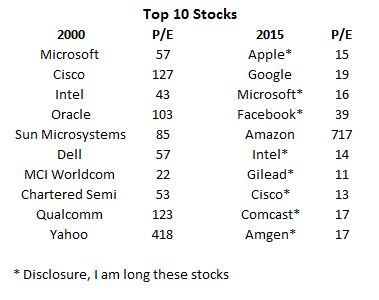
I don’t think so for a number of reasons. This is why things are different, even though both the Dow and S&P are at all time high’s.  First of all, in 2000 the NASDAQ traded at 100 times earnings (P/E) multiple, today it trades at about 21, only slightly higher than the S&P 500 18 x earnings. Secondly, Apple accounts for almost twice the market weight of the next biggest stock. Apple is probably one of the most financially sound companies in the world. By the way, Apple only trades at a 14 P/E, far less than the overall market. Of the 240 point rise in the S&P this year, Apple accounts for about 130 weighted points of the increase. A good reason that the number 1 stock in all equity hedge funds and equity index’s is Apple (APPL).

You might be interested in the difference between the top company’s then and now, just check out the “bubble” P/E’s of 2000.

Nasdaq 5000


Things look a little different, however Amazon sure looks like a 2000 bubble stock!


My Current Allocations – Well Balanced for Growth


I was recently asked to publish my current portfolio allocations; I’ll share them with you with the caveat that everyone’s situation is different.

My current investment goals include:

  1. Provide security while taking advantage of market growth.
  2. Consistently outperform the market (SPY) in “total returns “on both a quarterly and annual basis.
  3. Pick best of breed performing stocks and ride the winners.
  4. Exit positions when the economic cycle changes or an individual stock story changes
  5. Rebalance the overall portfolio as necessary.
  6. Maintain a tax-friendly environment; pay the least amount of fees as possible.
  7. Maintain a small exposure to bonds, but include “bond-like” equity’s such as REIT’s and higher yielding S&P stocks.
  8. Reinvest all dividends and maintain 5-7% cash for buying opportunities.
  9. Always has a “buy” list and quarterly update a “sell” list.

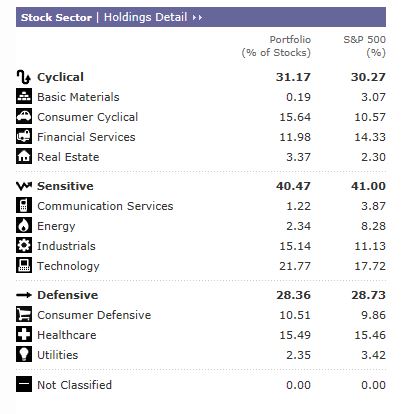
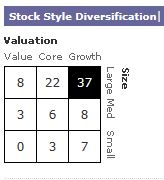
Below is a series of charts showing my portfolio including a few Morningstar analysis of my portfolio. In future articles I’ll further discuss my strategy and some best of breed choices.

Morn-1Allocations

Mon-2Mon-3


A Fixed Income Dream – A Dividend Increase Every Year for Over 35 Years

Dividends


Investors either in retirement or planning on retiring in a few years are always looking for ways to insure they have a secure and steady source of income.

Here are some facts for your review:

  1. The use of bonds for fixed income has been a favorite option for many years. However, bond yields since the 2009 financial crisis have fallen so far they may no longer be a viable option.
  2. Investors may need to generate 6-8% a year in total returns to make sure they won’t out-live their money. Bonds yielding 2-3% just won’t do that for you, especially given the guarantee that bond prices will fall as future rates start rising.
  3. Here are 5 blue-chip stocks that you will recognize, they have not only paid dividends for over 35 years, but have also increased their dividends each year for over 35 years.
    1. Procter & Gamble (NYSE:PG) currently pays a 2.99% dividend and has increased its dividend each year for the last 58 years.
    2. Altria Group (NYSE:MO) currently pays a 3.80% dividend and has increased its dividend each year for the last 44 years.
    3. SYSCO Corporation (NYSE:SYY) the largest food distributor in the US currently pays a 3.03% dividend and has increased its dividend each year for the last 43 years.
    4. PepsiCo (NYSE:PEP) currently pays a 2.83% dividend and has increased its dividend each year for the last 42 years.
    5. Clorox (NYSE:CLX) currently pays a 2.72% dividend and has increased its dividend each year for the last 37 years.
  4. Each of these blue-chip stocks have a high probability of increasing their dividends each year during the years of your retirement.
  5. The nice thing about owning these blue-chip stocks, not only do they pay consistently increased dividends, they may also have capital gains over the years.


Disclosure: I am long PG, MO,PEP and plan on adding CLX in the near future.

Is your 2014 Social Security Benefits Taxable – Maybe, and it’s Complicated

Many people believe the old adage that Social Security is not taxed. Years ago these benefits were not taxed, but today they can be depending on other factors.

Here are the rules for 2014 tax on Social Security, based on your filing status:

Single

  • Your combined income* is between $25,000 and $34,000, you may have to pay income tax on up to 50 percent of your benefits.
  •  If your combined income is more than $34,000, up to 85 percent of your benefits may be taxable.

Married Filing Jointly

  • If you and your spouse have a combined income that is between $32,000 and $44,000, you may have to pay income tax on up to 50 percent of your benefits
  • If your combined income is more than $44,000, up to 85 percent of your benefits may be taxable.

Married Filing Separately

  • You are out of luck, all of your benefits are usually taxable.
  • Keep in mind that Married Filing Separately is a really bad classification and has a lot of tax penalties.

Strategy Calculation

For every dollar of extra income you earn above the lower threshold, $0.50 of your Social Security benefits will be subject to tax. Above the upper threshold, each extra dollar of income adds $0.85 to the total benefits that the IRS will tax.

How to Calculate Combined Income

Your adjusted gross income

 + Nontaxable interest (like tax-exempt income from municipal bond interest)

+ ½ of your Social Security benefits

 = Your “Combined Income

This Stock has been flat for 3 years – You’ll just love it!

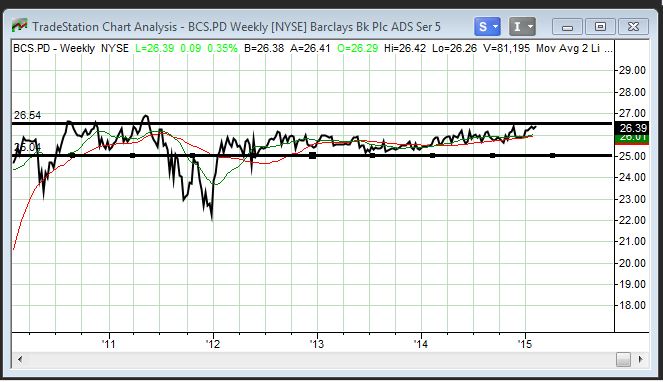
First look at this chart, this stock hasn’t moved more than $1.00 in the last 3 years. Why would you possibly want to own it in your portfolio? Because it is a “money machine”!!!!

 Barclays Pre


This is an excellent example of a “preferred stock” that is a money machine. It pays a current 7.70% quarterly dividend that is a “qualified dividend” for tax purposes. The dividend is fixed at $2.03/year. It trades under the symbol BCSPRD (Fidelity) you can look it up on Yahoo Finance under BCS-PD.  Barclays Bank is a UK based and worldwide financial powerhouse. It carries a S&P BB rating (not bad at all). At this current yield, you will double your investment every 9 years by just re-investing your dividends each quarter.  This preferred was originally issued at $25/share and 8.13% yield. As it rose in price to $26.xx the yield dropped to the current 7.7%. If you bought it at the initial $25 price you would still be getting the 8.13% yield.

For those of us who need a well balanced portfolio and are always looking for non-volatile stocks that are also tax friendly, preferred stocks are a great choice. I have allocated a portion of my core portfolio to quality preferred stocks with high-yields.  In general, they don’t go up or down in price but they sure crank out their nice steady dividends.

Preferred stocks act almost like a bond. They have coupon values, fixed dividends, call or expiration dates and so forth.

You can learn more about Preferred Stocks by checking out these sites.

https://www.preferredstockchannel.com/

http://www.investopedia.com/terms/p/preferredstock.asp